
Across boardrooms, manufacturing facilities, logistics hubs, financial institutions, and corporate headquarters, technology spending has become one of the defining business priorities of the decade. Large American companies are allocating billions of dollars toward artificial intelligence, automation, cloud infrastructure, cybersecurity, advanced analytics, and emerging digital tools. The scale of investment is significant, reshaping how organizations operate, compete, and grow in an increasingly data driven economy.
Why Corporate America is investing heavily in new technologies is no longer a question limited to technology leaders or investors. It has become a topic that affects employees, consumers, shareholders, policymakers, and global markets. Research from leading consulting firms and industry analysts consistently shows that organizations embracing digital transformation often achieve stronger operational efficiency, improved customer experiences, and greater adaptability during periods of economic uncertainty.
The shift extends beyond simple modernization. Corporate leaders increasingly view technology as a strategic asset rather than a support function. In many industries, technology investments influence revenue growth, risk management, customer retention, workforce productivity, and long term competitiveness. As global competition intensifies and innovation cycles accelerate, companies that fail to modernize risk falling behind peers that can operate faster, make better decisions, and respond more effectively to market changes.
The Growing Scale of Corporate Technology Spending
Technology spending among major American corporations has reached historic levels. According to industry estimates from research firms such as Gartner and International Data Corporation, global information technology spending continues to expand annually as organizations increase investments in cloud computing, cybersecurity, artificial intelligence, and enterprise software.
Several factors are contributing to this trend. Businesses face rising customer expectations, increasing cyber threats, growing data volumes, and pressure to improve efficiency. Technology offers solutions to each of these challenges while creating opportunities for innovation and growth.
The result is a business environment where technology is no longer optional. It has become a central driver of corporate strategy.
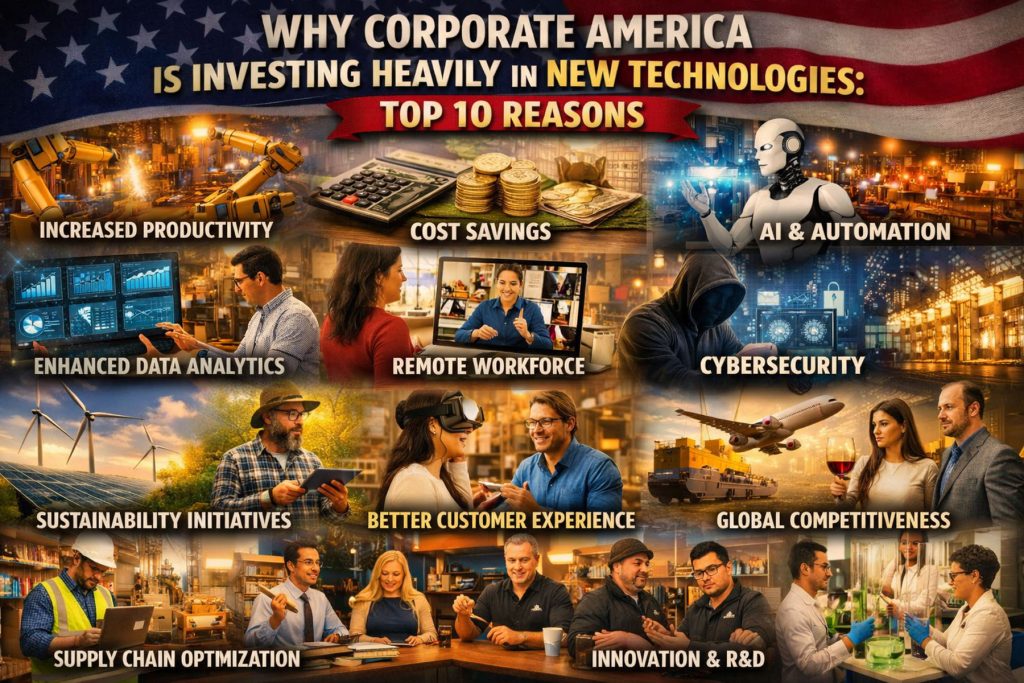
Top 10 Reasons Corporate America Is Investing Heavily in New Technologies
1. Artificial Intelligence Creates Competitive Advantages
Artificial intelligence has moved from experimentation to implementation. Companies across industries are deploying AI to automate processes, analyze large datasets, improve customer service, and support decision making.
Generative AI tools can assist with content creation, coding, customer support, and knowledge management. Predictive AI models help organizations forecast demand, identify risks, and optimize operations.
Executives increasingly recognize that AI can improve both efficiency and innovation. Organizations that successfully integrate AI often gain advantages in speed, accuracy, and scalability that are difficult for competitors to replicate.
2. Automation Improves Productivity
Labor shortages and rising operational costs have encouraged businesses to automate repetitive tasks wherever possible.
Automation technologies are now common in manufacturing, logistics, finance, customer support, and human resources. Tasks that once required substantial manual effort can often be completed faster and more accurately through automated systems.
Research has shown that automation can reduce processing times, lower error rates, and allow employees to focus on higher value activities. Rather than replacing every human role, many organizations use automation to augment workforce capabilities and improve overall productivity.
3. Cybersecurity Risks Continue to Rise
Cybersecurity has become a board level concern. Data breaches, ransomware attacks, phishing campaigns, and supply chain vulnerabilities can result in significant financial and reputational damage.
According to reports from cybersecurity organizations and government agencies, cybercrime costs continue to rise globally. As digital operations expand, attack surfaces also grow larger.
Corporate America is investing heavily in cybersecurity technologies such as threat detection systems, identity management platforms, endpoint protection, and security monitoring solutions. These investments help organizations protect sensitive information, maintain regulatory compliance, and reduce operational risk.
4. Cloud Computing Enables Flexibility
Cloud computing has transformed how businesses manage infrastructure and software.
Traditional technology environments often required substantial investments in physical servers and maintenance. Cloud platforms provide scalable resources that can expand or contract based on business needs.
Organizations benefit from improved flexibility, reduced infrastructure complexity, and faster deployment of applications. Cloud adoption also supports remote work, global collaboration, and data accessibility across multiple locations.
Many corporations view cloud technology as a foundation that enables broader digital transformation initiatives.
5. Data Has Become a Strategic Asset
Modern businesses generate enormous volumes of data from customers, operations, supply chains, and digital interactions.
The ability to collect, analyze, and interpret this information can provide valuable insights into consumer behavior, market trends, operational performance, and business opportunities.
Advanced analytics platforms allow companies to transform raw data into actionable intelligence. Organizations that effectively use data are often better positioned to make informed decisions and identify emerging opportunities before competitors.
Technology Investment Priorities Among Major Corporations
| Technology Area | Primary Business Goal | Potential Impact |
| Artificial Intelligence | Efficiency and innovation | Faster decision making |
| Automation | Productivity improvement | Reduced operational costs |
| Cybersecurity | Risk reduction | Stronger data protection |
| Cloud Computing | Scalability | Greater flexibility |
| Data Analytics | Better insights | Improved strategic planning |
| Internet of Things | Operational visibility | Enhanced monitoring |
| Advanced Networks | Connectivity | Faster communication |
| Digital Platforms | Customer engagement | Better user experiences |
6. Customer Expectations Have Changed
Digital experiences increasingly shape customer perceptions of brands.
Consumers expect seamless websites, personalized recommendations, rapid customer support, mobile accessibility, and consistent experiences across channels. Businesses that fail to meet these expectations risk losing customers to more technologically advanced competitors.
New technologies enable companies to personalize interactions, streamline transactions, and improve service quality. Customer experience has become a major factor influencing technology investment decisions.
7. Economic Uncertainty Requires Greater Agility
Periods of economic volatility create pressure on organizations to operate more efficiently and respond quickly to changing conditions.
Technology investments can improve organizational agility by providing real time data, predictive insights, and scalable operating models. Businesses can adjust production levels, inventory strategies, staffing decisions, and customer engagement approaches more effectively when supported by modern technology systems.
Companies increasingly view technology as a tool for resilience during uncertain economic environments.
8. Innovation Drives Revenue Growth
Technology investments are not solely focused on cost reduction. Many organizations pursue new technologies because they create opportunities for growth.
Digital products, subscription services, connected devices, and data driven business models have opened new revenue streams across industries. Technology enables companies to launch products faster, enter new markets, and develop innovative customer solutions.
Some of the fastest growing organizations have successfully integrated technology into their core business models rather than treating it as a supporting function.
9. Workforce Transformation Is Accelerating
The nature of work continues to evolve. Remote work, hybrid work arrangements, digital collaboration, and skills development have become important priorities for employers.
Technology plays a central role in supporting these changes. Collaboration platforms, project management systems, digital learning tools, and communication technologies help organizations maintain productivity regardless of employee location.
Many companies are also investing in workforce technologies to attract and retain talent in competitive labor markets.
10. Global Competition Is Intensifying
American companies compete not only with domestic rivals but also with organizations around the world.
Technology can create significant competitive advantages through efficiency, innovation, customer engagement, and operational excellence. Businesses that invest strategically in emerging technologies often position themselves to compete more effectively on a global scale.
As international competitors continue expanding their own technology capabilities, Corporate America faces increasing pressure to maintain leadership through innovation and modernization.
The Industries Leading Technology Investments
Financial Services
Banks, investment firms, and insurance companies are among the largest technology investors. Artificial intelligence, fraud detection systems, cybersecurity solutions, and digital banking platforms have become essential components of modern financial services.
Healthcare
Healthcare organizations increasingly use technology to improve operational efficiency, data management, patient engagement, and research capabilities. Digital transformation initiatives continue to expand across the sector.
Manufacturing
Manufacturers are adopting automation, robotics, industrial analytics, and connected devices to improve production efficiency and supply chain visibility.
Retail
Retailers invest heavily in ecommerce platforms, customer analytics, inventory management systems, and personalization technologies to meet changing consumer expectations.
Logistics and Transportation
Advanced routing systems, predictive analytics, automation technologies, and real time tracking solutions help transportation companies improve efficiency and service quality.
The Role of Artificial Intelligence in Corporate Strategy
Artificial intelligence deserves special attention because of its growing influence on corporate decision making.
A growing number of executives view AI as a transformative technology capable of affecting nearly every business function. Marketing teams use AI for audience analysis and campaign optimization. Human resources departments apply AI to workforce planning and talent management. Operations teams leverage AI to improve forecasting and process efficiency.
Industry surveys conducted in recent years indicate that executive interest in AI adoption has increased dramatically. Many organizations have shifted from pilot programs to enterprise wide implementation strategies.
The potential benefits extend beyond automation. AI can help identify patterns, generate insights, and support complex decision making processes that would be difficult to perform manually at scale.
Challenges Associated With Technology Investments
Despite the enthusiasm surrounding technology adoption, significant challenges remain.
Implementation Complexity
Large technology projects often require extensive planning, integration, and change management efforts. Organizations must align technology initiatives with business objectives to achieve meaningful results.
Skills Gaps
Many businesses struggle to find professionals with expertise in artificial intelligence, cybersecurity, cloud computing, and data analytics. Talent shortages can slow implementation efforts.
Security and Privacy Concerns
As organizations collect more data and increase digital connectivity, security and privacy responsibilities become more complex.
Return on Investment Measurement
Technology investments often involve substantial costs. Executives must evaluate performance carefully to determine whether initiatives deliver expected business outcomes.
These challenges highlight the importance of strategic planning and effective governance.
How Technology Investments Affect the Global Economy
The technology strategies adopted by Corporate America frequently influence markets beyond the United States.
Many multinational corporations operate across dozens of countries. When these organizations implement new technologies, suppliers, partners, competitors, and customers often adapt as well.
As a result, innovations introduced within American corporations can shape business practices worldwide. Trends such as cloud adoption, artificial intelligence integration, digital commerce, and cybersecurity modernization often spread rapidly across international markets.
Global observers closely monitor technology investments by major American companies because these decisions frequently signal broader economic and technological trends.
The Future of Corporate Technology Spending
Several emerging technologies are expected to attract increasing corporate investment during the coming years.
Artificial intelligence will likely remain a major priority as organizations expand implementation efforts. Advanced cybersecurity solutions will continue gaining importance as threat environments evolve. Quantum computing, advanced networking technologies, digital twins, and next generation automation systems may also receive greater attention as capabilities mature.
Business leaders increasingly view technology spending as a strategic necessity rather than a discretionary expense. The organizations that succeed in translating technology investments into measurable business value will likely shape the next phase of corporate leadership.
Closing Thoughts
Why Corporate America is investing heavily in new technologies ultimately comes down to a combination of opportunity and necessity. Technology enables organizations to improve productivity, strengthen security, enhance customer experiences, support workforce transformation, and compete more effectively in a rapidly changing economy. At the same time, rising competitive pressures and growing digital expectations leave little room for complacency. The most successful companies are not investing in technology simply because it is new. They are investing because technology has become deeply connected to growth, resilience, innovation, and long term business performance. As emerging technologies continue to mature, the decisions being made today will influence how businesses operate, compete, and create value for years to come.
Frequently Asked Questions
Why is Corporate America investing more in technology than ever before?
Companies are investing more because technology supports efficiency, innovation, security, and growth. Digital tools have become essential for maintaining competitiveness in modern markets.
Which technologies receive the most corporate investment?
Artificial intelligence, cloud computing, cybersecurity, automation, data analytics, and digital platforms currently attract significant investment across industries.
How does artificial intelligence benefit large corporations?
AI helps automate tasks, improve decision making, analyze data, and enhance customer experiences. It can also improve operational efficiency across multiple business functions.
Does technology investment always reduce jobs?
Technology often changes job responsibilities rather than eliminating entire workforces. Many organizations use technology to support employees and improve productivity.
Why is cybersecurity such a major investment area?
Cyber threats continue to grow in frequency and sophistication. Strong cybersecurity measures help protect data, operations, customers, and corporate reputations.
How does cloud computing help businesses?
Cloud computing provides scalability, flexibility, and easier access to digital resources. It also supports remote work and faster deployment of business applications.
Which industries spend the most on technology?
Financial services, healthcare, manufacturing, retail, and logistics are among the leading sectors investing heavily in technology initiatives.
What role does data analytics play in corporate strategy?
Data analytics helps organizations identify trends, improve decision making, understand customer behavior, and optimize business performance.
Are technology investments mainly about reducing costs?
Cost reduction is one factor, but many organizations invest to drive innovation, improve customer experiences, create new products, and generate revenue growth.
What technologies may shape the future of Corporate America?
Artificial intelligence, advanced automation, quantum computing, enhanced cybersecurity systems, and next generation digital infrastructure are expected to influence future business strategies.

