American higher education is undergoing one of the most significant transformations in decades. Traditional degree pathways continue to attract students, yet enrollment trends increasingly reveal a shift toward programs closely aligned with labor market needs, technological innovation, healthcare expansion, and data driven decision making. Universities across the country are responding by investing heavily in emerging disciplines that prepare graduates for rapidly changing industries.
The fastest growing academic programs in the USA are not expanding by chance. They are growing because employers are competing for specialized talent, governments are investing in strategic sectors, and organizations across industries require new skill sets that were far less important a decade ago. Fields connected to artificial intelligence, cybersecurity, healthcare, sustainability, and advanced analytics have experienced remarkable momentum as institutions adapt to workforce realities.
For students, parents, educators, and international observers, these enrollment trends provide valuable insight into where education and employment are headed. Academic growth often signals future opportunity. While no degree guarantees career success, understanding which programs are attracting resources, faculty investment, and student interest offers a clearer picture of the evolving American educational landscape.
Why Academic Program Growth Matters
Enrollment growth reflects more than student preference. It often indicates broader economic, technological, and societal changes. Universities typically expand programs when demand rises from both students and employers.
Several factors drive academic program growth:
- Strong employment projections
- Rising industry investment
- Government funding initiatives
- Technological advancement
- Workforce shortages
- Competitive salary potential
- Increased research opportunities
Programs that align with these factors often experience sustained growth rather than temporary popularity.
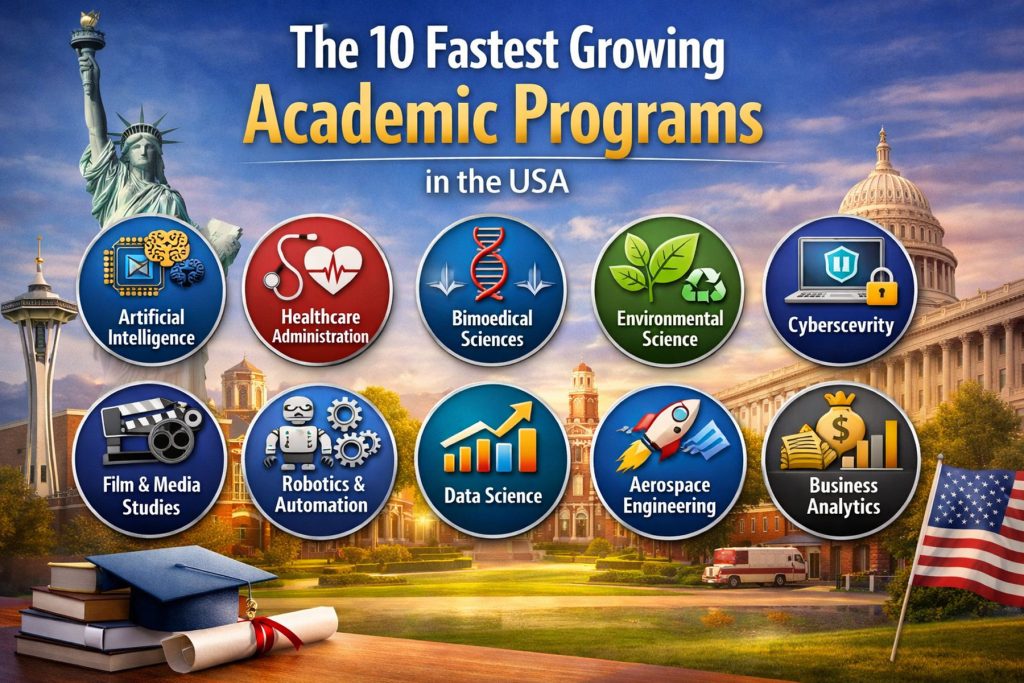
The Top 10 Fastest Growing Academic Programs in the USA
1. Artificial Intelligence and Machine Learning
Artificial intelligence has evolved from a niche research discipline into a transformative force across industries. Universities are launching dedicated AI degrees, specialized concentrations, and interdisciplinary research centers at an unprecedented pace.
Organizations increasingly rely on machine learning systems for automation, prediction, content generation, healthcare diagnostics, financial modeling, and customer service. As a result, demand for graduates with AI expertise continues to accelerate.
Key areas of study include:
- Neural networks
- Natural language processing
- Computer vision
- Deep learning
- AI ethics
- Predictive analytics
Many institutions now offer undergraduate AI majors that previously existed only at the graduate level.
2. Cybersecurity
Cybersecurity has become a national priority. Data breaches, ransomware attacks, and growing digital infrastructure have created an urgent need for security professionals.
Universities are expanding cybersecurity programs through dedicated schools, industry partnerships, and government supported initiatives. Students gain expertise in threat detection, network defense, ethical hacking, digital forensics, and risk management.
The increasing sophistication of cyber threats ensures that cybersecurity remains one of the fastest expanding educational fields in the country.
3. Data Science
Organizations generate massive volumes of data every day. Turning that information into actionable insights requires highly trained professionals capable of analyzing complex datasets.
Data science programs combine:
- Statistics
- Mathematics
- Programming
- Business intelligence
- Data visualization
Healthcare systems, financial institutions, retailers, technology companies, and government agencies all rely heavily on data driven decision making. This broad applicability has fueled rapid enrollment growth nationwide.
4. Nursing and Advanced Healthcare Studies
Healthcare workforce shortages continue to shape educational demand. Nursing programs remain among the most sought after academic pathways in the United States.
Growth extends beyond traditional nursing education into advanced healthcare disciplines such as:
- Nurse leadership
- Healthcare informatics
- Population health
- Public health administration
- Healthcare analytics
An aging population and increasing healthcare needs continue to support long term demand for trained healthcare professionals.
5. Public Health
The visibility of public health has increased significantly in recent years. Communities, governments, and healthcare systems increasingly recognize the importance of disease prevention, health policy, epidemiology, and community health initiatives.
Public health programs attract students interested in addressing large scale health challenges while working across research, policy, education, and healthcare sectors.
Universities have expanded both undergraduate and graduate public health offerings to meet growing demand.
Academic Growth Snapshot
| Academic Program | Primary Growth Driver | Industry Demand Level |
| Artificial Intelligence | Automation and innovation | Very High |
| Cybersecurity | Digital security threats | Very High |
| Data Science | Analytics and decision making | Very High |
| Nursing | Healthcare workforce shortages | Very High |
| Public Health | Population health management | High |
| Environmental Science | Sustainability initiatives | High |
| Biotechnology | Medical and scientific innovation | High |
| Supply Chain Management | Global logistics complexity | High |
| Digital Marketing | Online commerce expansion | High |
| Human Computer Interaction | Product design and UX demand | Growing Rapidly |
6. Environmental Science and Sustainability
Climate related challenges, renewable energy investments, and sustainability initiatives have increased demand for environmental expertise.
Students in these programs often study:
- Climate science
- Environmental policy
- Resource management
- Sustainability planning
- Renewable energy systems
Corporations increasingly seek professionals capable of helping organizations meet environmental objectives while balancing operational needs.
7. Biotechnology
Biotechnology sits at the intersection of biology, medicine, and technology. Advances in genetics, biomedical research, pharmaceutical development, and laboratory innovation have fueled substantial growth.
Modern biotechnology programs often incorporate:
- Molecular biology
- Genetic engineering
- Bioinformatics
- Biomedical research
- Laboratory technologies
Research funding and private sector investment continue to strengthen this academic field.
8. Supply Chain Management
Global disruptions exposed vulnerabilities within supply networks worldwide. Businesses now recognize supply chain management as a strategic function rather than a purely operational activity.
Academic programs emphasize:
- Logistics
- Procurement
- Operations management
- Inventory systems
- Global trade
- Risk management
The growth of ecommerce and international commerce has further accelerated demand for supply chain expertise.
9. Digital Marketing
Consumer behavior increasingly centers on digital platforms. Businesses invest heavily in online advertising, social media strategy, search visibility, content development, and customer analytics.
Modern digital marketing programs combine creativity with analytical thinking. Students learn how technology influences consumer engagement while developing practical skills applicable across industries.
Areas commonly covered include:
- Search engine optimization
- Content strategy
- Marketing analytics
- Social media management
- Consumer behavior
- Digital advertising
The continued expansion of digital commerce supports strong enrollment growth.
10. Human Computer Interaction and User Experience Design
Technology products succeed when they are intuitive, accessible, and user focused. Human Computer Interaction, often abbreviated as HCI, has emerged as one of the most dynamic interdisciplinary fields.
Programs typically integrate:
- Psychology
- Design
- Computer science
- User research
- Accessibility studies
Employers increasingly value professionals who can bridge technical development and human centered design principles.
Key Trends Driving Program Expansion
Employer Demand Shapes Academic Investment
Universities increasingly align new program development with workforce requirements. Institutions monitor labor market data, employer feedback, and emerging industry needs when deciding where to allocate resources.
Technology Influences Every Discipline
Technology is no longer confined to computer science departments. Artificial intelligence, analytics, and digital tools now influence healthcare, business, engineering, education, and public policy.
Interdisciplinary Learning Gains Momentum
Many of the fastest growing programs combine expertise from multiple fields. Students often graduate with a blend of technical, analytical, and communication skills that employers value highly.
Research Funding Accelerates Growth
Federal agencies, private foundations, and corporate partners frequently direct funding toward emerging fields. Increased funding often supports faculty hiring, laboratory development, student scholarships, and research opportunities.
Important Statistics Behind the Growth
Several broader trends help explain the rise of these academic programs:
- The United States continues to experience strong demand for technology focused occupations across multiple industries.
- Healthcare remains one of the largest employment sectors in the country, creating sustained educational demand.
- Digital transformation initiatives have expanded technology related hiring beyond traditional technology companies.
- Sustainability and environmental responsibility increasingly influence corporate and governmental priorities.
Together, these forces create favorable conditions for continued growth across the programs highlighted above.
What Students Should Consider Beyond Growth Rates
Fast growth does not automatically mean a program is the right fit for every student. Personal interests, strengths, career goals, learning preferences, and long term aspirations remain critical considerations.
Students evaluating academic pathways should assess:
- Curriculum quality
- Faculty expertise
- Internship opportunities
- Research access
- Industry partnerships
- Graduate outcomes
- Geographic opportunities
A rapidly expanding field may offer strong prospects, but long term success typically depends on sustained engagement and skill development.
Looking Ahead
The fastest growing academic programs in the USA reveal a clear pattern. Higher education is becoming increasingly connected to technological innovation, healthcare advancement, sustainability priorities, and data driven decision making. Universities are adapting curricula to prepare graduates for challenges that did not exist at the same scale even a decade ago.
As industries continue evolving, academic growth patterns will likely shift as well. Artificial intelligence may become embedded across disciplines rather than remaining a standalone specialization. Healthcare programs may increasingly integrate analytics and technology. Sustainability concepts may become foundational across business, engineering, and public policy education. The most valuable insight is not simply which programs are growing today, but why they are growing. The underlying forces driving these changes are reshaping both education and employment, creating new opportunities for learners in the United States and around the world.
Frequently Asked Questions
What is the fastest growing academic program in the USA?
Artificial Intelligence and Machine Learning currently ranks among the fastest growing academic programs. Universities continue launching new degrees and concentrations to meet increasing industry demand.
Why are technology related degrees growing so quickly?
Organizations across nearly every sector rely on technology for operations, innovation, and decision making. This creates demand for graduates with specialized technical skills.
Is cybersecurity a good field for long term growth?
Cybersecurity remains a rapidly expanding discipline because digital security threats continue to increase in complexity and frequency across industries.
Are healthcare programs still growing despite economic changes?
Yes. Healthcare demand remains strong due to demographic trends, workforce shortages, and ongoing public health needs.
What makes data science popular among students?
Data science combines analytical skills, technology knowledge, and practical business applications. Its versatility appeals to students interested in multiple industries.
Are sustainability programs becoming more important?
Environmental and sustainability programs continue expanding as governments and organizations focus more heavily on resource management and environmental responsibility.
Which business related academic program is growing fastest?
Supply Chain Management and Digital Marketing are among the fastest growing business focused disciplines because of global commerce and digital transformation.
Do fast growing programs guarantee high salaries?
Program growth can indicate strong demand, but salary outcomes vary based on experience, location, specialization, employer, and economic conditions.
Are these trends relevant for international students?
Yes. Many international students monitor American academic trends because they often influence educational and workforce developments globally.
How often do academic growth trends change?
Growth trends evolve continuously as technology, economics, public policy, and workforce needs change. Universities regularly adjust offerings to reflect these developments.