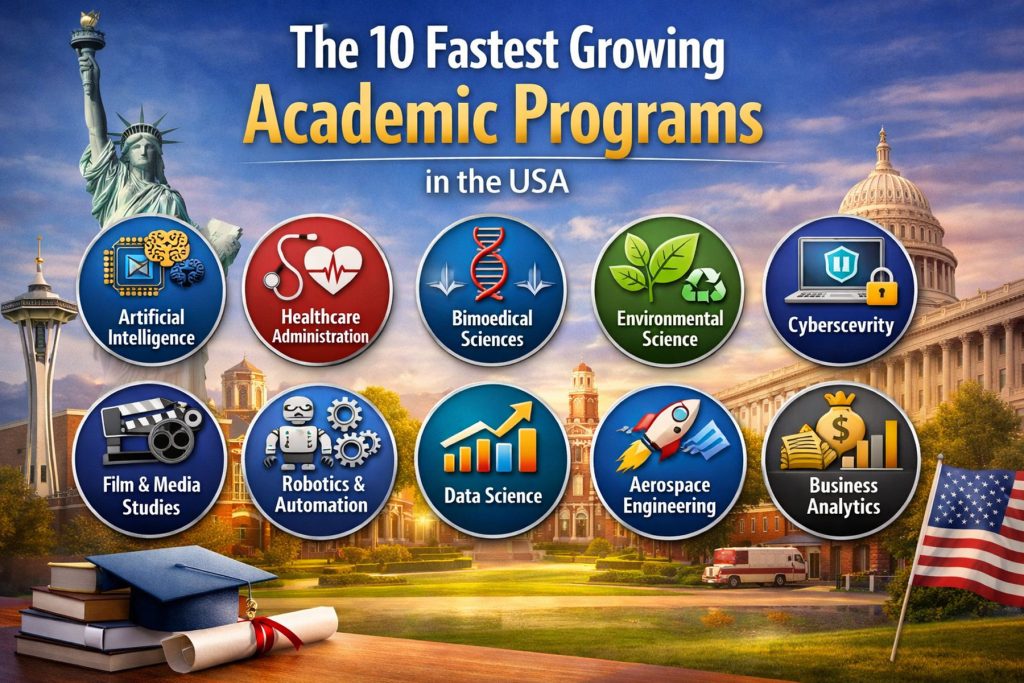

The career landscape in the United States is evolving at an unprecedented pace. Advances in artificial intelligence, remote work, automation, and digital technology have transformed how businesses operate and how professionals build their careers. Unlike previous generations, today’s graduates are no longer expected to remain in a single role or industry for decades. Instead, employers increasingly value adaptable professionals who can transfer their skills across multiple fields and embrace continuous learning.
Flexibility has become one of the most valuable qualities in the modern workforce. Many of the fastest growing careers allow professionals to work remotely, pursue freelance opportunities, transition between industries, or continue advancing through specialized certifications and professional development. According to labor market trends and workforce studies, graduates who combine technical expertise with communication, problem solving, and digital literacy are better prepared for long term success in an economy shaped by constant innovation.
This article highlights the most flexible career paths for American graduates in the upcoming years, focusing on professions that offer strong employment opportunities, career mobility, competitive earning potential, and resilience in a changing job market. Whether graduating with a degree in business, technology, healthcare, communications, or the liberal arts, these careers provide opportunities to grow alongside the evolving American economy.
The Most Flexible Career Paths for American Graduates in the Upcoming Years
Software Developer
Software development continues to be one of the most versatile career choices available.
Developers create websites, mobile applications, cloud platforms, enterprise software, and business solutions for organizations across virtually every industry. Skills in programming languages, cloud computing, and application development allow professionals to work in technology, healthcare, finance, education, retail, manufacturing, and entertainment.
Many software developers also enjoy opportunities for remote work, freelancing, consulting, and entrepreneurship, making this one of the most flexible professions in today’s economy.
Data Analyst and Data Scientist
Organizations rely on data to improve decision making, making data professionals valuable across countless industries.
Data analysts collect, organize, interpret, and visualize information that helps businesses understand customer behavior, operational performance, and market trends. Data scientists build advanced predictive models using artificial intelligence and machine learning techniques.
Graduates can apply these skills in healthcare, sports, government, retail, banking, manufacturing, logistics, and nonprofit organizations, providing exceptional career mobility.
Cybersecurity Professional
Digital security has become essential for organizations of every size.
Cybersecurity specialists protect networks, prevent cyberattacks, monitor security systems, and develop strategies that safeguard sensitive information. Because nearly every industry depends on secure technology, cybersecurity professionals can transition between sectors with relative ease.
The increasing frequency of cyber threats continues driving demand for qualified professionals across the United States.
Digital Marketing Specialist
Digital marketing combines creativity, technology, and business strategy into one highly adaptable career.
Professionals in this field manage search engine optimization, content creation, email campaigns, social media, paid advertising, and online brand development.
Since nearly every business requires digital marketing, graduates can work for corporations, nonprofit organizations, agencies, startups, or as independent consultants. The profession also supports remote work and freelance opportunities.
Registered Nurse and Healthcare Specialist
Healthcare remains one of the most resilient employment sectors in America.
Registered nurses and healthcare professionals have opportunities in hospitals, outpatient clinics, schools, research institutions, rehabilitation centers, insurance companies, public health agencies, and telehealth organizations.
Specialization options continue expanding, allowing professionals to adapt their careers as healthcare technology and patient needs evolve.
Project Manager
Project management skills apply across nearly every major industry.
Project managers coordinate budgets, schedules, resources, teams, and organizational objectives while ensuring projects remain on track. Construction firms, technology companies, healthcare organizations, financial institutions, manufacturing businesses, and government agencies all employ project managers.
Professional certifications further expand career opportunities and support advancement into leadership positions.
Financial Analyst
Financial professionals help businesses and individuals make informed economic decisions.
Financial analysts evaluate investments, assess market conditions, forecast business performance, and support strategic planning. Graduates may work in banking, insurance, corporate finance, consulting, government, investment management, or financial technology.
Strong analytical skills allow professionals to transition between numerous industries throughout their careers.
User Experience Designer
User experience design has become increasingly important as businesses invest in digital products and customer satisfaction.
UX designers conduct customer research, improve website usability, create intuitive mobile applications, and collaborate with software development teams.
Because digital experiences influence nearly every industry, UX professionals enjoy opportunities within healthcare, finance, education, ecommerce, entertainment, and technology companies.
The combination of creativity and technical knowledge makes this career highly adaptable.
Human Resources Specialist
Modern human resources professionals contribute far beyond recruitment.
Today’s HR specialists support employee development, workplace culture, compensation planning, diversity initiatives, performance management, and organizational strategy.
As companies continue adapting to hybrid work and changing workforce expectations, HR professionals play increasingly important roles in business success.
Graduates can work across virtually every sector while advancing into leadership positions.
Entrepreneur and Small Business Owner
Entrepreneurship offers perhaps the greatest career flexibility of all.
Graduates who identify market opportunities can launch businesses in technology, consulting, ecommerce, education, healthcare, digital media, or countless other industries.
Although entrepreneurship involves greater risk than traditional employment, it also provides unlimited potential for innovation, independence, and long term growth.
Many successful entrepreneurs begin with freelance work or small side businesses before expanding into larger companies.
Trends Driving Career Flexibility in America
Several long term trends continue creating more adaptable career opportunities.
Remote and hybrid work models have expanded employment options beyond geographic boundaries. Artificial intelligence is automating repetitive tasks while increasing demand for analytical thinking, creativity, and strategic decision making.
Cloud computing enables professionals to collaborate from virtually anywhere. The growth of freelance platforms has made independent consulting more accessible, while digital credentials and professional certifications allow workers to continuously update their skills throughout their careers.
Employers increasingly prioritize transferable skills over narrow technical specialization, giving graduates greater freedom to change industries as opportunities evolve.
Skills That Support Long Term Career Flexibility
Graduates who invest in broad, transferable skills are better prepared to adapt throughout their professional lives.
Some of the most valuable competencies include:
- Digital literacy
- Artificial intelligence awareness
- Communication skills
- Critical thinking
- Problem solving
- Leadership
- Data analysis
- Time management
- Collaboration
- Adaptability
Developing these abilities alongside technical expertise creates a strong foundation for career growth regardless of industry.
Flexible Career Paths for American Graduates
| Rank | Career | Major Industries | Flexibility Level |
| 1 | Software Developer | Technology, Healthcare, Finance | Very High |
| 2 | Data Analyst and Data Scientist | Business, Healthcare, Government | Very High |
| 3 | Cybersecurity Professional | Technology, Banking, Government | Very High |
| 4 | Digital Marketing Specialist | Retail, Media, Technology | High |
| 5 | Registered Nurse | Healthcare | High |
| 6 | Project Manager | Construction, Technology, Finance | High |
| 7 | Financial Analyst | Banking, Corporate Finance | High |
| 8 | User Experience Designer | Technology, Ecommerce | High |
| 9 | Human Resources Specialist | All Industries | High |
| 10 | Entrepreneur | Multiple Industries | Unlimited |
Looking Ahead
The future workforce in the United States will reward graduates who embrace flexibility, continuous learning, and innovation. As artificial intelligence, automation, and digital transformation continue reshaping industries, professionals who develop transferable skills will be better equipped to transition between roles and seize new opportunities.
The careers featured in this guide demonstrate that long term success is no longer defined by remaining in a single profession. Instead, adaptability, technological competence, and a commitment to lifelong learning have become the foundation of sustainable career growth. Graduates who invest in these flexible career paths will be well positioned to thrive in an American economy that continues evolving with remarkable speed and opportunity.