Healthcare has become one of the most important sources of employment growth in the United States. The latest projections from the U.S. Bureau of Labor Statistics show that healthcare occupations are expected to generate about 1.9 million openings each year from 2025 through 2035, driven by both employment growth and replacement needs. That demand is creating opportunities across hospitals, outpatient centers, technology companies, rehabilitation facilities, physician practices, universities, and public health organizations.
For students evaluating healthcare degrees in the USA, the choice is no longer limited to becoming a physician or registered nurse. Modern healthcare depends on professionals who manage medical organizations, analyze health data, operate diagnostic technology, provide rehabilitation services, and deliver specialized clinical care. The National Center for Education Statistics reported that health professions and related programs accounted for 263,800 bachelor’s degrees in 2021 to 2022, representing 13 percent of all bachelor’s degrees awarded that year.
The most promising degree paths therefore differ considerably in academic level, cost, licensing requirements, and career direction. Some can lead to professional employment after an associate degree, while others require graduate or doctoral education. The following list compares ten fields using current employment projections, educational pathways, career breadth, and the role each field plays within the American healthcare system.
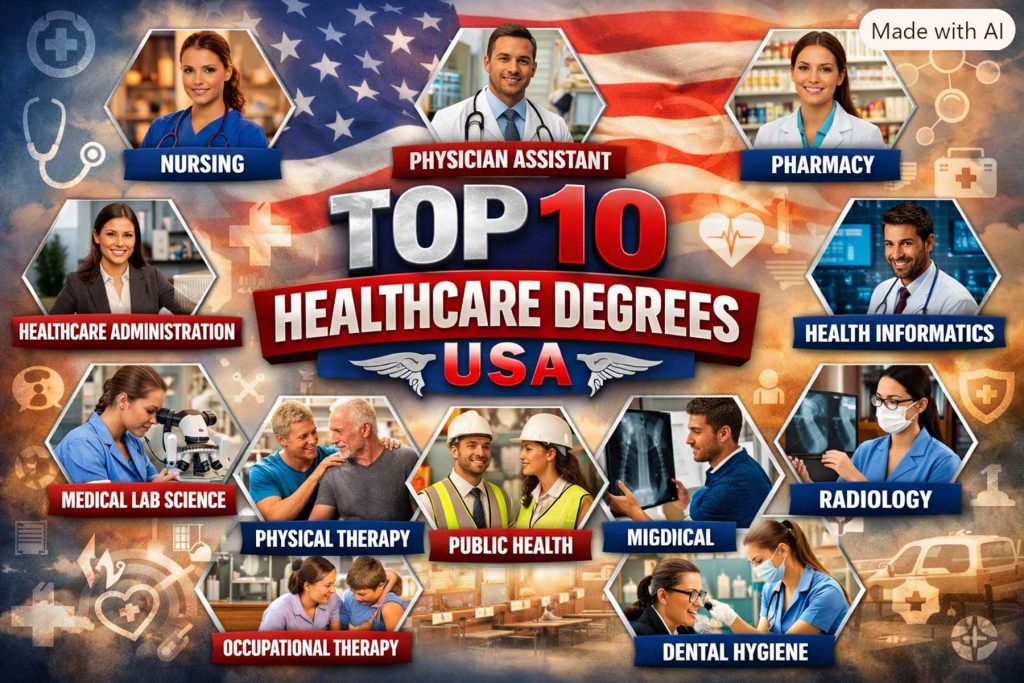
Top 10 Healthcare Degrees in the USA
Nursing
Nursing remains one of the broadest healthcare degree pathways in the USA because registered nurses work across hospitals, outpatient care, home health, schools, long term care facilities, and other settings.
Students can enter registered nursing through an associate degree, bachelor’s degree, or approved nursing diploma program, although licensing is required. The bachelor’s degree in nursing provides a particularly broad academic foundation for clinical practice and later specialization.
The scale of the profession is significant. BLS data shows about 3.47 million registered nurses employed in 2025, with employment projected to reach approximately 3.66 million by 2035. About 180,800 openings are projected each year.
Nursing also provides a pathway toward advanced practice roles. Nurse practitioners are projected to experience 41 percent employment growth from 2025 to 2035, according to BLS.
Health Administration
Healthcare does not function through clinical professionals alone. Hospitals, medical groups, nursing facilities, outpatient centers, and other organizations require managers who understand operations, finance, staffing, compliance, and healthcare delivery.
A degree in health administration can lead toward administrative and management roles without requiring a clinical license. BLS projects employment of medical and health services managers to grow 24 percent from 2025 to 2035, with approximately 62,300 openings each year.
The field also offers significant career variety. Graduates may work in hospitals, physician practices, nursing facilities, outpatient organizations, government agencies, and other healthcare businesses. For students interested in the business side of healthcare, this degree provides a direct connection between management and patient care systems.
Physician Assistant Studies
Physician assistant education provides a graduate level route into direct patient care. Physician assistants work with physicians and other healthcare professionals across medical specialties and healthcare settings.
BLS projects 21 percent employment growth for physician assistants from 2025 to 2035, considerably above the 3 percent projection for all occupations. About 11,500 openings are projected annually.
The profession is also connected to changing patterns of healthcare delivery. An aging population and rising prevalence of chronic conditions are expected to increase demand for medical services. Physician assistants can work across areas such as primary care, surgery, emergency medicine, and specialty practices, although exact responsibilities depend on state law and employer structure.
Advanced Practice Nursing
Advanced practice nursing represents another rapidly growing pathway for students who want to progress beyond traditional registered nursing.
Nurse practitioners, nurse anesthetists, and nurse midwives are advanced practice registered nurses who generally require graduate education and state licensing. BLS projects combined employment in these occupations to grow 36 percent from 2025 to 2035, with nurse practitioners alone projected to grow 41 percent.
This pathway requires substantially more education than entry level nursing, but it can lead to specialized clinical roles involving assessment, diagnosis, treatment, prevention, and patient management within the authority established by applicable state laws.
Physical Therapy
Physical therapy is a strong option for students interested in rehabilitation, mobility, injury recovery, and long term functional health.
Physical therapists require a Doctor of Physical Therapy degree and state licensure. BLS projects employment growth of 12 percent between 2025 and 2035, with approximately 13,400 openings each year.
Demand is closely connected to demographic and health trends. Older adults have higher rates of mobility limitations and injuries, while conditions such as arthritis, back pain, diabetes, and obesity can also contribute to demand for rehabilitation services.
The profession also provides varied work environments, including private clinics, hospitals, nursing facilities, and patient homes.
Occupational Therapy
Occupational therapy focuses on helping people participate in everyday activities despite illness, injury, disability, or developmental challenges.
The profession has relevance across several age groups. BLS projects 15 percent employment growth from 2025 to 2035, with approximately 10,000 openings each year.
Older adults represent an important source of demand because age related conditions can affect independence and daily activities. Occupational therapy also has applications involving children and young adults with developmental conditions.
For students interested in rehabilitation combined with functional independence and everyday living, occupational therapy provides a specialized career direction.
Speech Language Pathology
Speech language pathology combines healthcare, communication science, rehabilitation, and education. Professionals assess and treat communication and swallowing disorders across different populations.
A master’s degree is typically required, and state licensing requirements apply. BLS projects 17 percent employment growth from 2025 to 2035 and about 12,500 openings each year.
The demand comes from several areas. An aging population can increase the number of people affected by conditions such as stroke and dementia, while greater recognition of childhood communication disorders also contributes to demand.
This degree can therefore lead to work in healthcare facilities as well as educational settings, giving graduates a career path that crosses traditional boundaries between healthcare and education.
Health Informatics
Healthcare is increasingly dependent on electronic records, clinical data, digital systems, and information security. Health informatics sits at the intersection of healthcare and technology.
Health information technologists and medical registrars advise organizations on computerized healthcare systems and analyze clinical information. BLS projects 16 percent employment growth for the occupation from 2025 to 2035.
The field can appeal to students who want healthcare involvement without spending their careers in direct patient care. Depending on the program and role, graduates may work with electronic health records, data quality, healthcare information systems, clinical databases, compliance, or technology implementation.
The growing connection between healthcare delivery and digital infrastructure makes health informatics increasingly relevant to hospitals, clinics, technology companies, insurers, and other organizations.
Diagnostic Medical Sonography
Diagnostic medical sonography offers a technology focused healthcare pathway with a relatively short typical educational route. BLS states that diagnostic medical sonographers typically need at least an associate degree or postsecondary certificate, depending on the role and employer.
Employment is projected to grow 14 percent from 2025 to 2035, with approximately 6,000 openings annually. The median annual wage was $96,590 in May 2025.
Sonographers operate ultrasound equipment to produce internal images used in medical diagnosis. The field can therefore suit students interested in medical technology, imaging, patient interaction, and hands on clinical work.
Respiratory Therapy
Respiratory therapy is a specialized clinical field focused on patients experiencing breathing difficulties and respiratory conditions.
Respiratory therapists typically need an associate degree, although some employers prefer bachelor’s level preparation. Licensing is required in every state except Alaska, with requirements varying by jurisdiction.
BLS projects employment growth of 9 percent from 2025 to 2035, with about 8,600 openings annually. The occupation had a median annual wage of $82,280 in May 2025.
The field has particular relevance in hospitals and other settings treating respiratory disorders. An aging population and the prevalence of respiratory conditions are among the factors supporting continued demand.
Healthcare Degree Comparison
| Rank | Degree Path | Typical Education | Related Career | Projected Growth |
| 1 | Nursing | Associate or bachelor degree | Registered nurse | 6 percent |
| 2 | Health Administration | Bachelor degree | Health services manager | 24 percent |
| 3 | Physician Assistant Studies | Graduate degree | Physician assistant | 21 percent |
| 4 | Advanced Practice Nursing | Graduate degree | Nurse practitioner | 41 percent |
| 5 | Physical Therapy | Doctoral degree | Physical therapist | 12 percent |
| 6 | Occupational Therapy | Master degree | Occupational therapist | 15 percent |
| 7 | Speech Language Pathology | Master degree | Speech language pathologist | 17 percent |
| 8 | Health Informatics | Associate or bachelor degree | Health information technologist | 16 percent |
| 9 | Diagnostic Medical Sonography | Associate degree | Diagnostic medical sonographer | 14 percent |
| 10 | Respiratory Therapy | Associate degree | Respiratory therapist | 9 percent |
Employment growth figures reflect BLS projections for 2025 to 2035 where current occupation specific data is available. Education requirements vary by occupation, program, employer, and state.
What Is Driving Healthcare Degree Demand?
An Aging Population
Demographic change is one of the strongest forces affecting healthcare employment. Older Americans generally require more healthcare services, contributing to demand for nurses, rehabilitation professionals, diagnostic specialists, and advanced practitioners.
BLS identifies population aging as an important factor behind expected demand across numerous healthcare occupations.
Digital Healthcare
Healthcare technology is creating career opportunities beyond traditional clinical roles. Electronic health records, computerized systems, clinical databases, and data analysis increasingly require professionals who understand both healthcare and technology.
Health informatics reflects this change particularly clearly, with the occupation projected to grow much faster than the overall economy.
Expanding Care Outside Hospitals
Healthcare delivery is also spread across outpatient clinics, physician offices, rehabilitation centers, home health organizations, and other settings.
Registered nursing data illustrates this shift, with BLS identifying continued demand across hospitals, outpatient services, home healthcare, and other care environments.
How Should Students Compare Healthcare Degrees?
The strongest comparison begins with the desired type of work rather than salary alone. Clinical degrees generally involve patient interaction, licensing, supervised training, and professional examinations. Administrative and technology programs can provide healthcare careers with less direct clinical responsibility.
Program length is another important distinction. Associate degree programs can provide faster entry into several healthcare occupations, while advanced clinical careers may require several additional years of graduate education.
Accreditation, clinical placement opportunities, state licensing rules, certification expectations, total education costs, and local employment conditions should also be examined before selecting a program. A degree with strong national demand can still have different employment conditions across individual states and metropolitan areas.
The Future of Healthcare Education in America
The American healthcare workforce is becoming more multidisciplinary. The future is not defined only by physicians and nurses. Technology specialists, managers, therapists, imaging professionals, respiratory specialists, and advanced practitioners are increasingly important parts of the system.
BLS projects healthcare support occupations to grow 13.3 percent and healthcare practitioner and technical occupations to grow 8.0 percent between 2025 and 2035. Together, these groups are expected to account for almost one third of new jobs created during the period.
That trend has implications for education. Students entering healthcare programs can increasingly choose between direct patient care, rehabilitation, administration, technology, diagnostic services, and advanced clinical practice. The most useful degree choice depends on the desired professional role, academic commitment, licensing requirements, and long term career direction.
Closing Perspective
Healthcare education in the USA is becoming broader as the healthcare system itself becomes more complex. Nursing remains a major employment pathway because of its scale and versatility, while advanced nursing, physician assistant studies, health administration, therapy, health informatics, diagnostic imaging, and respiratory therapy serve increasingly specialized needs. Current BLS projections show particularly strong growth across several of these fields, but projected growth should be treated as one factor rather than a guarantee of employment. For students and international readers examining the American education system, the central takeaway is that healthcare careers now span clinical practice, technology, management, diagnostics, and rehabilitation, creating a much wider range of academic pathways than the traditional image of healthcare education suggests.
Frequently Asked Questions
What are the most promising healthcare degrees in the USA?
Prominent options include nursing, health administration, physician assistant studies, advanced practice nursing, physical therapy, occupational therapy, speech language pathology, health informatics, diagnostic medical sonography, and respiratory therapy. Their career requirements and employment outlooks vary considerably.
Which healthcare degree has the highest projected job growth?
Among the occupations associated with the listed degree paths, nurse practitioners have one of the highest projected growth rates. BLS projects 41 percent employment growth from 2025 to 2035.
Is nursing still a strong degree choice in America?
Nursing remains one of the largest healthcare professions in the United States. BLS projects about 180,800 registered nursing openings annually from 2025 to 2035.
What healthcare degree can lead to administrative careers?
Health administration is specifically designed around healthcare operations, management, finance, staffing, compliance, and organizational performance. Graduates can pursue administrative positions across hospitals, medical practices, nursing facilities, and other healthcare organizations.
Which healthcare degrees require graduate education?
Several prominent healthcare careers require education beyond a bachelor degree. Physician assistant studies, physical therapy, occupational therapy, speech language pathology, and advanced practice nursing generally require graduate level preparation.
Is health informatics a healthcare degree?
Health informatics is a healthcare related academic field that combines healthcare knowledge with information systems, data, and technology. Programs may have different names and structures depending on the college.
Which healthcare degrees can be completed through an associate program?
Several healthcare careers have associate degree entry pathways, including registered nursing, respiratory therapy, diagnostic medical sonography, and radiologic technology. Exact requirements depend on the occupation, employer, certification standards, and state.
Which healthcare careers are growing because of technology?
Health informatics and diagnostic imaging are particularly connected to technology. Health information technologists work with computerized healthcare systems, while sonographers operate specialized imaging equipment.
Do healthcare degrees always require professional licensing?
No. Licensing requirements differ by occupation and state. Many clinical professions require licenses, while certain administrative and technology roles may not have the same licensing structure.
What should students consider before choosing a healthcare degree?
Students should compare educational length, accreditation, licensing requirements, clinical training, program cost, career settings, projected employment, and personal interest in clinical or nonclinical work. National employment projections provide useful context but do not guarantee an individual employment outcome.