
A family dinner can look perfectly normal while an invisible food safety problem is already sitting on the plate. A burger can appear browned but remain below a safe internal temperature. A container of leftovers can smell fine after sitting on the counter for hours. A cutting board used for raw chicken can then become the surface for vegetables that will never be cooked. These are not unusual kitchen mistakes, and they help explain why dangerous food habits remain a meaningful public health concern in the United States.
The CDC estimates that foodborne illness causes about 48 million illnesses, 128,000 hospitalizations, and 3,000 deaths in the United States each year. Those figures cover many sources of contamination, including food prepared commercially and food handled at home. The scale makes everyday food handling more than a matter of culinary preference. CDC+1
The most concerning habits are often the ones that feel harmless because they are familiar. Relying on appearance instead of a thermometer, rinsing raw chicken, tasting raw dough, leaving a party dish out for hours, or trusting smell as a safety test can all create unnecessary exposure to harmful germs. The following Top 10 ranking focuses on dangerous food habits Americans should stop, with the ranking based on the potential for contamination, the frequency with which the mistake occurs, and the strength of established food safety guidance.
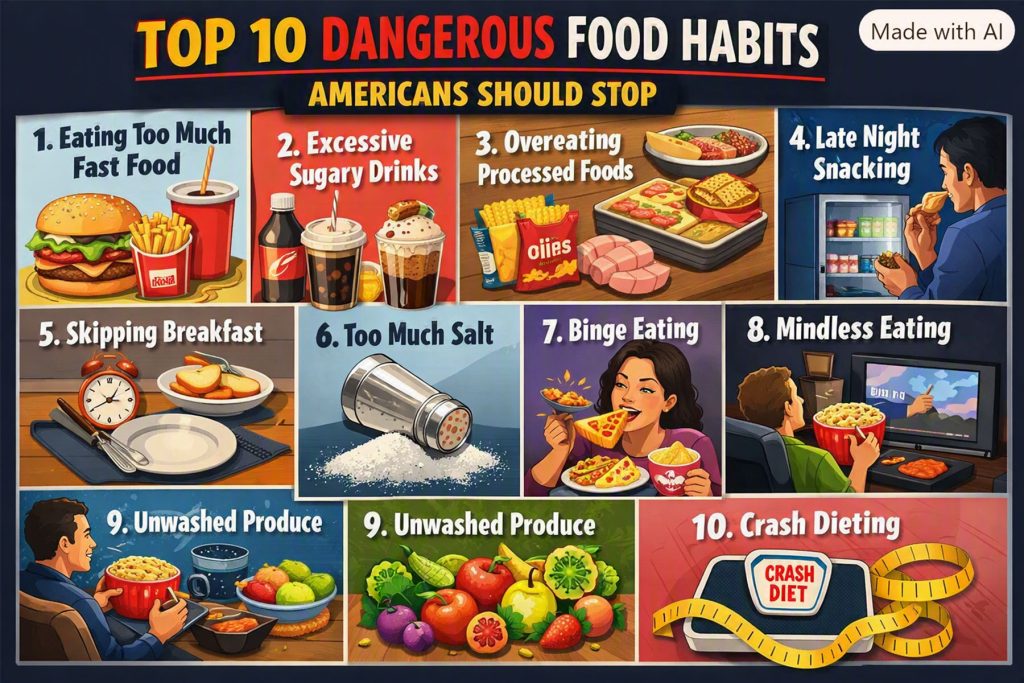
Top 10 Dangerous Food Habits in the USA
Eating Meat, Poultry, Eggs, or Seafood Without Checking Safety
Undercooked animal foods remain among the clearest food safety risks because harmful microorganisms can survive when food does not reach an appropriate internal temperature. Raw or undercooked poultry, meat, seafood, and eggs are specifically identified by the CDC as foods more likely to contain harmful germs. CDC+1
The common mistake is judging doneness by appearance. Ground beef may brown before reaching a temperature that destroys harmful bacteria, while chicken can look cooked on the outside before the thickest portion reaches a safe temperature. USDA guidance specifies 165 degrees F for poultry, 160 degrees F for ground meat, 145 degrees F for whole cuts of beef, pork, lamb, and veal with a three minute rest, and 145 degrees F for fish and shellfish. Food Safety and Inspection Service+1
A food thermometer removes much of the guesswork. USDA research has also found that visual cues remain a common basis for judging doneness, even though color and grill marks are not reliable indicators of safety. Food Safety and Inspection Service
Leaving Perishable Food Out for Hours
A plate of chicken, a casserole, a bowl of pasta salad, or a tray of sandwiches can become unsafe when it remains at room temperature for too long. The USDA defines the food danger zone as 40 degrees F to 140 degrees F, a temperature range in which bacteria can multiply rapidly. Ask USDA
The basic time rule is straightforward. Perishable foods should not remain unrefrigerated for more than two hours, or more than one hour when the surrounding temperature is above 90 degrees F. USDA guidance explains that certain bacteria can double in number in as little as 20 minutes under favorable conditions. Ask USDA
This habit becomes particularly risky during summer gatherings, outdoor events, road trips, and holiday meals. Food that has been sitting out overnight should not be judged by smell or appearance. USDA guidance says perishable food left at room temperature for more than two hours should be discarded. Ask USDA
Washing Raw Chicken in the Sink
Rinsing chicken before cooking remains a surprisingly persistent kitchen practice. The problem is that washing does not make raw poultry safer, while splashing water can spread contaminated droplets around the sink, counters, utensils, and nearby food.
The CDC specifically advises that raw chicken does not need to be washed before cooking. Water can spread germs to other foods and surfaces, increasing the possibility of cross contamination. CDC
FDA guidance similarly tells consumers not to wash meat, poultry, fish, or eggs because water splashing from the sink can spread bacteria. The safer principle is simple: keep raw poultry contained, wash hands and surfaces appropriately, and rely on thorough cooking rather than rinsing to reduce microbial hazards. U.S. Food and Drug Administration
Using the Same Cutting Board for Raw Meat and Ready to Eat Foods
Cross contamination can turn a clean salad into a food safety problem in seconds. A cutting board used for raw chicken or ground beef can carry microorganisms onto lettuce, fruit, bread, or other foods that will not receive another cooking step.
CDC guidance recommends keeping raw meat, poultry, seafood, and eggs separate from ready to eat foods. Using separate cutting boards is one practical way to reduce the chance that contaminated juices will reach food that is ready for consumption. CDC+1
The same principle applies to plates and utensils. Cooked meat should not be placed on the same unwashed plate that previously held raw meat. FDA guidance identifies this type of transfer as a classic example of cross contamination. U.S. Food and Drug Administration
Eating Raw Dough or Raw Batter
Raw cookie dough may seem harmless because it contains familiar ingredients, but uncooked flour can carry harmful bacteria. Raw eggs can also present food safety concerns.
The CDC lists raw dough and raw batter made with uncooked flour among foods that can cause foodborne illness. That means the risk is not limited to recipes containing raw eggs. Flour itself can be a source of contamination before it has been heat treated through cooking. CDC+1
The safest distinction is between ordinary raw dough and products specifically manufactured or labeled for raw consumption. A food labeled for safe raw consumption has been processed with that intended use in mind. Homemade dough should not automatically be treated as safe simply because the recipe appears simple.
Thawing Frozen Meat on the Kitchen Counter
Leaving frozen meat on the counter may seem like an efficient way to speed up dinner preparation, but it can allow the outer portions of the food to enter temperatures where bacteria multiply while the center remains frozen.
The CDC recommends thawing frozen foods in the refrigerator, in cold water, or in the microwave rather than leaving them on the counter. The concern is uneven temperature exposure, particularly when the surface warms substantially before the interior has thawed. CDC
Refrigerator thawing takes longer, but it keeps the food at a controlled temperature. For households that frequently cook frozen meat, building thawing into meal planning is safer than relying on a countertop shortcut.
Trusting Smell, Taste, or Appearance to Judge Food Safety
Food can be contaminated without looking spoiled. That makes sensory testing an unreliable food safety strategy.
The CDC notes that food contaminated with Salmonella or other harmful germs can look, taste, and smell normal. USDA likewise states that harmful bacteria cannot reliably be detected through sight, smell, or taste. CDC+1
This matters with leftovers in particular. Taking a small taste to decide whether questionable food is still safe does not provide a dependable safety check. When time and temperature controls have clearly been violated, the absence of an unpleasant odor does not reverse the risk.
Eating Unpasteurized Milk, Juice, or Certain Soft Cheeses Without Considering the Risk
Pasteurization is a major food safety control because heat treatment is designed to destroy harmful microorganisms. Unpasteurized products can therefore carry risks that consumers may not recognize from appearance or taste.
The CDC lists unpasteurized milk, juice, cider, and certain soft cheeses among foods that can carry harmful germs. People at greater risk of severe foodborne illness include young children, adults 65 and older, pregnant women, and people with weakened immune systems. CDC+1
The issue is not whether every unpasteurized product will cause illness. The issue is that skipping a validated safety control can increase exposure to pathogens. That distinction is particularly important for people in higher risk groups.
Failing to Wash Hands Before Handling Food
A kitchen can contain clean ingredients and still become a source of contamination if hands transfer germs between surfaces and food. Hands can carry microorganisms from raw meat, poultry, eggs, pets, bathrooms, and other sources.
The CDC recommends washing hands before, during, and after food preparation and before eating, using soap and water for at least 20 seconds. Surfaces and utensils should also be cleaned after preparing different foods, particularly when raw animal products are involved. CDC
Handwashing is especially important when switching from raw food preparation to ready to eat foods. The FDA Food Code also emphasizes handwashing during food preparation when changing tasks or moving between raw food and ready to eat food. U.S. Food and Drug Administration
Keeping Leftovers for Too Long
Leftovers can save time and money, but refrigeration does not make food permanently safe. Time continues to matter after cooking, and storage conditions determine how quickly food quality and safety can deteriorate.
USDA guidance says leftovers should be refrigerated within two hours, stored at 40 degrees F or below, and generally used within three to four days when refrigerated. Leftovers should be reheated to 165 degrees F before serving. Ask USDA+1
A practical storage system helps prevent forgotten containers from remaining in the refrigerator for extended periods. Dating containers, using shallow storage containers for faster cooling, and keeping the refrigerator at the recommended temperature can make safe storage much easier.
The Numbers Behind Food Safety
The scale of foodborne illness puts everyday kitchen behavior into perspective. CDC estimates indicate that approximately 48 million people in the United States experience foodborne illness each year, with about 128,000 hospitalizations and 3,000 deaths. CDC
Not every case results from a mistake made in a home kitchen. Contamination can occur during production, processing, transportation, retail handling, restaurant preparation, or at home. Still, household food handling remains an important point at which risk can either increase or decrease.
The CDC’s current prevention framework is built around four basic principles: clean, separate, cook, and chill. Those four words address most of the behaviors identified in this ranking, from handwashing and avoiding cross contamination to temperature control and prompt refrigeration. CDC+1
| Rank | Dangerous food habit | Main concern | Safer food safety principle |
| 1 | Eating undercooked food | Harmful germs may survive | Cook to a safe internal temperature |
| 2 | Leaving food out too long | Bacteria can multiply rapidly | Refrigerate within two hours |
| 3 | Washing raw chicken | Germs can spread through splashing | Cook poultry thoroughly |
| 4 | Reusing contaminated cutting boards | Cross contamination | Separate raw and ready to eat foods |
| 5 | Eating raw dough | Flour or eggs may contain harmful germs | Eat dough after proper cooking |
| 6 | Thawing food on the counter | Outer surfaces can warm into the danger zone | Thaw in the refrigerator, cold water, or microwave |
| 7 | Trusting smell or appearance | Contaminated food may look normal | Follow time and temperature controls |
| 8 | Consuming unpasteurized products | Pathogens may survive | Choose pasteurized options when appropriate |
| 9 | Skipping handwashing | Hands can transfer germs | Wash hands with soap and water |
| 10 | Keeping leftovers too long | Refrigeration slows but does not stop deterioration | Refrigerate promptly and use within recommended time |
Why Familiar Kitchen Habits Can Be Misleading
The most dangerous food habits are not always dramatic. In many households, the problem comes from routine behavior that has never been questioned.
A person may rinse chicken because a family member always did it. A cook may press a burger with a spatula and assume its brown color proves it is finished. Someone may leave food on the dining table throughout a long gathering because it still looks fresh. Another person may taste leftover food before deciding whether to keep it.
Food safety science does not rely on these visual or sensory assumptions. It relies on controls that can be measured or consistently applied. Temperature, time, separation, hygiene, and pasteurization provide much stronger safeguards than appearance or habit.
This distinction also explains why kitchen convenience should not be confused with safety. A quick shortcut may save a few minutes while removing an important control. The better approach is to build simple safety checks into ordinary cooking routines so they require little additional thought.
The Habits That Matter Most for Families
Risk is not distributed equally across the population. Anyone can develop foodborne illness, but certain groups are more likely to experience severe outcomes. The CDC identifies children younger than five, adults 65 and older, pregnant women, and people with weakened immune systems as groups at higher risk. CDC+1
That makes food handling particularly important in households with young children, older adults, or people whose immune systems are weakened. The same meal can carry different consequences depending on who consumes it.
For everyday households, the most useful strategy is consistency rather than complexity. A clean preparation area, separate tools for raw and ready to eat foods, a reliable food thermometer, prompt refrigeration, and careful attention to food labels can eliminate many common sources of avoidable risk.
A Safer Kitchen Starts With Four Rules
The CDC’s clean, separate, cook, and chill framework provides a practical foundation for household food safety.
Clean means washing hands, utensils, cutting boards, countertops, and produce appropriately. Separate means preventing raw meat, poultry, seafood, eggs, and their juices from contacting foods that will not be cooked. Cook means using a food thermometer rather than relying on color. Chill means keeping the refrigerator at 40 degrees F or below and refrigerating perishable food promptly. CDC+1
These rules are deliberately simple. Food safety does not require a professional kitchen or complicated equipment. It requires a few repeatable controls applied at the right moments.
Closing Perspective
Dangerous food habits rarely announce themselves as dangerous. They usually appear as shortcuts, traditions, assumptions, or small acts of convenience that seem harmless in the moment. Yet foodborne illness prevention depends heavily on those ordinary decisions. The most effective change is not to become fearful of food, but to replace guesswork with reliable habits: cook by temperature, refrigerate by time, separate raw foods from ready to eat foods, wash hands and surfaces, and treat questionable storage conditions seriously. In American kitchens, those basic controls can make an important difference because food safety is ultimately built through repetition. A thermometer used consistently, a cutting board kept separate, or a leftover refrigerated on time may seem insignificant by itself, but together those habits create a much safer food environment.
FAQ
What are the most dangerous food habits in America?
The most concerning habits include eating undercooked food, leaving perishable food at room temperature too long, washing raw chicken, cross contaminating ready to eat foods, and storing leftovers improperly. These behaviors can increase exposure to harmful bacteria and other foodborne pathogens.
How long can food sit out before it becomes unsafe?
Perishable food should generally not remain at room temperature for more than two hours. When the surrounding temperature is above 90 degrees F, the limit is one hour. Ask USDA
Is washing raw chicken actually dangerous?
Washing raw chicken can spread contaminated droplets around the sink and nearby surfaces. The CDC and FDA advise against washing raw poultry because thorough cooking, rather than rinsing, is the important safety control. CDC+1
Can food look and smell safe but still cause food poisoning?
Yes. Harmful germs can be present without producing obvious changes in smell, taste, color, or texture. Food safety therefore depends on proper handling, cooking, and storage rather than sensory inspection alone. CDC+1
What temperature should chicken reach in the USA?
USDA guidance specifies a minimum internal temperature of 165 degrees F for all poultry, including chicken and turkey. A food thermometer should be used to verify the temperature in the thickest portion. Food Safety and Inspection Service
Is raw cookie dough unsafe to eat?
Raw cookie dough can contain uncooked flour and, depending on the recipe, raw eggs. The CDC identifies raw dough and batter made with uncooked flour as foods that can carry harmful germs. CDC
What is the safest way to thaw frozen meat?
Recommended methods include thawing in the refrigerator, in cold water, or in the microwave. Leaving meat on the kitchen counter can allow parts of the food to warm into temperatures where bacteria multiply more rapidly. CDC
How long are leftovers safe in the refrigerator?
USDA guidance recommends using refrigerated leftovers within three to four days when they have been properly chilled and stored at 40 degrees F or below. Leftovers should be reheated to 165 degrees F before serving. Ask USDA+1
Why is cross contamination so dangerous?
Cross contamination transfers harmful microorganisms from one food, surface, utensil, or hand to another. The greatest concern occurs when raw foods contact ready to eat foods that will not receive another cooking step. CDC
Who faces the greatest risk from foodborne illness?
Anyone can become sick from contaminated food, but children younger than five, adults 65 and older, pregnant women, and people with weakened immune systems have a higher risk of serious illness. Food safety precautions are particularly important when meals are being prepared for these groups. CDC+1

