
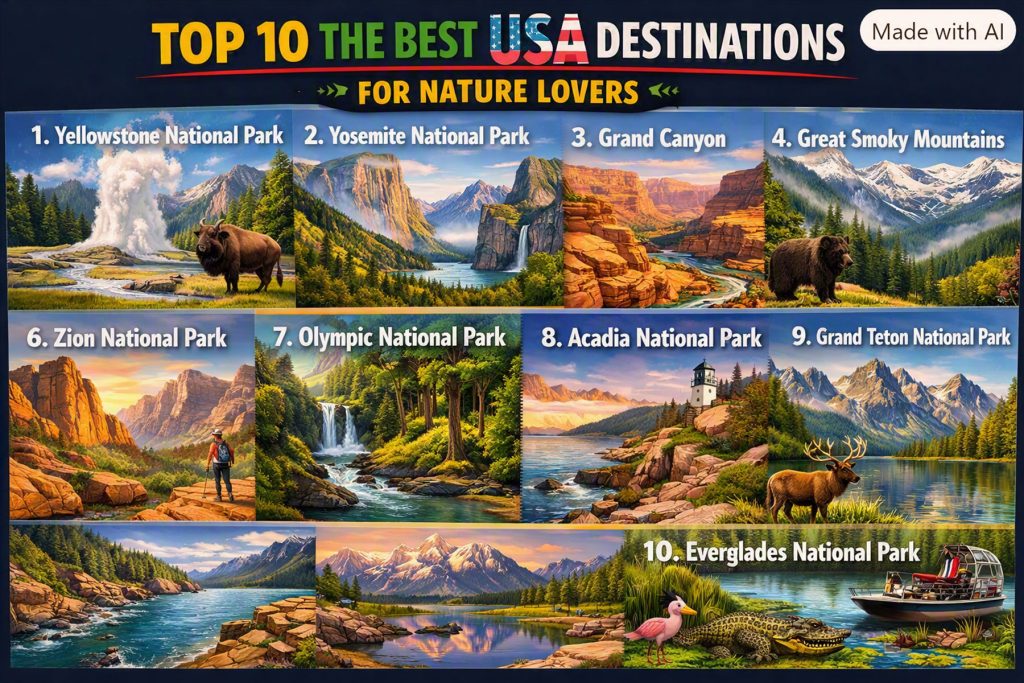
The United States contains an extraordinary range of natural environments within a single country. Snow covered mountain ranges, ancient forests, deep canyons, volcanic landscapes, rugged coastlines, alpine lakes, desert formations, and wildlife rich valleys can all be found across its borders. For travelers searching for the best USA destinations for nature lovers, that variety creates an unusual advantage: a single country can provide dramatically different outdoor experiences without crossing an international border.
National parks remain central to that appeal. The National Park Service recorded more than 323 million recreation visits across the national park system in 2025, demonstrating the continuing strength of public interest in America’s protected natural spaces. Among individual national parks, Great Smoky Mountains, Zion, Yellowstone, Grand Canyon, Yosemite, Rocky Mountain, Acadia, Grand Teton, Olympic, and Glacier ranked as the ten most visited in 2025.
Popularity alone does not determine the quality of a nature destination. A place can attract millions of visitors because it offers easy access, while another can provide exceptional wilderness with far fewer visitors. The strongest destinations combine memorable scenery, ecological variety, wildlife, recreational opportunities, distinctive geography, and the ability to provide experiences that remain meaningful beyond a single viewpoint. The following ranking uses those factors alongside recent visitation data to identify ten destinations that stand out for nature focused travel in the USA.
Top 10 USA Destinations for Nature Lovers
Great Smoky Mountains National Park, Tennessee and North Carolina
Great Smoky Mountains National Park earns the top position because it combines remarkable biodiversity, extensive forests, mountain scenery, waterfalls, wildlife, and relatively broad accessibility. The park recorded 11,527,939 recreation visits in 2025, making it the most visited national park in the United States by a substantial margin.
The Smokies are especially distinctive because of their biological richness. The Appalachian environment supports thousands of plant species, numerous mammals, extensive salamander populations, and a wide variety of birds. Elevation changes create different ecological conditions within a relatively compact area.
Cades Cove is one of the best known areas, offering an open valley surrounded by mountains and opportunities to see wildlife. Black bears are an important attraction, although wildlife viewing requires considerable distance and respect for park rules. The Appalachian Trail also passes through the park, adding appeal for serious hikers.
Unlike some western parks dominated by dramatic rock formations, Great Smoky Mountains creates its visual impact through layers of forested ridges, mist, streams, and changing seasonal color. Spring wildflowers and autumn foliage make it particularly attractive for travelers interested in plant life and forest scenery.
Its popularity also means that visitors should expect congestion during major holiday periods and peak fall color. The combination of accessibility and ecological diversity, however, makes the Smokies one of the strongest nature destinations in America.
Yellowstone National Park, Wyoming, Montana and Idaho
Yellowstone offers a type of natural variety that few destinations anywhere can match. The park combines geothermal features, mountains, forests, rivers, lakes, waterfalls, broad valleys, and major wildlife habitats.
Yellowstone recorded 4,762,988 recreation visits in 2025, placing it third among all national parks by annual visitation.
Its geothermal character remains the defining feature. Old Faithful, the Grand Prismatic Spring, Norris Geyser Basin, and Mammoth Hot Springs demonstrate the continuing geological activity beneath the Yellowstone region. The park sits above one of the world’s most significant active volcanic systems, which helps explain its concentration of geysers and hot springs.
The wildlife experience is equally important. Bison are widely associated with Yellowstone, while elk, grizzly bears, wolves, pronghorn, and other species inhabit different parts of the ecosystem. Lamar Valley is particularly well known for wildlife observation.
Yellowstone also illustrates the pressure created by its popularity. The National Park Service reports that visitation has increased significantly over the long term, creating challenges involving traffic, infrastructure, staffing, and resource protection.
For nature lovers, that tension is part of the modern Yellowstone experience. The park is extraordinary, but responsible visitation is essential to preserving the same wildlife and geothermal resources that attract millions of people.
Yosemite National Park, California
Yosemite is one of America’s most recognizable natural destinations, largely because its granite cliffs, waterfalls, giant trees, and high country scenery create an exceptionally dramatic setting.
The park received 4,278,413 recreation visits in 2025, placing it fifth among America’s national parks.
Yosemite Valley provides the classic experience. Massive granite formations such as El Capitan and Half Dome dominate the landscape, while waterfalls create powerful seasonal displays. Yosemite Falls, Bridalveil Fall, and the Merced River contribute to the valley’s distinctive character.
The park extends far beyond the valley, however. High elevation meadows, alpine environments, sequoia groves, and extensive wilderness provide a much broader nature experience. This geographic range allows visitors to encounter dramatically different conditions within the same protected area.
Yosemite’s popularity can create intense congestion, particularly during warmer months. The National Park Service reported that Yosemite had almost 2.92 million visits through August 2025, seven percent higher than the comparable period in 2024.
That pattern illustrates why timing matters. Travelers seeking quieter conditions often consider spring, fall, or less crowded areas away from the central valley.
Grand Canyon National Park, Arizona
Few natural features are as instantly recognizable as the Grand Canyon. Its enormous scale, layered geology, changing light, and Colorado River corridor make it one of the most significant natural destinations in the USA.
Grand Canyon National Park recorded 4,430,653 visits in 2025, ranking fourth among national parks.
The South Rim provides the most accessible introduction and remains open throughout the year. Its overlooks reveal an immense geological record exposed across the canyon walls. Different rock layers represent hundreds of millions of years of Earth’s history.
The North Rim offers a different atmosphere, with higher elevation forests and a quieter setting. The two rims are geographically close on a map but require substantial driving because the canyon itself separates them.
For visitors interested in more than viewpoints, the canyon also supports hiking, river trips, wildlife observation, astronomy, and backcountry experiences. The physical demands can be significant, particularly because temperatures and elevation change dramatically between the rim and canyon interior.
National Park Service statistics for 2025 recorded more than 55,000 backpacking user nights and more than 232 search and rescue incidents, underscoring the importance of respecting the canyon’s physical environment.
The Grand Canyon is therefore not simply a scenic stop. It is a vast natural system that rewards travelers who give the landscape enough time and attention.
Grand Teton National Park, Wyoming
Grand Teton National Park delivers one of the most visually powerful mountain settings in the country. The sharp Teton Range rises dramatically from the surrounding valley, creating a landscape that feels unusually immediate.
The park recorded 3,800,648 visits in 2025.
Its appeal extends well beyond mountain photography. Jackson Lake and other waterways provide opportunities for boating and fishing, while trails lead through forests, wetlands, meadows, and mountain terrain. The area also supports elk, moose, pronghorn, bears, and numerous bird species.
The relationship between the mountains and valley is one of Grand Teton’s greatest strengths. Rather than presenting a single dramatic geological feature, the park creates a complete alpine environment in which mountains, lakes, rivers, forests, and wildlife interact.
Grand Teton also benefits from its proximity to Yellowstone, making the two parks a natural pairing for longer nature focused trips. Travelers can move from geothermal landscapes and broad wildlife valleys into a more concentrated mountain environment.
Rocky Mountain National Park, Colorado
Rocky Mountain National Park represents the classic high altitude wilderness experience. Located near Estes Park, Colorado, the park offers dramatic peaks, alpine lakes, evergreen forests, tundra, waterfalls, and expansive mountain views.
It recorded 4,171,431 recreation visits in 2025, ranking sixth among national parks.
The park’s elevation range is one of its defining characteristics. Visitors can move from lower forest environments into high alpine terrain where vegetation becomes increasingly sparse. Trail Ridge Road provides access to some of the highest paved terrain in North America and offers broad views across the surrounding mountains.
Wildlife is another major attraction. Elk are particularly visible, while bighorn sheep, moose, marmots, and numerous bird species contribute to the experience.
Rocky Mountain National Park is especially attractive for travelers who want a combination of accessible scenic drives and challenging hiking. The diversity of trails means that the destination can work for casual visitors as well as experienced outdoor enthusiasts.
Acadia National Park, Maine
Acadia demonstrates that extraordinary American nature does not require towering western mountains. Located primarily on Mount Desert Island along Maine’s Atlantic coast, the park combines rocky shoreline, forests, mountains, ponds, and ocean views.
Acadia recorded 4,079,318 visits in 2025, making it the seventh most visited national park in the country.
Cadillac Mountain is among its best known features. The park also contains extensive hiking routes and scenic roads that connect coastal and inland environments. Granite formations, spruce and fir forests, tidal areas, and ocean viewpoints create a distinctive northeastern character.
Acadia is particularly attractive during autumn, when forests take on intense seasonal color. Summer brings warmer coastal conditions, while spring and fall provide different scenery and generally different crowd patterns.
Its compact geography also makes it appealing to travelers who want variety without spending days driving between separate attractions. A visitor can experience forest trails, mountain overlooks, and rugged Atlantic coastline within a relatively concentrated region.
Olympic National Park, Washington
Olympic National Park is one of the most ecologically diverse protected areas in the continental United States. Its geography includes temperate rainforest, rugged Pacific coastline, glacier covered mountains, lakes, and alpine environments.
The park received 3,584,187 recreation visits in 2025.
Hoh Rain Forest is one of the park’s signature environments. Heavy precipitation supports dense vegetation covered in mosses and ferns, creating a landscape that looks radically different from the dry forests and deserts found elsewhere in the country.
The Pacific coastline provides another dramatic contrast. Rocky beaches, sea stacks, tide pools, and changing weather create a distinctly wild coastal experience. Farther inland, the Olympic Mountains provide high elevation scenery and opportunities for more demanding hiking.
This combination is what places Olympic among the strongest USA destinations for nature lovers. Few American national parks provide such a broad ecological range within one protected area.
Glacier National Park, Montana
Glacier National Park provides some of America’s most impressive mountain scenery, with sharp peaks, deep valleys, alpine lakes, and extensive forests. Its name reflects a glacial history that has shaped the terrain for thousands of years.
The park recorded 3,136,557 visits in 2025.
Going to the Sun Road remains one of its defining experiences, crossing the park through spectacular mountain terrain. Hiking trails lead to alpine viewpoints, lakes, waterfalls, and wildlife habitats.
Glacier is also important for understanding how changing climate conditions affect mountain ecosystems. The park’s glaciers have declined substantially over the long term, making the landscape relevant not only as a travel destination but also as a visible example of environmental change.
Wildlife adds another layer of interest. Mountain goats, bighorn sheep, elk, black bears, and grizzly bears can inhabit different areas of the park. Visitors need to maintain appropriate distances and follow park guidance when encountering wildlife.
Zion National Park, Utah
Zion National Park closes the ranking with a landscape that is immediately recognizable for its towering sandstone cliffs, narrow canyons, high plateaus, and striking desert vegetation.
Zion recorded 4,984,525 recreation visits in 2025, making it the second most visited national park in the country behind Great Smoky Mountains.
The contrast between the red and cream colored rock walls and the green vegetation along the Virgin River creates one of America’s most distinctive canyon environments.
Zion appeals to travelers because it offers multiple ways to experience the terrain. Scenic areas provide impressive views without requiring long hikes, while more demanding routes lead deeper into the canyon system.
The park’s popularity has also made visitor management an important part of the experience. Heavy demand can produce congestion, especially around major attractions during peak periods.
For nature lovers, Zion demonstrates that desert environments can be just as biologically and visually compelling as forests and mountain ranges. Its geology alone makes it one of the most memorable outdoor destinations in the USA.
How the Top Nature Destinations Compare
The ranking becomes easier to understand when visitation is placed alongside the type of natural experience each destination provides.
| Rank | Destination | 2025 Recreation Visits | Defining Natural Feature |
| 1 | Great Smoky Mountains | 11,527,939 | Forests, mountains and wildlife |
| 2 | Yellowstone | 4,762,988 | Geothermal features and wildlife |
| 3 | Yosemite | 4,278,413 | Granite cliffs and waterfalls |
| 4 | Grand Canyon | 4,430,653 | Canyon geology and river scenery |
| 5 | Grand Teton | 3,800,648 | Alpine mountains and lakes |
| 6 | Rocky Mountain | 4,171,431 | High altitude mountain terrain |
| 7 | Acadia | 4,079,318 | Atlantic coastline and forests |
| 8 | Olympic | 3,584,187 | Rainforest, coast and mountains |
| 9 | Glacier | 3,136,557 | Glaciers, peaks and alpine lakes |
| 10 | Zion | 4,984,525 | Sandstone cliffs and desert canyons |
Source: National Park Service 2025 visitation data.
The numbers reveal an interesting pattern. Zion ranks second in visitation among the ten destinations despite appearing tenth in this broader nature focused ranking. That difference exists because visitation is only one consideration. A destination’s ecological variety, scenery, wildlife, recreation opportunities, and geographic character also matter.
What Makes a Great Nature Destination in the USA
Biodiversity matters
The strongest destinations offer more than attractive scenery. Great Smoky Mountains, Yellowstone, and Olympic are particularly compelling because visitors encounter multiple ecosystems within the same destination.
Biodiversity also creates seasonal variety. Wildlife activity, flowering periods, fall color, snowfall, and water levels can dramatically alter the appearance of a place from one month to another.
Geological character creates lasting appeal
Some destinations stand apart because their geology is impossible to mistake for another region. Grand Canyon reveals immense layers of geological history. Zion presents towering sandstone formations. Yellowstone displays geothermal activity created by powerful forces beneath the surface.
These geological differences give each destination a distinct identity and help explain why certain landscapes remain culturally significant for generations.
Accessibility influences popularity
A destination can be extraordinary and still attract fewer visitors if reaching it requires substantial travel or physical effort. Great Smoky Mountains benefits from its location near major population centers in the eastern United States, while Yellowstone, Glacier, and Olympic require longer journeys for many travelers.
The National Park Service recorded more than 323 million recreation visits across the system in 2025, showing just how strongly accessibility and public interest intersect.
Seasonal timing changes the experience
Nature destinations are not static. Acadia’s coastline and forests look different in autumn than in summer. Yellowstone’s wildlife patterns change through the year. Mountain destinations can have dramatically different road and trail access depending on snow conditions.
That makes seasonality an important consideration when comparing destinations. The most popular period is not necessarily the most rewarding period for every traveler.
Responsible Travel Is Becoming More Important
The extraordinary popularity of America’s natural destinations creates a responsibility for visitors and destination managers alike. Crowding can affect wildlife, vegetation, parking capacity, trails, water resources, and the overall visitor experience.
Yellowstone provides a clear example. The National Park Service describes increasing visitation as a factor that places additional pressure on staffing, infrastructure, funding, and resource protection.
Responsible travel means staying on designated trails, following wildlife distance requirements, respecting closures, keeping natural objects where they are found, and using established facilities appropriately. These actions may seem small at the individual level, but millions of visits can produce substantial cumulative effects.
For travelers, responsible behavior also improves the experience. A quieter approach to wildlife viewing, early morning visits, less crowded trails, and respect for local restrictions can produce a more meaningful connection with a destination.
Choosing the Right USA Nature Destination
There is no single best destination for every type of nature lover.
Great Smoky Mountains is particularly strong for forests, wildlife, waterfalls, and eastern mountain scenery. Yellowstone stands out for geothermal features and large mammals. Yosemite is ideal for dramatic granite formations and waterfalls. Grand Canyon is unmatched for immense geological scale.
Grand Teton and Rocky Mountain suit travelers drawn to alpine environments, while Acadia provides an unusually strong combination of ocean and forest scenery. Olympic is particularly valuable for ecological variety, Glacier for mountain scenery, and Zion for desert canyon landscapes.
This range is what makes the USA such a strong destination for nature focused travel. Different regions provide completely different experiences, allowing travelers to choose destinations according to interests rather than simply following popularity.
The Future of Nature Travel in America
The future of outdoor travel in the United States will likely involve a greater emphasis on managing visitor demand while preserving access to protected areas. The National Park Service’s 2025 statistics show both the enormous popularity of these places and the scale of the responsibility involved. More than 323 million recreation visits were recorded across the system that year.
Technology will also influence how visitors plan trips. Real time information about road conditions, trail closures, weather, visitor levels, and seasonal access can help distribute demand and reduce unnecessary pressure on busy areas.
At the same time, interest in less crowded seasons and less concentrated destinations may continue to grow. Travelers increasingly have reasons to consider shoulder seasons, alternative entrances, lesser known trails, and nearby public lands rather than concentrating every trip around the most famous viewpoint.
The result could be a healthier relationship between tourism and conservation, provided access continues to be balanced with responsible management.
Closing Perspective
The best USA destinations for nature lovers are not defined by one type of scenery. Their strength comes from the extraordinary range of natural systems protected across the country. Great Smoky Mountains provides dense forests and exceptional biodiversity, Yellowstone combines geothermal activity with wildlife, Yosemite and Grand Teton deliver monumental mountain scenery, Grand Canyon reveals immense geological history, and destinations such as Acadia, Olympic, Glacier, Rocky Mountain, and Zion demonstrate how dramatically America’s environments can change from region to region. The National Park Service visitation figures show that public interest remains exceptionally strong, but the future value of these destinations will depend on preserving the qualities that made them famous in the first place. For travelers, the most meaningful nature trips may increasingly be those that balance memorable scenery with patience, responsible behavior, seasonal awareness, and genuine respect for the places being visited.
FAQ
What is the best USA destination for nature lovers?
Great Smoky Mountains National Park is a strong overall choice because it combines mountains, forests, wildlife, waterfalls, and extensive hiking opportunities. It also recorded more than 11.5 million recreation visits in 2025, the highest total among U.S. national parks.
What is the most visited national park in the USA?
Great Smoky Mountains National Park was the most visited U.S. national park in 2025, with 11,527,939 recreation visits. Zion ranked second with 4,984,525 visits.
Which USA destination is best for seeing wildlife?
Yellowstone is one of the strongest choices for wildlife viewing because its ecosystem supports bison, elk, pronghorn, wolves, bears, and many other species. Wildlife sightings are never guaranteed, and visitors are expected to maintain safe distances and follow park regulations.
Which national park has the best mountain scenery?
Yosemite, Grand Teton, Rocky Mountain, and Glacier are among the strongest choices for mountain scenery. Each has a different character, ranging from Yosemite’s granite formations to the sharp peaks of the Teton Range and Glacier’s alpine terrain.
What is the best USA destination for forests and waterfalls?
Great Smoky Mountains is particularly strong for travelers interested in forests, streams, waterfalls, and mountain scenery. Its combination of dense woodland and extensive trail networks gives it broad appeal.
Which USA destination is best for dramatic desert scenery?
Zion National Park is one of the leading choices for dramatic desert scenery. Its towering sandstone cliffs, narrow canyon environments, and Virgin River corridor create a landscape very different from America’s forested and alpine destinations.
Is Yellowstone or Yosemite better for nature lovers?
The choice depends on interests. Yellowstone is stronger for geothermal features and wildlife, while Yosemite is particularly known for granite cliffs, waterfalls, giant trees, and high country scenery.
Which USA nature destination is best for coastal scenery?
Acadia and Olympic are two excellent choices. Acadia combines rocky Atlantic coastline with forests and mountains, while Olympic adds Pacific beaches, temperate rainforest, and alpine terrain.
Which national park is best for first time visitors?
There is no universal answer, but Great Smoky Mountains, Yosemite, Yellowstone, and Grand Canyon are especially strong first choices because they offer iconic scenery and a wide range of visitor experiences. Access, season, physical ability, and preferred activities should influence the final selection.
Are America’s most popular national parks becoming too crowded?
Crowding is a significant management issue at several highly visited parks. The National Park Service recorded more than 323 million recreation visits across the national park system in 2025 and continues to use visitation data to manage visitor use and protect natural resources.

