
A restaurant search that once began with a familiar app is increasingly beginning somewhere else. In 2026, an American consumer might ask an AI assistant for a nearby dinner recommendation, compare prices across several platforms, use a membership to reduce delivery costs, order groceries in the same transaction, and receive a personalized promotion before placing the next order. The food delivery experience is no longer limited to moving a meal from a restaurant to a front door.
That shift is visible in the latest consumer data. DoorDash reported in May 2026 that 22 percent of surveyed U.S. consumers had used an AI tool such as ChatGPT or Google Gemini to help choose a restaurant. The same research found that 64 percent preferred one app for managing delivery, pickup, and reservations. The findings came from a nationally representative survey of 3,001 U.S. consumers and more than 500 restaurant operators. DoorDash
At the same time, cost remains a major factor. Restaurant prices continue to rise, delivery platforms are changing how fees are calculated, and subscription programs are becoming increasingly important to order frequency. The result is a U.S. food delivery market shaped by convenience, technology, value, personalization, and increasingly sophisticated logistics. These are the 10 food delivery trends changing how Americans order food in 2026.
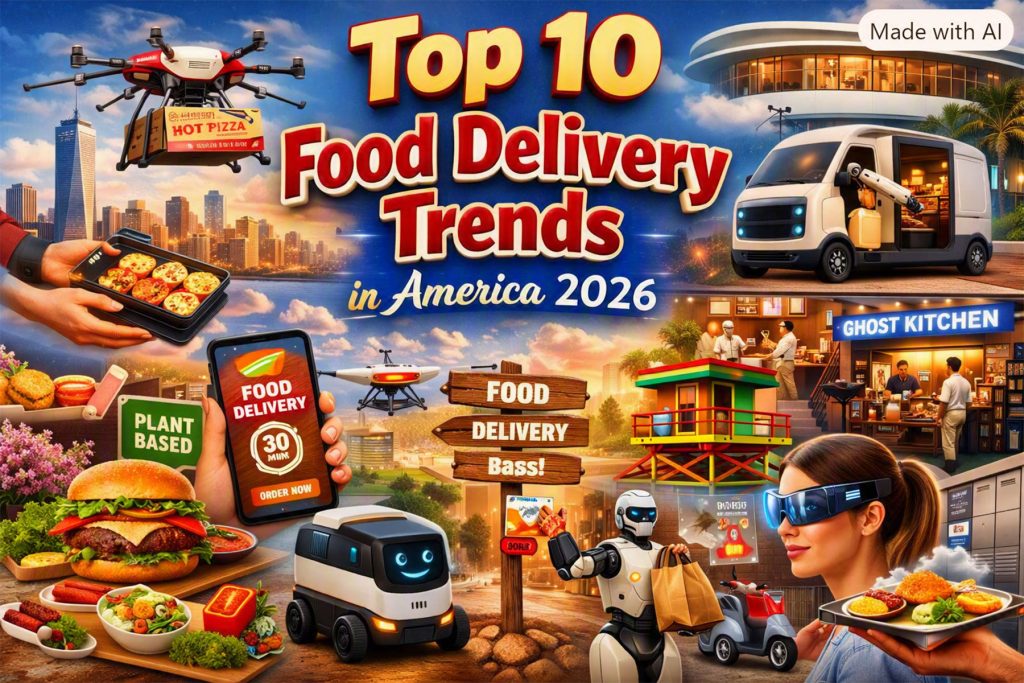
Top 10 Food Delivery Trends in America in 2026
AI Is Changing How Americans Choose Restaurants
Artificial intelligence is becoming part of the restaurant discovery process before an order is ever placed.
For years, consumers primarily relied on search engines, restaurant apps, reviews, maps, social media, and recommendations from friends. In 2026, AI assistants are adding another layer. Consumers can describe an occasion, budget, dietary preference, location, or cuisine and receive restaurant recommendations based on that context.
DoorDash’s 2026 restaurant research found that 22 percent of consumers surveyed had already used AI to choose a restaurant. The research also found that restaurant listing platforms accounted for more than 41 percent of sources cited by AI tools for restaurant recommendations, according to data referenced in the report. DoorDash+1
That changes what restaurant visibility means. A business now needs accurate menus, current hours, useful descriptions, strong photographs, reviews, and consistent location information across digital platforms. Restaurant discovery is increasingly becoming an information quality problem as much as a traditional search ranking problem.
Delivery Memberships Are Becoming a Bigger Part of Ordering
Consumers who order frequently are increasingly evaluating delivery through the economics of membership rather than the price of a single order.
Programs such as DoorDash DashPass and Uber One are designed to reduce delivery fees and encourage repeat ordering. Uber One, for example, currently offers eligible members a $0 delivery fee and discounts on qualifying orders for a monthly membership fee. Uber
DoorDash reported that paid DashPass membership in the United States grew substantially during the 12 months through the second quarter of 2026. The company also said membership tends to increase order frequency and retention because consumers face lower transaction costs. DoorDash
This creates an important change in consumer behavior. Once a household has already paid for a membership, ordering delivery can feel less expensive on each individual occasion. That psychological and financial shift can encourage consumers to use delivery more frequently and across more categories.
Grocery and Restaurant Delivery Are Converging
The delivery app is becoming less about restaurants alone.
Consumers increasingly expect a single digital marketplace to handle meals, groceries, convenience products, household goods, and other everyday purchases. Uber reported in 2026 that its grocery and retail delivery business was growing faster than restaurant delivery, with annualized gross bookings reaching $15 billion. The company also highlighted AI powered shopping experiences, smarter substitutions, and live shelf verification as technology supporting the category. Uber Investor Relations
DoorDash is following a similar direction. Its platform now includes restaurants alongside grocery and everyday retail categories, reflecting a broader shift toward local commerce delivered on demand. DoorDash
For consumers, the distinction between ordering dinner and ordering groceries is becoming less important. Both can involve the same app, payment method, delivery network, membership, and personalized recommendations.
Delivery Fees Are Becoming More Dynamic
The simple idea of one standard delivery fee is giving way to more flexible pricing models.
In July 2026, DoorDash announced changes intended to make fees better reflect delivery effort, including factors such as distance. The company said that more than 70 percent of recent orders would have had the same or lower fees under the new structure, based on its analysis. DoorDash
Uber Eats has also changed restaurant marketplace fees in the United States. Its March 2026 pricing structure included different marketplace fee levels for restaurants depending on the package selected, with separate terms for pickup orders. Uber
For consumers, this means the final checkout price matters more than the menu price alone. Delivery fee, service fee, small order fee, membership benefits, promotional credits, and minimum order requirements can all affect the actual cost.
For restaurants, fee structures also influence margins. A meal that looks profitable at menu price can produce a very different result after platform commissions, discounts, packaging, labor, and other fulfillment costs are considered.
Restaurant Discovery Is Moving From Search to Browsing
A growing share of delivery orders begin without a consumer having a particular restaurant in mind.
DoorDash reported that 55 percent of first time orders on its platform came from consumers who were browsing rather than searching for a specific restaurant. The company also reported an average 13 percent increase in sales after restaurants added photographs to more than half of their menu items, based on its platform data. DoorDash Merchants
That finding has important implications for restaurant marketing.
A restaurant competing for delivery orders is not simply competing against nearby restaurants serving the same cuisine. It is competing for attention inside a digital storefront where photographs, ratings, menu descriptions, pricing, estimated delivery time, promotions, and availability can determine which listing receives the click.
This makes menu presentation a direct commercial factor rather than a cosmetic concern.
Loyalty Programs Are Becoming More Valuable
Restaurants are increasingly focused on turning one delivery order into a repeat relationship.
DoorDash’s 2026 restaurant research found that 66 percent of consumers order more often from restaurants where they actively use a loyalty program. The same research found that 87 percent of consumers said a credit, discount, or perk had influenced them to order again from a restaurant within the previous six months. DoorDash Merchants
The shift is significant because acquiring a new customer can be more difficult than retaining an existing one. A consumer who already knows the menu, has received an acceptable order, and trusts the restaurant has less uncertainty than a first time customer.
Modern loyalty programs are also increasingly crossing between delivery and dine in. DoorDash found that 74 percent of consumers surveyed said a dine in visit had later led them to order delivery from the same restaurant, while 62 percent said a delivery order had later led them to dine in. DoorDash
The restaurant relationship is therefore becoming less about a single transaction and more about repeated interaction across channels.
Personalization Is Moving Into the Food Order
Food delivery is becoming more personalized, from restaurant recommendations to promotions and menu information.
Consumers may receive recommendations based on previous orders, dietary preferences, location, spending behavior, or the time of day. This can reduce the amount of effort required to decide what to eat.
DoorDash found that 65 percent of surveyed consumers said having a restaurant remember preferences such as dietary restrictions or favorite dishes would affect how often they chose that restaurant. It also found that 59 percent actively seek allergen and dietary information when ordering or consider it valuable when available. DoorDash
Personalization also affects promotions. A discount sent to a consumer who regularly orders from a restaurant may be more effective than a broad discount sent to an audience with no established relationship.
The important development is not simply more recommendations. It is the increasing ability of delivery platforms to connect individual preferences with restaurant discovery, ordering, loyalty, and retention.
Faster Delivery Is Expanding Beyond Dense Cities
The next phase of food delivery growth is not limited to the biggest urban centers.
Uber reported in 2026 that suburban and less densely populated markets were growing faster than denser markets in its broader mobility business, while delivery continued to expand across restaurant, grocery, and descriptions, outdated hours, or inaccurate dietary information. Delivery speed is not enough if foods will shape value. Loyalty programs will encourage repeat ordering. Grocery and restaurant delivery will increasingly share infrastructure. Delivery pricing will become more responsive to distance, demand, and service levels. Restaurants will compete brought to the front door. In 2026, the sector is becoming an integrated part of how consumers discover restaurants, compare value, manage memberships, order groceries, interact with loyalty programs, and move between digital and physical dining experiences. The most consequential change is the connection between these behaviors. AI can influence discovery, a membership can change the economics of ordering, a loyalty program can encourage another purchase, and a delivery experience can eventually lead to a restaurant visit. That interconnected model is likely to shape the next stage of U.S. food commerce. Restaurants that understand the full retail categories. Uber Investor Relations
Delivery economics have historically been easier in dense neighborhoods because drivers can complete more orders over shorter distances. Improvements in routing, batching, local selection, membership programs, and courier technology can help platforms serve less dense markets more efficiently.
Two wheeled delivery is another part of this change. DoorDash reported in 2026 on the growing use of bicycles and electric bikes for local commerce, particularly in cities that are adapting streets and infrastructure for more efficient short distance delivery. DoorDash
The broader trend is clear. Delivery infrastructure is being designed around different types of communities rather than a single urban model.
Value Is Becoming a Central Part of Delivery Decisions
Convenience remains important, but consumers are paying closer attention to what delivery actually costs.
The National Restaurant Association reported that 37 percent of U.S. adults ordered restaurant delivery at least once a week in its 2025 off premises research. It also found that value promotions such as limited time offers, discounts, and buy one get one deals resonated with roughly eight in ten off premises customers. NRA
That pattern matters even more as restaurant prices continue to rise. DoorDash reported that its restaurant price index was up 3.2 percent year over year as of June 2026, roughly matching the broader pace of inflation at that time. DoorDash
Consumers therefore have more reasons to compare the complete order price rather than simply choosing the restaurant with the lowest menu price.
Promotions, membership savings, bundled meals, pickup options, and minimum order thresholds can all change the final calculation.
Delivery Is Becoming Part of the Entire Restaurant Relationship
The biggest change may be that delivery is no longer being treated as a separate business channel.
A customer can discover a restaurant through an AI recommendation, order through a delivery marketplace, join its loyalty program, visit the physical restaurant later, and place another delivery order the following week. The boundaries between delivery, pickup, dine in, reservations, loyalty, and digital discovery are becoming increasingly connected.
DoorDash found that 64 percent of consumers surveyed preferred a single app for delivery, pickup, and reservations. It also found that 79 percent of delivery orders were associated with restaurants consumers had previously tried. DoorDash+1
That behavior changes the strategic role of delivery. It is not simply a fulfillment mechanism. It can serve as an acquisition channel, a loyalty channel, a customer data channel, and a bridge to physical restaurant visits.
For consumers, the result is a more integrated restaurant experience. For operators, it creates more opportunities but also greater pressure to provide consistent service across every customer touchpoint.
The Numbers Behind America’s Delivery Shift
The most important food delivery trends become clearer when the available 2026 data is placed alongside broader off premises restaurant behavior.
The National Restaurant Association reported that 41 percent of consumers considered restaurant delivery an essential part of their lifestyle in its 2025 research. Among Gen Z adults and millennials, roughly six in ten reported that delivery had become essential. NRA
At the same time, Pew Research Center found in 2025 that home cooking remained much more common than ordering takeout or delivery. Nearly nine in ten U.S. adults reported eating home cooked meals at least a few times a week, while 17 percent reported ordering takeout or delivery at that frequency. Pew Research Center
These figures are not contradictory. They show that delivery is becoming more important without replacing home cooking. Americans continue to use different food channels for different occasions.
| Rank | Food delivery trend | Key 2026 signal | What it changes |
| 1 | AI restaurant discovery | 22 percent used AI to choose a restaurant | How consumers find restaurants |
| 2 | Delivery memberships | U.S. membership growth remains strong | How consumers evaluate delivery fees |
| 3 | Grocery and restaurant convergence | Grocery and retail delivery expanding rapidly | What consumers expect from delivery apps |
| 4 | Dynamic delivery fees | Platforms are changing fee structures | How consumers compare order costs |
| 5 | Browsing based discovery | 55 percent of first orders came from browsing | How restaurants compete for attention |
| 6 | Loyalty programs | 66 percent order more often from loyalty restaurants | How restaurants retain customers |
| 7 | Personalization | 65 percent value remembered preferences | How platforms and restaurants market |
| 8 | Broader delivery coverage | Suburban and less dense markets gaining attention | Where delivery can scale |
| 9 | Value focused ordering | Promotions influence a large share of off premises customers | How consumers manage rising prices |
| 10 | Connected restaurant channels | 64 percent prefer one app for multiple restaurant services | How delivery fits into the restaurant relationship |
What Food Delivery Trends Mean for American Consumers
For consumers, convenience remains the central attraction, but convenience now comes with more choices and more variables.
A delivery decision can involve restaurant price, delivery time, service charges, membership status, promotions, loyalty benefits, minimum order requirements, and availability. Comparing only the advertised menu price can therefore produce an incomplete picture of the actual cost.
Consumers also have more control over how food reaches the household. Restaurant delivery, pickup, grocery delivery, convenience delivery, and direct ordering can all serve different needs.
The most significant shift is that consumers are gradually becoming participants in a highly personalized digital food marketplace. Their previous orders influence recommendations. Their membership status can influence fees. Their location affects available restaurants. Their preferences can influence what appears on screen.
What These Trends Mean for U.S. Restaurants
Restaurants face a more complicated operating environment in 2026 because digital visibility and physical execution are increasingly connected.
A strong menu is no longer enough if the digital listing contains poor photographs, incomplete descriptions, outdated hours, or inaccurate dietary information. Delivery speed is not enough if food quality deteriorates before arrival. Discounts may increase order volume while reducing profitability if the economics of the promotion are not carefully controlled.
The National Restaurant Association has reported that off premises dining remains an important part of restaurant consumer behavior, while operators continue to balance delivery and takeout with dine in traffic. NRA
That balance is likely to remain important. Delivery does not necessarily compete with restaurants in a simple either or relationship. Current consumer data suggests that people can move between delivery and dine in depending on the occasion.
Where Food Delivery Is Headed Next
The next stage of American food delivery is likely to be defined by integration rather than a single breakthrough technology.
AI will influence discovery. Memberships will shape value. Loyalty programs will encourage repeat ordering. Grocery and restaurant delivery will increasingly share infrastructure. Delivery pricing will become more responsive to distance, demand, and service levels. Restaurants will compete for attention through digital menus as much as through traditional advertising.
The economics will matter just as much as the technology. Restaurant operators must account for platform costs, labor, packaging, food quality, promotions, and customer retention. Consumers, meanwhile, will continue to compare convenience against total cost.
The winning delivery experiences are therefore unlikely to be defined by speed alone. Reliability, transparent pricing, accurate information, useful personalization, food quality, and consistent service are becoming equally important.
Closing Perspective
Food delivery in America has moved well beyond the simple promise of having dinner brought to the front door. In 2026, the sector is becoming an integrated part of how consumers discover restaurants, compare value, manage memberships, order groceries, interact with loyalty programs, and move between digital and physical dining experiences. The most consequential change is the connection between these behaviors. AI can influence discovery, a membership can change the economics of ordering, a loyalty program can encourage another purchase, and a delivery experience can eventually lead to a restaurant visit. That interconnected model is likely to shape the next stage of U.S. food commerce. Restaurants that understand the full customer relationship will have a stronger position than those treating delivery as nothing more than transportation, while consumers will increasingly judge the entire experience from discovery to checkout to the final meal.
FAQ
What are the biggest food delivery trends in America in 2026?
The biggest trends include AI assisted restaurant discovery, delivery memberships, grocery and restaurant delivery integration, personalized recommendations, changing fee structures, and stronger loyalty programs. Delivery is increasingly becoming part of a broader digital restaurant relationship.
How is AI changing food delivery in the USA?
AI is increasingly helping consumers decide where to eat based on location, cuisine, budget, occasion, and preferences. DoorDash reported that 22 percent of surveyed consumers had used AI to help choose a restaurant in 2026. DoorDash
Are Americans ordering more food delivery in 2026?
Delivery remains an important part of off premises dining, particularly among younger consumers. The National Restaurant Association reported that 37 percent of adults ordered restaurant delivery at least once a week in its 2025 research. NRA
Why are food delivery subscriptions becoming popular?
Membership programs can reduce delivery costs and provide discounts or other benefits for frequent users. Lower transaction costs can encourage customers to order more frequently and remain active on a platform.
Are grocery delivery and restaurant delivery becoming connected?
Yes. Major delivery platforms are expanding beyond restaurant meals into groceries, convenience products, and other retail categories. The goal is increasingly to provide one digital marketplace for multiple everyday delivery needs. Uber Investor Relations
Why are food delivery fees changing in 2026?
Delivery companies are adjusting fee structures to better reflect factors such as distance, delivery effort, demand, and membership status. These changes can affect both the consumer’s final checkout price and the economics of restaurant delivery. DoorDash+1
How important are loyalty programs for food delivery?
Loyalty programs are becoming an important retention tool for restaurants. DoorDash reported that 66 percent of surveyed consumers order more often from restaurants where they actively use a loyalty program. DoorDash Merchants
Are food delivery apps replacing restaurants?
The available evidence does not suggest a simple replacement of dine in restaurants by delivery. Consumers continue to use restaurants for different occasions, and research shows that delivery customers can later visit the same restaurant in person. DoorDash
What do Americans care about most when ordering food delivery?
Convenience, price, speed, food quality, reliable service, promotions, and easy ordering all influence delivery decisions. Current research also shows growing interest in dietary information, personalized recommendations, and integrated restaurant services. DoorDash+1
What will food delivery look like in the future?
Food delivery is likely to become more integrated with AI discovery, grocery ordering, loyalty programs, memberships, restaurant reservations, and personalized recommendations. The major shift will be from a single delivery transaction toward a connected digital relationship between consumers, restaurants, and local commerce platforms.

