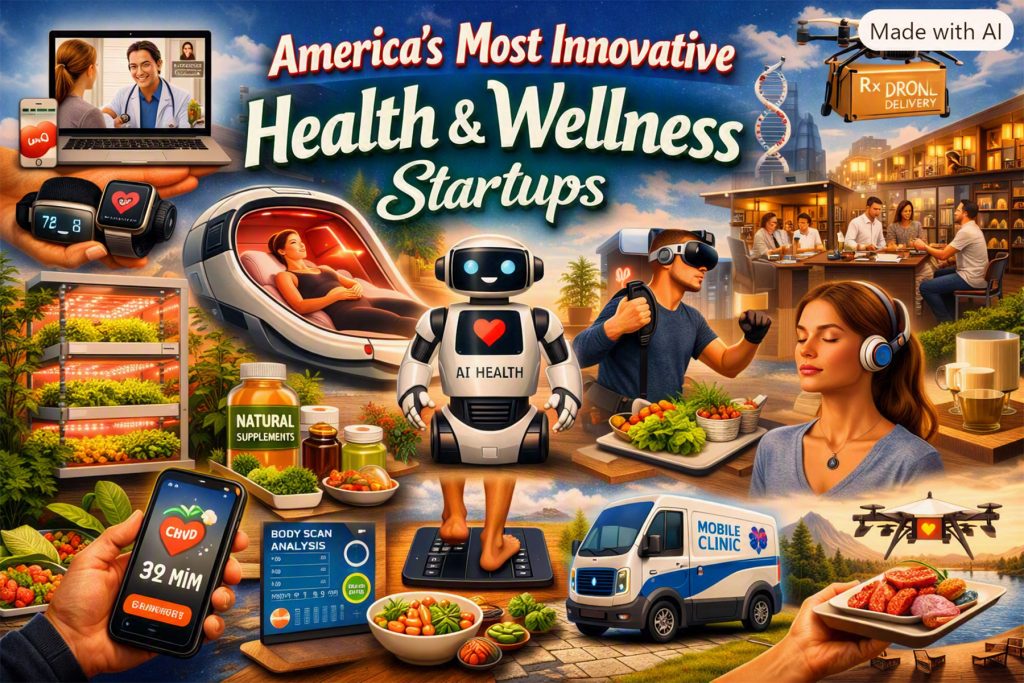
Healthcare innovation in the United States is no longer confined to hospitals, pharmaceutical companies, and medical device manufacturers. A new generation of startups is moving health technology into homes, workplaces, smartphones, bedrooms, kitchens, and everyday routines. America’s most innovative health and wellness startups are building products that monitor sleep, interpret laboratory data, deliver nutrition care, support physical therapy, automate clinical documentation, and connect consumers with specialized healthcare professionals.
The investment numbers show how quickly the sector has matured. U.S. digital health startups raised $14.2 billion across 482 deals in 2025, according to Rock Health. That represented a 35 percent increase from 2024 and marked the highest annual funding total since 2022. Fitness and wellness alone attracted $2 billion across 44 deals, moving into the third most funded digital health category during the year.
The quality of that investment matters as much as its size. Capital is increasingly concentrating around companies that can demonstrate a clear connection between technology and measurable health outcomes. Artificial intelligence has become a major force, but the strongest startups are not using AI merely as a marketing label. They are applying software, sensors, clinical data, automation, and specialized care models to problems that have traditionally been expensive, fragmented, or difficult to access.
That shift has produced a diverse group of companies. Function Health is connecting laboratory testing with longitudinal health information and AI assisted interpretation. Eight Sleep is turning the mattress into a health monitoring environment. Hinge Health has built a digital model for musculoskeletal care. Nourish is expanding access to registered dietitians through insurance supported virtual care. Abridge is applying generative AI to clinical documentation. Midi Health is addressing a historically underserved area of women’s healthcare.
These companies differ significantly in business model and clinical purpose, but they share a central idea: health technology becomes meaningful when it solves a problem people encounter repeatedly.
The New Economics of Health Innovation
The American digital health sector entered 2026 with considerably more investor confidence than it had during the market correction that followed the pandemic era boom.
Rock Health reported that U.S. digital health startups raised $14.2 billion in 2025. The average deal reached $29.3 million, compared with $20.7 million in 2024, while 26 deals exceeded $100 million. AI enabled companies accounted for 54 percent of total digital health funding and received an average deal size premium of approximately 19 percent compared with companies without an explicit AI focus.
The numbers reveal a more selective market. Investors are placing larger amounts of capital behind companies that have evidence of demand, strong distribution, proprietary data, clinical relationships, or a credible path to sustainable revenue.
Wellness has also become more important to investors. Rock Health reported that fitness and wellness startups raised $2 billion across 44 deals in 2025. Oura accounted for nearly half of that category’s funding, while companies including Function, Eight Sleep, and Nourish also raised substantial rounds.
This combination of healthcare and consumer wellness is changing the definition of a health startup. The modern category includes both clinically oriented businesses and consumer platforms that use technology to help people monitor and improve aspects of daily health.
Function Health
Function Health represents one of the clearest examples of the shift toward data driven preventive health.
The company combines extensive laboratory testing with health information and software intended to help members understand changes over time. In November 2025, Function Health raised $298 million in Series B funding at a reported valuation of $2.5 billion, bringing total capital raised to $350 million.
Its approach is based on a simple observation: consumers generate health information across multiple disconnected systems. Laboratory results sit in one place, medical records in another, wearable data somewhere else, and imaging information may remain with a separate provider.
Function is attempting to place those sources into a single longitudinal framework.
Medical intelligence
The company also introduced Medical Intelligence Lab, an AI initiative designed to connect personal health data with medical research and other information. Function says its model is trained by doctors and can use laboratory results, medical notes, scans, and other information to produce personalized health insights.
That model represents a broader trend in digital health. The competitive advantage is moving from data collection toward data interpretation.
Collecting a blood test result is relatively straightforward. Making years of laboratory results, wearable measurements, clinical notes, and imaging information useful to an individual is substantially harder.
Function’s growth demonstrates how investors are responding to that problem. Its challenge will be maintaining scientific rigor and appropriate boundaries as AI becomes increasingly involved in personal health interpretation.
Eight Sleep
Sleep has become one of the most commercially important areas of consumer wellness technology, and Eight Sleep has taken an unusually hardware intensive approach.
The New York based startup develops smart sleep systems that use sensors and software to monitor aspects of sleep and automatically adjust the sleeping environment. Its Pod system measures signals including sleep stages, heart rate, breathing patterns, and movement, while automatically adjusting temperature and other settings.
In August 2025, Eight Sleep raised $100 million, bringing its reported total funding to approximately $260 million. The company said its products had generated more than $500 million in sales and accumulated more than one billion hours of recorded sleep data.
From tracking to intervention
The important distinction is that Eight Sleep is attempting to move beyond passive measurement.
Traditional fitness trackers primarily tell users what happened. Eight Sleep attempts to change the environment in response to observed signals.
That could represent an important direction for wellness technology. A sensor that identifies poor sleep is useful. A system that can automatically adjust temperature or other environmental conditions based on an individual’s patterns may provide a more direct connection between measurement and behavior.
The company is also developing health related capabilities and has stated that it is pursuing regulatory approval for certain future applications. Such developments illustrate the boundary between consumer wellness technology and medical technology, a distinction that becomes increasingly important as startups collect more sensitive physiological information.
Hinge Health
Hinge Health has helped establish digital musculoskeletal care as a major category within American healthcare technology.
The company uses software, wearable sensors, computer vision, and clinical support to deliver physical therapy and pain management programs remotely. Its TrueMotion technology provides real time exercise feedback using computer vision, allowing users to receive guidance without requiring every session to occur in a conventional clinic.
Hinge Health’s growth also shows how digital care can move beyond consumer wellness into employer and health plan markets.
The company reported $170.7 million in fourth quarter revenue for 2025, representing 46 percent year over year growth.
Why the model matters
Musculoskeletal conditions create enormous costs for patients, employers, and healthcare systems. Physical therapy also requires repeated appointments, which can create scheduling and transportation barriers.
A digital model cannot eliminate every clinical need, but it can reduce some of the friction associated with routine physical therapy and exercise based care.
Hinge Health’s technology is particularly significant because it demonstrates how computer vision can be applied to physical movement rather than simply text or images. The system observes exercises and provides feedback based on movement patterns, creating a more interactive form of digital care.
Nourish
Nutrition care is another area undergoing rapid change.
Nourish connects patients with registered dietitians through virtual care. Its business model reflects a broader movement toward making nutrition support part of mainstream healthcare rather than treating it solely as a consumer wellness service.
In 2025, Nourish was reported to have reached unicorn status after raising a $70 million Series B, giving the company a valuation of approximately $1 billion. The company was founded in 2020 and had raised more than $100 million in total funding, according to PitchBook data cited by TechCrunch.
Insurance changes the equation
One reason nutrition startups are gaining traction is that insurance coverage can make professional dietary support more accessible.
TechCrunch reported in 2025 that Nourish and other dietitian platforms were benefiting from increased demand for nutrition counseling, including demand associated with the growing use of GLP 1 medications. The broader opportunity is much larger than one medication category because nutrition intersects with metabolic health, diabetes, cardiovascular risk, weight management, and general wellness.
The startup’s significance comes from connecting professional nutrition expertise with a digital delivery model.
That approach may prove more durable than consumer wellness products that rely entirely on out of pocket subscriptions.
Abridge
Abridge is changing a less visible part of healthcare: clinical documentation.
The company uses generative AI to convert medical conversations into structured clinical notes. Rather than asking physicians to manually reconstruct every detail of an encounter, Abridge records the conversation and generates documentation that can be reviewed and incorporated into clinical workflows.
Its adoption has expanded rapidly. In 2025, Sharp HealthCare selected Abridge for enterprise wide deployment across its system, which supports more than one million patients annually. Abridge also reported that it was trusted by more than 100 large health systems.
Riverside Health reported a 61 percent reduction in cognitive load among clinicians using Abridge during its implementation assessment, while 55 percent fewer clinicians reported burnout after using the platform.
Why clinical workflow matters
Some of the most important health startups are not consumer brands.
Healthcare organizations spend enormous amounts of time on administrative work. If software can reduce documentation burden while preserving accurate medical records, the effect can reach clinicians and patients simultaneously.
Abridge is significant because it demonstrates a practical use of generative AI where the economic value is relatively clear. The objective is not to replace the clinician. It is to reduce the amount of time clinicians spend producing documentation.
That distinction will remain important as healthcare organizations evaluate AI systems.
Midi Health
Women’s health has become one of the most active areas of startup innovation, particularly around conditions that have historically received limited specialized care.
Midi Health focuses on women in midlife, including perimenopause and menopause care. The platform connects patients with healthcare providers trained in this area and uses telehealth to provide ongoing support.
The company was founded after co founder Joanna Strober experienced difficulty obtaining appropriate care for perimenopause symptoms and recognized that many women faced similar barriers. TechCrunch reported that Midi was designed around longer term relationships with specialized providers rather than one time digital consultations.
A neglected market becomes a startup opportunity
The significance of Midi extends beyond one demographic.
Healthcare startups often emerge when a large population has a clear need but limited access to specialized services. Telehealth can reduce geographic barriers, while a focused provider network can concentrate expertise around conditions that general primary care systems may not always address in depth.
Women’s health has attracted increasing investment because entrepreneurs and investors are recognizing large areas of unmet demand.
Midi is an example of a company using technology to make specialized care more accessible without reducing the healthcare experience to a purely automated interaction.
Bevel
Bevel represents another direction in wellness technology: software that brings together data from devices people already own.
The New York based startup combines information from wearables and daily habits involving sleep, fitness, and nutrition. Instead of requiring a proprietary device, Bevel aims to provide a software layer that interprets information generated by multiple sources.
In October 2025, the company announced a $10 million Series A investment from General Catalyst. Bevel said it had more than 100,000 daily active users and had grown more than eightfold over the preceding year.
The case for software first wellness
The consumer health market has historically been dominated by hardware. Watches, rings, sensors, scales, and other devices create valuable data but can also be expensive and difficult to maintain.
A software first approach changes the economics.
If a consumer already owns a compatible wearable, the health application can focus on interpretation rather than manufacturing another device.
That distinction could become increasingly important as the number of health sensors continues to increase.
Form Health
Form Health has built its business around obesity and cardiometabolic care, combining medical professionals with digital access.
The company was named one of Fierce Healthcare’s 2025 Fierce 15, a list recognizing private healthcare companies viewed as innovative within the industry. Form Health describes its model as science based weight and cardiometabolic care delivered across the United States.
Its position reflects the changing economics of metabolic health.
The growing demand for obesity care has created an enormous market for services that extend beyond prescriptions. Nutrition, behavioral support, monitoring, and longitudinal medical care all play roles in managing complex metabolic conditions.
For startups, the opportunity lies in coordinating these services while keeping the patient experience relatively simple.
The Startup Categories Attracting the Most Attention
The current American health startup market is not centered on one technology. Several distinct categories are attracting substantial investment and consumer interest.
| Startup category | Example companies | Core innovation | Primary audience |
| Preventive health | Function Health | Laboratory data and health intelligence | Consumers |
| Sleep technology | Eight Sleep | Sensor based sleep environment | Consumers |
| Digital physical therapy | Hinge Health | Computer vision and remote care | Patients and employers |
| Nutrition care | Nourish | Virtual dietitian services | Consumers and health plans |
| Clinical AI | Abridge | Automated medical documentation | Clinicians and health systems |
| Women’s health | Midi Health | Specialized virtual care | Women in midlife |
| Wellness software | Bevel | Integrated wearable data | Consumers |
| Metabolic care | Form Health | Digital medical and lifestyle support | Patients and employers |
The diversity of these companies is important. It indicates that innovation is spreading across the entire healthcare value chain.
Some startups are improving how patients receive care. Others are changing how clinicians work. A third group is creating new consumer health products.
Artificial Intelligence Is Reshaping the Sector
AI has become the most influential technology trend in digital health investment.
Rock Health reported that AI enabled startups captured 54 percent of digital health funding in 2025. During the first half of that year, AI enabled startups had already captured 62 percent of funding, receiving an average round size of $34.4 million compared with $18.8 million for companies without an explicit AI focus.
The applications vary significantly.
Abridge uses AI for clinical documentation. Function uses AI to interpret health information. Bevel uses software to synthesize wearable and behavioral data. Other startups are applying AI to medical imaging, administrative workflows, patient communication, diagnostics, and research.
Yet the healthcare sector imposes a higher standard than many consumer technology markets.
Accuracy matters. Privacy matters. Auditability matters. Clinical context matters.
An AI system that produces an entertaining wellness recommendation can tolerate occasional mistakes. A system generating medical documentation or interpreting clinical information operates under much greater expectations.
Wearables Are Becoming Health Platforms
Wearables are also moving beyond basic step counting.
Smart rings, watches, fitness bands, sleep sensors, and other devices can continuously collect information related to movement, sleep, heart rate, temperature, and other physiological signals.
The startup opportunity is increasingly shifting from hardware to interpretation.
A sensor produces data. The software determines whether that data is meaningful.
This is one reason companies such as Function, Bevel, Eight Sleep, and other health technology startups are competing around the intelligence layer rather than simply the sensor itself.
The long term value of wearables will depend on whether these measurements lead to better decisions and more useful healthcare interactions rather than simply producing larger dashboards.
Preventive Health Is Becoming a Major Business Category
Traditional healthcare has often been organized around treating problems after they appear.
A growing group of startups is building products around earlier detection, continuous monitoring, health optimization, and risk awareness.
Function Health is an obvious example because its model centers on repeated laboratory testing and longitudinal data. Sleep companies are attempting to monitor recovery patterns continuously. Wearable platforms track activity and physiological measures throughout the day.
The concept of prevention is commercially attractive because consumers increasingly want more visibility into their health.
The scientific challenge is equally important. More data does not automatically produce better health outcomes.
The strongest companies will need to demonstrate that their information is accurate, clinically meaningful, and useful enough to justify its cost.
What Separates Strong Startups From Hype
Innovation alone does not guarantee a successful health company.
Healthcare startups face unusual barriers. They may need clinical evidence, regulatory clearance, provider relationships, reimbursement agreements, enterprise sales, privacy protections, and significant technical infrastructure.
The strongest businesses tend to solve a clearly defined problem first.
Hinge Health addresses musculoskeletal care. Abridge addresses clinical documentation. Midi addresses specialized midlife women’s care. Nourish addresses access to registered dietitians. Function focuses on longitudinal health information. Eight Sleep focuses on sleep and recovery technology.
Each has a recognizable customer problem.
That clarity matters because healthcare is rarely improved simply by adding another application.
The Importance of Evidence
Health startups operate in a market where impressive technology can generate attention quickly.
Evidence takes longer.
A startup can demonstrate a sophisticated interface in months. Establishing that a technology improves meaningful health outcomes can require years of research, validation, and real world deployment.
This distinction is especially important as consumer wellness products begin moving toward clinical applications.
A sleep tracker can provide useful information without being a diagnostic device. An AI wellness assistant can organize personal data without being a medical professional. A digital therapy platform can deliver structured exercises without replacing every aspect of physical clinical care.
Responsible startups communicate these boundaries clearly.
Privacy Is Becoming a Competitive Advantage
Health information is among the most sensitive categories of personal data.
Consumers are increasingly concerned about who can access their laboratory results, wearable information, medical records, genetic information, location data, and other health related details.
Startups therefore face a dual challenge. They must collect enough information to make their products useful while limiting unnecessary exposure.
Function says its user data is encrypted and that personal information is not sold. Eight Sleep has also described privacy and encryption as foundational elements of its platform.
Privacy cannot simply be a technical feature. Consumers need clear explanations of what data is collected, how it is used, where it is stored, and whether it is shared.
Trust becomes particularly important when AI systems are trained or personalized using health information.
What Comes Next for American Health Startups
The next generation of health startups is likely to combine several technologies rather than rely on one.
A wearable may provide continuous data. An AI system may interpret it. A clinician may review relevant information. A health plan may finance the service. A digital platform may keep the entire record connected.
That model could produce a more continuous form of healthcare.
The opportunity is enormous, but the challenges are equally substantial. Healthcare data is fragmented. Reimbursement rules vary. Clinical workflows are complex. Consumers have different levels of health literacy. Privacy expectations are high.
The startups that succeed will likely be those that make these complexities less visible to the user.
The technology should feel simple even when the underlying infrastructure is sophisticated.
America’s Health Startup Market Is Growing Up
The American health startup sector is entering a more mature phase.
The easy funding environment of the early digital health boom has given way to stronger expectations around revenue, clinical value, retention, reimbursement, and operational efficiency. Rock Health’s 2025 funding data reflects this shift. Funding increased substantially, but the number of deals fell five percent, indicating that larger amounts of capital are concentrating among a smaller group of companies.
That environment favors startups with defensible technology and strong distribution.
It also favors companies capable of working with existing healthcare institutions rather than trying to replace the entire healthcare system.
Abridge’s relationships with major health systems illustrate this approach. Hinge Health’s employer and health plan model demonstrates another. Nourish’s insurance supported nutrition model shows how consumer services can become integrated into established healthcare financing.
Closing Perspective
America’s most innovative health and wellness startups are increasingly defined by their ability to connect technology with practical healthcare needs. The most promising companies are not simply creating another wellness dashboard or adding artificial intelligence to an existing application. They are addressing structural problems involving fragmented health information, limited access to specialists, clinical administrative burden, chronic pain, nutrition care, sleep, metabolic health, and preventive monitoring.
Function Health is building a data centered model around laboratory information, Eight Sleep is turning sleep technology into an active health platform, Hinge Health is changing the delivery of physical therapy, Nourish is expanding access to professional nutrition care, Abridge is reducing clinical documentation work, and Midi Health is bringing specialized attention to women’s midlife health.
At the same time, the $14.2 billion raised by U.S. digital health startups in 2025 shows that investors continue to see substantial opportunity in the sector. The next stage of innovation will depend less on how futuristic a product appears and more on whether it can produce reliable value, protect sensitive information, fit naturally into healthcare systems, and demonstrate measurable benefits for the people who use it.
What are America’s most innovative health and wellness startups?
Leading examples include Function Health, Eight Sleep, Hinge Health, Nourish, Abridge, Midi Health, Bevel, and Form Health. They operate across preventive health, sleep, physical therapy, nutrition, clinical AI, women’s health, wellness software, and metabolic care.
Which health startups are attracting the most investment?
Digital health investment has increasingly concentrated around AI enabled companies, wellness platforms, and healthcare infrastructure. Rock Health reported $14.2 billion in U.S. digital health funding across 482 deals during 2025, with fitness and wellness receiving $2 billion.
What is Function Health and why is it innovative?
Function Health combines laboratory testing with health information and software designed to provide longitudinal health insights. In 2025, the company raised $298 million in Series B funding at a reported valuation of $2.5 billion.
How is Hinge Health changing healthcare?
Hinge Health uses digital technology, computer vision, wearable sensors, and clinical support to provide musculoskeletal care remotely. Its approach can reduce some of the scheduling and access barriers associated with conventional physical therapy.
Which startups are innovating in sleep technology?
Eight Sleep is one of the most prominent American sleep technology startups. Its systems use sensors and software to monitor sleep related signals and adjust the sleeping environment, while the company is developing additional AI based capabilities.
What health startups are focused on women’s health?
Midi Health is a notable startup focused on women’s midlife health, particularly perimenopause and menopause care. Its platform connects patients with providers who have specialized experience in this area through virtual care.
How is AI being used by health startups?
AI is being applied to clinical documentation, health data interpretation, administrative workflows, wearable data analysis, and personalized digital services. In 2025, AI enabled companies captured 54 percent of U.S. digital health funding, according to Rock Health.
Are health and wellness startups replacing traditional healthcare?
Most leading startups are not replacing traditional healthcare entirely. Many are building services that complement existing providers, insurers, employers, and healthcare systems by improving access, administration, monitoring, or specialized support.
Why are wellness startups attracting more investment?
Wellness startups benefit from growing consumer interest in preventive health, wearable technology, longevity, sleep, nutrition, and personalized health information. Rock Health reported that fitness and wellness became the third most funded digital health category in 2025, with $2 billion raised across 44 deals.
What will determine which health startups succeed?
Long term success will depend on evidence, customer retention, sustainable economics, privacy, clinical credibility, regulatory compliance where applicable, and integration with existing healthcare systems. Technology can attract attention, but measurable value is likely to determine which companies become lasting healthcare businesses.