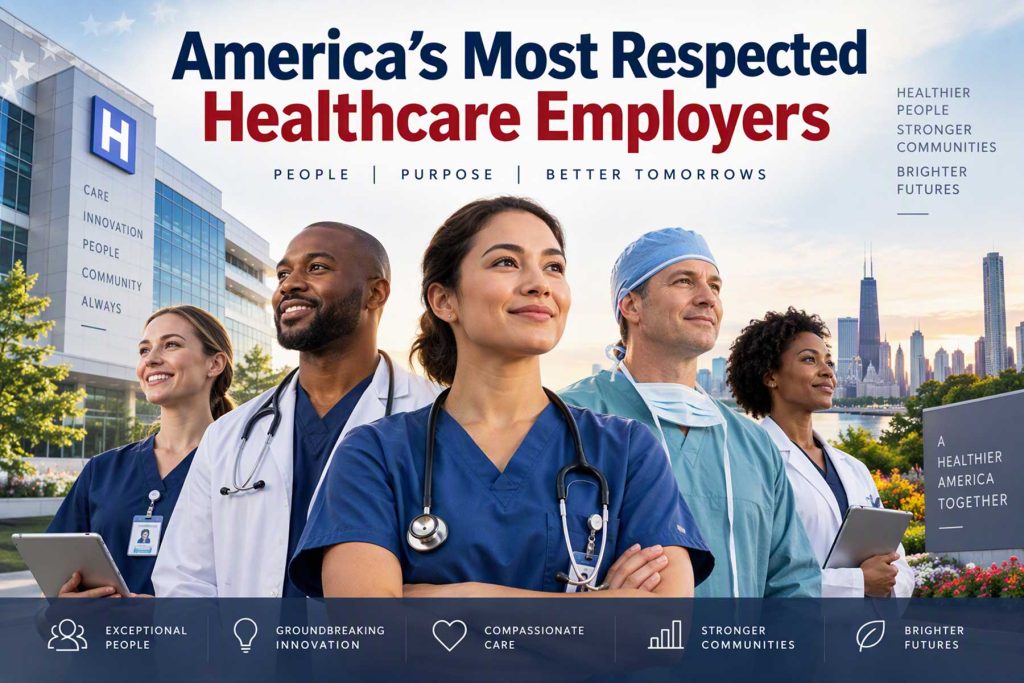
Healthcare remains one of America’s largest employment sectors, but the most respected healthcare employers are competing for far more than clinical talent. Hospitals, health systems, medical research organizations, insurers, and specialized care companies increasingly compete on workplace culture, professional development, flexibility, compensation, employee benefits, and the quality of the environment in which people deliver care.
The scale of the workforce makes employer quality particularly important. The U.S. Bureau of Labor Statistics projects healthcare occupations to grow much faster than the average for all occupations from 2024 through 2034, with about 1.9 million openings projected each year from employment growth and replacement needs. (bls.gov) That sustained demand gives skilled healthcare professionals more opportunities to compare employers rather than simply accept the first available position.
Respect, however, cannot be measured by hospital size or brand recognition alone. A nationally famous medical center may provide exceptional research opportunities but have a demanding work environment. A regional health system may offer stronger employee satisfaction and community relationships. A large insurer may provide extensive career mobility for technology and business professionals that a hospital cannot match. Employer recognition therefore requires several measures to be considered together.
Recent workplace rankings provide useful signals. Fortune and Great Place to Work, Forbes, Newsweek, Becker’s Hospital Review, and healthcare specific organizations regularly evaluate companies and health systems based on employee feedback, workplace practices, professional opportunities, and organizational performance. Those sources repeatedly place organizations such as Mayo Clinic, Cleveland Clinic, Massachusetts General Brigham, Northwestern Medicine, Johns Hopkins Medicine, Kaiser Permanente, MD Anderson Cancer Center, Stanford Health Care, and other major systems among America’s most prominent healthcare employers.
What Makes a Healthcare Employer Respected?
Respect in healthcare employment is built through the employee experience.
For clinicians, that experience can include staffing levels, leadership, scheduling, professional autonomy, continuing education, clinical resources, and opportunities for advancement. For nonclinical employees, technology, management quality, career mobility, workplace flexibility, and organizational purpose can carry greater weight.
A respected employer also needs to operate responsibly. Healthcare workers are entrusted with patients during some of the most vulnerable moments of their lives. An organization that invests in employee development, safety, education, and collaboration is better positioned to create an environment in which high quality care can be delivered consistently.
Reputation has several dimensions
A useful assessment considers at least five areas:
- Workplace culture
- Career development
- Compensation and benefits
- Clinical and research reputation
- Employee satisfaction and retention
No single ranking captures all five.
That is why a combination of workplace surveys, healthcare quality indicators, employee reviews, and organizational data offers a more balanced picture.
Mayo Clinic
Mayo Clinic is one of the strongest examples of an American healthcare organization whose reputation extends from clinical care into employment.
The Rochester, Minnesota based organization operates a large integrated medical practice, research enterprise, and education system. Its scale creates opportunities across medicine, nursing, laboratory science, research, administration, information technology, and numerous specialized fields.
Mayo Clinic has also maintained a powerful reputation among healthcare professionals. Its combination of clinical practice and academic medicine means employees can participate in patient care while working within an environment heavily connected to research and education.
That combination is particularly attractive to professionals who want career development without choosing exclusively between clinical and academic work.
A research driven workplace
Research is one of Mayo Clinic’s defining characteristics.
The Mayo Clinic Research division conducts basic, translational, and clinical research, creating opportunities for scientists and clinicians to work across disciplines. The organization also operates medical education programs that train physicians, residents, fellows, and other healthcare professionals.
For employees who value learning, that academic infrastructure can be as important as salary.
The workplace proposition is therefore broader than employment. It includes access to specialized expertise, research infrastructure, education, and a large professional network.
Cleveland Clinic
Cleveland Clinic has built a similarly strong national reputation while developing a large and diverse employment base.
The Ohio based organization operates hospitals, outpatient facilities, research programs, and medical education initiatives in multiple locations. Its international presence also creates opportunities for employees interested in healthcare delivery across different markets.
Cleveland Clinic has repeatedly appeared in employer and healthcare rankings. Forbes included Cleveland Clinic among its America’s Best Employers in recent years, while its medical reputation has also remained strong across major hospital rankings.
Opportunities beyond bedside care
One reason major academic health systems remain attractive employers is the sheer variety of career paths.
A healthcare organization the size of Cleveland Clinic employs nurses, physicians, pharmacists, imaging professionals, researchers, engineers, analysts, information technology specialists, patient access employees, administrators, and many other professionals.
That breadth can allow employees to change roles without leaving the organization.
For early career professionals, internal mobility can be an important consideration. A first position may provide entry into a much larger career ecosystem.
Massachusetts General Brigham
Massachusetts General Brigham represents one of America’s largest academic medical systems and has a particularly strong presence in Boston’s healthcare and research economy.
The system includes Massachusetts General Hospital, Brigham and Women’s Hospital, and other institutions, creating a broad network of clinical and research opportunities.
Massachusetts General Hospital has consistently appeared among leading American hospitals in national quality rankings. Its academic relationship with Harvard Medical School further strengthens the institution’s position in medical education and research.
Academic medicine as an employer advantage
For physicians, scientists, nurses, and research professionals, an academic medical environment can offer exposure to advanced clinical programs and research.
Employees may have opportunities to participate in clinical studies, medical education, quality improvement, and specialized care.
That combination makes academic systems particularly attractive to professionals who value intellectual development alongside day to day employment.
Johns Hopkins Medicine
Johns Hopkins Medicine has long represented the intersection of healthcare, education, and biomedical research.
Its Baltimore based system includes Johns Hopkins Hospital and a broad network of healthcare facilities. The organization is closely connected to the Johns Hopkins University School of Medicine and a major research enterprise.
The institution’s employer appeal comes partly from this academic ecosystem.
A culture built around learning
Healthcare evolves quickly. New diagnostic techniques, treatment approaches, technologies, and data systems continually reshape clinical practice.
Organizations connected to major research universities can offer employees unusually strong access to that flow of knowledge.
Johns Hopkins is particularly significant for professionals interested in academic medicine, biomedical research, nursing education, public health, and specialized clinical fields.
Its reputation can also benefit employees pursuing long term academic careers.
Northwestern Medicine
Northwestern Medicine has become an important healthcare employer in the Chicago region, combining clinical care with medical education and research.
The organization is closely associated with Northwestern University Feinberg School of Medicine, creating opportunities across patient care, medical education, and scientific research.
Its geographic position also matters.
Chicago is one of America’s largest healthcare markets, and Northwestern Medicine provides access to a broad professional environment involving hospitals, outpatient services, research institutions, universities, and biotechnology organizations.
Career mobility in a large system
Large urban health systems can provide opportunities that smaller organizations cannot easily match.
Employees may move between specialties, facilities, administrative departments, research programs, or technology roles while remaining within the same broader organization.
For professionals who value long term career development, that internal mobility can be an important advantage.
Kaiser Permanente
Kaiser Permanente occupies a different position from traditional academic medical centers.
Its integrated model combines health insurance with healthcare delivery, creating a large organization spanning clinical care, administration, technology, public health, and insurance operations.
This structure produces a broad range of employment opportunities.
Physicians and nurses represent only part of the workforce. Kaiser Permanente also employs data scientists, information technology professionals, pharmacists, care coordinators, health educators, claims specialists, researchers, and administrative professionals.
An integrated employment model
The integrated model can provide employees with exposure to multiple parts of healthcare.
A technology professional, for example, may work on systems that directly influence clinical operations. A care management professional can interact with insurance and provider functions within the same organization.
That integration can make Kaiser Permanente particularly attractive to people interested in the operational side of healthcare.
The organization has also received recognition in workplace rankings, including Fortune’s Best Workplaces in Health Care list.
MD Anderson Cancer Center
MD Anderson Cancer Center has one of the most specialized employment environments in American healthcare.
Based in Houston, Texas, the institution is part of The University of Texas System and focuses heavily on cancer treatment, research, prevention, and education.
Its specialization creates a distinctive workplace.
Professionals working there can collaborate with experts concentrated around oncology rather than practicing across a general hospital environment.
Specialization can accelerate expertise
Highly specialized institutions can be especially valuable for professionals who want deep expertise in a particular field.
Researchers gain access to large clinical populations and specialized laboratories. Physicians can work alongside experts in specific cancer types. Nurses and allied health professionals can develop experience in complex oncology care.
That concentration of expertise is one reason institutions such as MD Anderson remain attractive to ambitious healthcare professionals.
Stanford Health Care
Stanford Health Care combines the resources of a major academic university with a highly developed clinical system in Silicon Valley.
Its relationship with Stanford University creates opportunities across medicine, research, education, and technology.
Location adds another advantage.
The San Francisco Bay Area has one of the world’s strongest concentrations of technology companies and venture capital firms. Healthcare professionals working in the Stanford ecosystem can therefore encounter projects involving artificial intelligence, digital health, medical devices, genomics, robotics, and advanced data systems.
Healthcare meets technology
The convergence of medicine and technology is becoming increasingly important.
Hospitals now depend on electronic health records, imaging systems, remote monitoring, artificial intelligence tools, cybersecurity, data analytics, and digital patient services.
Stanford’s location and research environment place it close to many of these developments.
For employees interested in the future of healthcare technology, this combination can be particularly attractive.
NewYork Presbyterian
NewYork Presbyterian is another major academic health system with a substantial presence in the New York metropolitan region.
The organization is affiliated with Weill Cornell Medicine and Columbia University Vagelos College of Physicians and Surgeons, giving employees access to an extensive academic and clinical ecosystem.
New York’s healthcare market also provides unusual professional density.
Medical institutions, universities, pharmaceutical companies, biotechnology businesses, insurers, technology companies, and public health organizations operate in close proximity.
For professionals interested in moving between healthcare sectors, that environment can create significant networking and career opportunities.
University of Michigan Health
University of Michigan Health has a strong reputation in academic medicine and serves as a major employer in Michigan.
Its connection to the University of Michigan creates opportunities across healthcare delivery, research, education, public health, and biomedical innovation.
Academic medical centers often provide a different employee value proposition from purely commercial healthcare organizations.
Employees can participate in teaching, research, clinical quality improvement, and interdisciplinary programs alongside conventional clinical responsibilities.
That environment can be especially attractive to professionals who want their careers to include education or research.
HCA Healthcare
HCA Healthcare represents another important model.
Unlike university affiliated systems, HCA operates one of the largest networks of hospitals and healthcare facilities in the United States.
Its scale creates employment opportunities across a huge geographic footprint.
Scale creates mobility
Large national healthcare companies can provide a different kind of career advantage.
An employee may have opportunities to relocate between markets, move into management, transition between clinical and administrative roles, or pursue specialized corporate positions.
HCA also operates graduate medical education programs and employs a large number of clinical professionals.
The organization demonstrates that respected healthcare employment does not exist only inside prestigious academic medical centers.
CommonSpirit Health
CommonSpirit Health is another major nonprofit healthcare system with a broad national footprint.
The organization operates hospitals and healthcare facilities across numerous states, creating a diverse workforce and substantial employment base.
Its nonprofit structure places community health among its organizational priorities.
Community mission matters
Healthcare professionals frequently cite purpose as an important component of job satisfaction.
Working for a health system that provides care to underserved communities can provide a strong sense of professional meaning, particularly for people drawn to public health and community medicine.
CommonSpirit’s scale also creates opportunities across clinical, administrative, technology, finance, research, and community health functions.
How America’s Respected Healthcare Employers Compare
| Healthcare employer | Primary strength | Career opportunities | Workplace appeal |
| Mayo Clinic | Clinical care and research | Very broad | Academic and research focused |
| Cleveland Clinic | Specialized medicine | Very broad | Clinical excellence and innovation |
| Massachusetts General Brigham | Academic medicine | Very broad | Research and education |
| Johns Hopkins Medicine | Medicine and research | Very broad | Academic environment |
| Northwestern Medicine | Urban academic healthcare | Broad | Education and clinical practice |
| Kaiser Permanente | Integrated healthcare | Very broad | Healthcare and insurance integration |
| MD Anderson Cancer Center | Oncology | Specialized | Research and cancer care |
| Stanford Health Care | Medicine and technology | Broad | Technology and academic research |
| NewYork Presbyterian | Academic healthcare | Very broad | Major urban medical ecosystem |
| University of Michigan Health | Research and education | Very broad | University environment |
| HCA Healthcare | National healthcare delivery | Extremely broad | Geographic mobility and scale |
| CommonSpirit Health | Community healthcare | Broad | Mission and community focus |
The table illustrates why there is no single definition of an excellent healthcare employer. Academic systems emphasize research and education. Integrated organizations combine insurance and clinical care. Large national operators emphasize geographic reach and career mobility.
Workplace Culture Matters
Healthcare workers face demanding schedules, emotional pressure, and complex responsibilities.
That makes workplace culture especially important.
A supportive manager cannot eliminate the inherent challenges of healthcare work, but strong leadership can influence how employees experience those challenges.
Organizations with clear communication, opportunities for development, recognition programs, employee assistance resources, and mechanisms for reporting workplace concerns are generally better positioned to retain skilled workers.
Employee surveys are useful because they capture experiences that cannot always be inferred from a hospital’s clinical reputation.
A hospital can be among the best in the country for patient care while offering a very different employee experience.
The two measurements should remain separate.
Career Development Is a Major Advantage
Healthcare careers are increasingly specialized.
A registered nurse can develop expertise in critical care, oncology, pediatrics, perioperative services, informatics, leadership, education, or research. A healthcare technology professional can move from IT support into cybersecurity, data engineering, clinical informatics, or artificial intelligence.
Large employers can provide internal pathways for these transitions.
Academic medical centers have an additional advantage because they often combine employment with continuing education, research, residency programs, fellowships, and professional development.
For ambitious professionals, the ability to continue learning without leaving the organization can be more valuable than a small difference in starting salary.
Compensation Is Only Part of the Equation
Salary remains important, particularly in expensive metropolitan areas.
But healthcare professionals typically evaluate total compensation rather than base pay alone.
Health insurance, retirement contributions, paid time off, tuition assistance, professional development funding, parental leave, wellness programs, shift differentials, and bonuses can materially change the value of a job.
Location also changes purchasing power.
A salary that appears generous in one American city may be less attractive in another with substantially higher housing costs.
That is why employer comparisons should account for both compensation and geography.
The Growing Role of Technology
Healthcare employers increasingly compete for technology talent alongside traditional clinical professionals.
Electronic medical records, artificial intelligence, cloud computing, cybersecurity, medical imaging, robotics, telehealth, and data analytics have become central to modern healthcare operations.
This trend creates new career paths inside hospitals and health systems.
Stanford Health Care, Mayo Clinic, Cleveland Clinic, Kaiser Permanente, and other large organizations employ significant technology teams alongside clinical staff.
For technology professionals, healthcare can therefore provide a route into a mission driven industry without requiring a clinical license.
Research Opportunities
Research remains one of the strongest advantages offered by America’s leading academic health systems.
Mayo Clinic, Johns Hopkins Medicine, Massachusetts General Brigham, Stanford Health Care, University of Michigan Health, MD Anderson, and other major institutions maintain significant research programs.
Research experience can be valuable for scientists, physicians, nurses, pharmacists, epidemiologists, data scientists, and other professionals.
It can also create opportunities to work with clinical trial data, biomedical technologies, genomics, artificial intelligence, and translational research.
For people interested in academic careers, research opportunities can significantly influence employer choice.
Why Location Still Matters
Healthcare employment is inherently local.
A prestigious health system may have an outstanding reputation but offer limited opportunities to someone unwilling or unable to relocate.
Regional systems can also have advantages that national rankings do not capture.
A local employer may have stronger community relationships, shorter commuting distances, lower living costs, or more accessible leadership.
States and metropolitan areas also differ in healthcare demand, compensation, union representation, licensing requirements, and labor market conditions.
Consequently, national employer rankings should be used as a starting point rather than a final employment decision.
What Healthcare Professionals Should Evaluate
A respected employer should be evaluated from the perspective of the actual role.
Clinical employees should examine staffing, scheduling, patient volumes, professional development, credentialing support, and opportunities for specialization.
Researchers should examine funding, laboratory infrastructure, publication opportunities, and academic collaboration.
Technology professionals should assess the organization’s digital strategy, data infrastructure, cybersecurity investment, and opportunities to work with clinical teams.
Administrative professionals should examine leadership pathways, internal mobility, benefits, and organizational stability.
The same employer can be an excellent fit for one profession and a poor fit for another.
Healthcare Employment Is Becoming More Diverse
The traditional image of a hospital workforce centered around doctors and nurses no longer reflects the full healthcare economy.
Hospitals and health systems employ cybersecurity specialists, software engineers, data scientists, project managers, supply chain experts, financial analysts, human resources professionals, communications teams, legal specialists, and many other occupations.
The Bureau of Labor Statistics expects healthcare and social assistance to remain one of the fastest growing major employment sectors in the United States over the coming decade. (bls.gov)
That growth means healthcare employers are competing for talent far beyond traditional clinical roles.
Organizations with strong reputations may therefore have an advantage in recruiting specialized professionals.
What the Future Holds for Healthcare Employers
The American healthcare workforce is entering a period of significant change.
An aging population, increased demand for healthcare services, advances in medical technology, workforce shortages, and expanding digital systems are changing the skills healthcare organizations need.
Artificial intelligence will affect documentation, scheduling, research, imaging, analytics, customer service, and many other areas. Robotics and automation will alter certain operational tasks. Remote care will continue to influence how patients interact with health systems.
But technology will not eliminate the importance of people.
Healthcare remains fundamentally dependent on physicians, nurses, technicians, therapists, pharmacists, researchers, administrators, and support staff.
The employers that earn long term respect will be those that use technology to support employees rather than simply increase workloads.
Closing Perspective
America’s most respected healthcare employers represent very different models of working life, from the research intensive environment of Mayo Clinic and Johns Hopkins Medicine to the integrated healthcare structure of Kaiser Permanente, the specialized oncology focus of MD Anderson, the technology rich setting of Stanford Health Care, and the enormous geographic reach of organizations such as HCA Healthcare and CommonSpirit Health. Their common advantage is not simply prestige.
Strong healthcare employers create professional ecosystems in which employees can develop expertise, access education, work alongside experienced colleagues, pursue new career paths, and contribute to meaningful patient outcomes. The projected growth of healthcare employment in the United States makes these qualities increasingly important as organizations compete for skilled workers. (bls.gov) For job seekers, the smartest comparison therefore goes beyond a familiar hospital name.
The more useful questions involve leadership, culture, career development, total compensation, location, workload, research opportunities, technology investment, and the specific experience of the department offering the position. In a healthcare economy where skilled people remain essential, employers that invest seriously in their workforce are likely to remain the organizations that attract and retain the strongest talent.
:::
Frequently Asked Questions
What are the most respected healthcare employers in America?
Mayo Clinic, Cleveland Clinic, Johns Hopkins Medicine, Massachusetts General Brigham, Kaiser Permanente, Stanford Health Care, MD Anderson Cancer Center, Northwestern Medicine, NewYork Presbyterian, and University of Michigan Health are among America’s most prominent healthcare employers. HCA Healthcare and CommonSpirit Health also offer major career opportunities because of their national scale.
Which healthcare employer is best for medical research careers?
Major academic medical centers are particularly strong for research careers. Mayo Clinic, Johns Hopkins Medicine, Massachusetts General Brigham, Stanford Health Care, MD Anderson Cancer Center, and University of Michigan Health maintain extensive research and academic programs.
Is Mayo Clinic a good place to build a healthcare career?
Mayo Clinic offers a broad employment environment spanning clinical care, research, medical education, technology, administration, and specialized healthcare services. Its academic structure can be particularly attractive to professionals interested in continuing education and research.
Which healthcare employers offer opportunities outside clinical jobs?
Large health systems employ professionals in technology, finance, cybersecurity, data analytics, human resources, communications, supply chain management, project management, and administration. Organizations such as Kaiser Permanente, HCA Healthcare, Mayo Clinic, Cleveland Clinic, and major academic medical centers offer extensive nonclinical career paths.
Why are academic medical centers attractive employers?
Academic medical centers combine patient care with education and research. Employees can have access to specialized clinical programs, professional education, scientific research, teaching opportunities, and interdisciplinary collaboration.
Which healthcare employers are known for technology innovation?
Stanford Health Care, Mayo Clinic, Cleveland Clinic, Kaiser Permanente, and other major academic systems have invested heavily in digital health, data infrastructure, artificial intelligence, electronic records, and other healthcare technologies. Technology opportunities vary substantially by department and location.
Does a famous hospital always provide the best workplace?
Not necessarily. Clinical reputation and employee experience are separate measures, and a hospital can excel in patient care while having a different employee experience than its reputation suggests.
What should healthcare professionals look for in an employer?
Important factors include workplace culture, compensation, benefits, scheduling, staffing, career development, leadership, professional education, geographic location, and opportunities for advancement. The priorities should also reflect the specific profession and department.
Are healthcare jobs expected to grow in the United States?
Yes. The Bureau of Labor Statistics projects healthcare occupations to grow much faster than the average for all occupations from 2024 through 2034, with approximately 1.9 million openings expected each year from growth and replacement needs. (bls.gov)
Will artificial intelligence change healthcare employment?
AI is expected to change many healthcare tasks, particularly documentation, analytics, administrative work, research, imaging, and information management. The technology is more likely to reshape specific responsibilities and create new roles than eliminate the need for the broader healthcare workforce.