
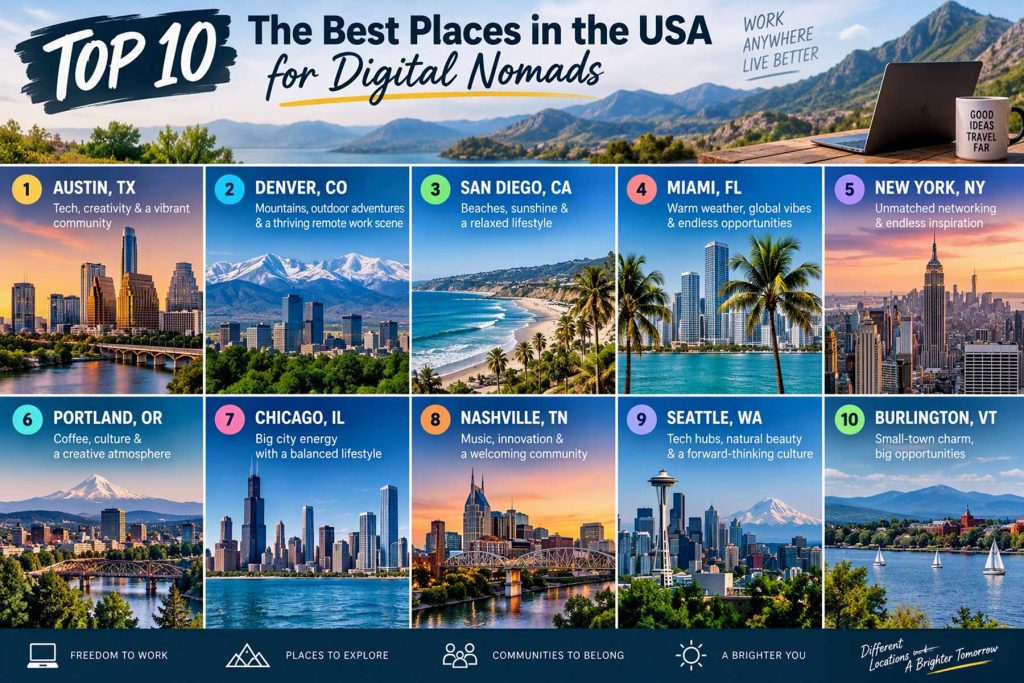
A laptop and a reliable internet connection have changed what a workplace can look like. For many professionals, the office is now a coworking desk in a downtown tower, a quiet coffee shop near the coast, or a furnished apartment overlooking a mountain range. The best USA places for digital nomads are no longer judged simply by how attractive they look on a travel website. Reliable connectivity, housing costs, coworking options, transportation, safety, social opportunities, and quality of life all influence whether a city actually works as a remote base.
The United States offers an unusual range of choices for location independent workers. Major technology centers provide sophisticated infrastructure and professional networks, while smaller cities can offer lower housing costs and a slower pace without sacrificing broadband access. A 2026 ranking of American cities for remote work found Houston and Philadelphia tied for the strongest U.S. positions after evaluating factors including internet speed, coworking availability, accommodation costs, healthcare, and digital security. Other current rankings have placed Las Vegas, El Paso, Chattanooga, Atlanta, and several other cities prominently based on combinations of affordability, connectivity, walkability, coworking, and lifestyle.
There is no universal definition of the perfect digital nomad city. A freelancer trying to reduce monthly expenses may prioritize affordable housing and fast internet, while a startup founder may care more about networking, airport connections, coworking communities, and access to investors. A remote employee may simply want dependable infrastructure, good restaurants, outdoor activities, and a pleasant neighborhood. The destinations below are ranked by their ability to balance these practical and lifestyle considerations while providing a distinctly American experience.
Top 10 USA Places for Digital Nomads
Las Vegas, Nevada
Las Vegas may seem like an unconventional choice for remote professionals, yet its combination of connectivity, entertainment, sunshine, airport access, and relatively competitive costs has pushed it toward the top of several 2026 digital nomad rankings.
One recent 2026 index covering 70 major U.S. cities placed Las Vegas first overall, assigning particular weight to cost of living, internet speed, walkability, weather, safety, coworking availability, coffee culture, airport connectivity, and entertainment. The analysis gave Las Vegas a composite score of 6.39 out of 10.
The city’s greatest advantage is variety. Remote workers can spend weekdays working from a coworking facility or apartment and use evenings for restaurants, shows, fitness, sporting events, or outdoor activities. Red Rock Canyon is close enough to provide an immediate change of scenery when city life becomes repetitive.
Las Vegas also has an important logistical advantage. Harry Reid International Airport provides extensive domestic and international connections, making the city practical for nomads who frequently travel for business or personal reasons.
The main tradeoff is that the city’s tourism oriented environment does not suit everyone. Summer heat can also be severe, and some neighborhoods remain heavily car dependent. Still, for digital nomads who value connectivity, entertainment, airport access, and sunshine, Las Vegas offers an unusually strong combination.
El Paso, Texas
El Paso is one of the most interesting options for digital nomads who want American city infrastructure without the housing costs associated with many larger technology centers.
A 2026 digital nomad index ranked El Paso second among 70 U.S. cities. The same analysis identified it as the least expensive mainland city in its top group, with an average one bedroom rent of about $800 and a cost of living approximately 12 percent below the national average. It also reported average internet speeds of about 178 Mbps.
Those numbers give El Paso an important advantage. A remote worker earning a salary tied to a higher cost market can potentially stretch income considerably further than in cities such as San Francisco, New York, or Miami.
El Paso also offers a distinctive cultural environment shaped by its location on the U.S. Mexico border. Mexican and Southwestern influences are deeply visible in the city’s food, architecture, festivals, and everyday culture.
Outdoor access adds another dimension. Franklin Mountains State Park sits within the city, giving residents direct access to hiking, climbing, and desert scenery.
The city has fewer coworking and entertainment options than larger technology centers, which is an important consideration for highly social nomads. For independent workers who care more about affordability, broadband, sunshine, and outdoor access, however, El Paso can be exceptionally practical.
Chattanooga, Tennessee
Chattanooga demonstrates why smaller American cities deserve attention from location independent professionals.
The city has developed an unusually strong reputation for internet infrastructure because of EPB’s municipal fiber network. A 2026 digital nomad ranking reported average internet speeds of 186.4 Mbps in its dataset, the fastest among the cities included in that particular top group. The same analysis placed Chattanooga’s cost of living about 11 percent below the national average.
That combination is powerful for remote workers. Reliable broadband is not an optional convenience when a career depends on video meetings, cloud platforms, large file transfers, online collaboration, and constant communication.
Chattanooga also provides a lifestyle that contrasts sharply with America’s largest metropolitan areas. The Tennessee River runs through the city, while Lookout Mountain and surrounding outdoor areas provide opportunities for hiking, cycling, climbing, and scenic recreation.
Downtown Chattanooga is compact enough to make many daily activities manageable without the overwhelming scale of a major metropolitan area. The city also has a growing collection of coffee shops, breweries, restaurants, creative businesses, and coworking environments.
For digital nomads who want strong internet without living in a high cost technology hub, Chattanooga may be one of America’s most compelling alternatives.
Houston, Texas
Houston offers something that many smaller digital nomad destinations cannot match: metropolitan scale.
A 2026 remote work study identified Houston as one of the strongest U.S. cities overall, tying Philadelphia for the highest American score in the study’s comparison of 16 North American World Cup host cities. The analysis considered internet speed, coworking availability, accommodation costs, healthcare, and digital security.
The city’s size creates a deep professional ecosystem. Houston has major industries spanning energy, healthcare, aerospace, technology, logistics, manufacturing, and finance. For digital nomads who want opportunities for networking or consulting work, that diversity can be valuable.
Housing costs can also compare favorably with other major American cities, although prices vary substantially by neighborhood. The metropolitan area offers an enormous selection of restaurants, international communities, shopping districts, cultural institutions, sports, and entertainment.
Houston’s biggest disadvantage is transportation. The metropolitan area is sprawling, and many daily activities are easier with a car. Summer heat and humidity can also be challenging for people accustomed to milder climates.
Still, the combination of professional depth, airport connectivity, cultural diversity, and relatively broad housing options makes Houston a strong base for digital professionals.
Philadelphia, Pennsylvania
Philadelphia combines one of America’s largest urban environments with a cost profile that can be more approachable than New York City.
The city tied Houston for the top U.S. position in the 2026 remote work analysis cited earlier, which assessed internet, coworking, accommodation, healthcare, and digital security among other factors.
Its greatest advantage for digital nomads is urban convenience. Center City, University City, Old City, Rittenhouse, and surrounding neighborhoods offer restaurants, cafes, cultural attractions, parks, offices, transit connections, and residential options within a relatively compact metropolitan core.
Philadelphia is also one of the strongest cities in the United States for rail connectivity. Amtrak provides connections to New York, Washington, Boston, and other major destinations, while the city’s airport provides domestic and international flights.
The city’s history is another benefit for nomads who prefer cultural depth. Museums, historic neighborhoods, food markets, sports, music venues, and major universities provide a broad social environment.
Philadelphia is not the cheapest city on this list, and some neighborhoods differ considerably in cost and convenience. Yet for a nomad who wants walkability, culture, transit, professional networks, and big city amenities without New York prices, it deserves serious consideration.
Atlanta, Georgia
Atlanta combines a large professional economy with a strong airport network and a substantial remote work community.
A 2025 ranking cited by Quartz placed Atlanta first among U.S. cities evaluated for remote work, based on factors including coworking density, the share of residents working remotely, cost of living, connectivity, entertainment, and airport access. The analysis reported that 25.6 percent of Atlanta residents worked remotely and that the city had the highest coworking density in that ranking.
The city’s professional ecosystem is particularly valuable. Atlanta has major concentrations in technology, media, finance, logistics, healthcare, entertainment, and corporate services.
Hartsfield Jackson Atlanta International Airport is another major advantage. Its extensive route network makes Atlanta especially practical for digital nomads who need to travel regularly.
The city also provides a diverse neighborhood experience. Midtown, Old Fourth Ward, Buckhead, East Atlanta, and other areas offer different combinations of restaurants, parks, nightlife, apartments, and coworking options.
Atlanta’s sprawling geography remains the principal challenge. A nomad who chooses the wrong neighborhood can spend considerable time commuting. Choosing a location close to preferred workspaces and daily amenities can make a substantial difference.
Austin, Texas
Austin remains one of America’s most recognizable remote work and technology centers, even though rising housing costs have reduced some of its former affordability advantage.
The city has a strong technology ecosystem, extensive coworking infrastructure, major startup activity, live music, restaurants, outdoor recreation, and a large population of entrepreneurs and remote professionals.
A 2026 digital nomad index placed Austin tenth among the 70 cities it assessed. The analysis noted that Austin’s average one bedroom rent was approximately $1,450 and that its cost of living had risen to about 3 percent above the national average. It also identified Austin as having the strongest coworking density among the cities in that study.
That combination explains Austin’s position. It remains excellent for networking and professional community, but it is no longer the bargain it once appeared to be.
Lady Bird Lake, Barton Springs, Zilker Park, and the city’s extensive food and music scene provide plenty to do outside working hours.
For digital nomads who prioritize community, technology, entrepreneurship, and social opportunities, Austin remains one of the country’s strongest choices. For those primarily seeking the lowest possible living costs, other destinations on this list may provide better value.
Miami, Florida
Miami offers one of the strongest lifestyle propositions for digital nomads in the United States.
The city combines beaches, international culture, warm weather, restaurants, nightlife, entrepreneurship, and strong air connections. Its Latin American and Caribbean influences also give Miami a genuinely international atmosphere that can appeal to professionals accustomed to moving between countries.
Miami’s airport is particularly important for nomads who travel frequently. The city’s geographic position makes it a major gateway between the United States, Latin America, and the Caribbean.
The tradeoff is cost. Miami is not an inexpensive destination, particularly in neighborhoods that are popular with professionals and visitors. The same 2026 ranking that included Miami among the stronger remote work cities identified its cost profile as one of the factors preventing it from ranking with the most affordable American locations.
Miami works best for digital nomads who place a high value on climate, international connectivity, social life, and lifestyle. It is less attractive for someone whose primary objective is minimizing monthly expenses.
Denver, Colorado
Denver provides an appealing balance between urban amenities and immediate access to outdoor recreation.
The city has a strong technology and professional economy, extensive coffee culture, coworking options, restaurants, breweries, and a large population of young professionals. More importantly for many digital nomads, the Rocky Mountains are close enough to shape everyday life rather than merely serve as an occasional vacation destination.
Remote workers can spend weekdays working from downtown or a neighborhood coworking space and use evenings or weekends for hiking, cycling, skiing, climbing, or mountain trips depending on the season.
The cost side is less favorable. Denver is considerably more expensive than cities such as El Paso or Chattanooga, and housing can consume a substantial portion of a remote worker’s budget.
The payoff is lifestyle variety. Someone who wants an active outdoor life while retaining access to a sophisticated American city may consider Denver worth the additional expense.
San Diego, California
San Diego rounds out the list because it provides one of the strongest combinations of remote work infrastructure and outdoor lifestyle in America.
The city has beaches, parks, hiking areas, restaurants, coffee shops, coworking spaces, and a large professional population. La Jolla, North Park, Little Italy, Downtown, and other neighborhoods offer distinctly different environments for remote workers.
San Diego also benefits from strong regional connectivity. The city is close to Mexico, has an international airport, and offers a broad selection of neighborhoods suitable for different lifestyles.
The biggest limitation is cost. Housing and everyday expenses can be considerably higher than in the lower cost cities on this list.
For digital nomads with sufficient income, however, San Diego offers something difficult to replicate elsewhere: a major American city where beach access, outdoor recreation, professional opportunities, and mild weather can all become part of everyday life.
USA Digital Nomad Destinations Compared
The differences between these cities become clearer when the major considerations are placed side by side.
| Rank | City | Main Strength | Lifestyle Advantage | Main Tradeoff |
| 1 | Las Vegas | Connectivity and value | Entertainment and sunshine | Extreme summer heat |
| 2 | El Paso | Affordability | Mountains and Southwestern culture | Smaller professional scene |
| 3 | Chattanooga | Internet infrastructure | Outdoor recreation | Smaller metro area |
| 4 | Houston | Professional ecosystem | Diversity and dining | Car dependence |
| 5 | Philadelphia | Urban convenience | Walkability and culture | Neighborhood cost differences |
| 6 | Atlanta | Coworking and connectivity | Business and nightlife | Sprawling geography |
| 7 | Austin | Remote work community | Technology and live music | Rising costs |
| 8 | Miami | Lifestyle and international access | Beaches and global culture | High housing costs |
| 9 | Denver | Outdoor lifestyle | Mountains and recreation | Housing costs |
| 10 | San Diego | Overall lifestyle | Beaches and outdoor activities | Very high housing costs |
The table highlights an important point. There is no single metric that determines whether a city is suitable for digital nomads. A city can have excellent internet but limited social opportunities, affordable housing but weak transportation, or outstanding lifestyle benefits but very high rent.
What Digital Nomads Should Look for in a USA City
Reliable internet comes first
Remote work becomes fragile when connectivity is inconsistent. Video meetings, cloud applications, digital payments, file transfers, and collaboration platforms all depend on stable broadband.
Chattanooga is a particularly notable example because of its municipal fiber network. Current 2026 rankings have repeatedly highlighted the city’s connectivity as a major advantage.
The practical lesson is simple. Nomads should evaluate actual internet reliability in the specific neighborhood and accommodation rather than assuming that a citywide broadband statistic guarantees a good connection everywhere.
Coworking spaces provide more than desks
A coworking space can function as a professional environment, networking venue, meeting location, and social community.
Austin, Atlanta, Houston, and Philadelphia are particularly attractive for nomads who want a broad selection of workspaces. Current remote work research has increasingly included coworking density as a key factor when comparing American cities.
For someone staying only a few weeks, flexible memberships and day passes may be more useful than long term memberships.
Housing can determine the real cost
A city with inexpensive restaurants does not necessarily provide an affordable nomad lifestyle if furnished housing is expensive.
Short term accommodation can cost considerably more than a standard annual apartment lease, so digital nomads need to distinguish between published rent figures and the actual price of furnished, flexible housing.
This is one reason El Paso and Chattanooga stand out. Lower general living costs can create more room in a remote worker’s budget even before lifestyle spending is considered.
Transportation affects daily productivity
A city may appear attractive until transportation consumes two hours every day.
Philadelphia’s urban transit and Atlanta’s airport connectivity solve different problems. San Diego and Denver provide extensive lifestyle options but can require more planning depending on neighborhood. Houston and Austin can be much easier with a car.
The best neighborhood is often more important than the city itself. Staying close to coworking facilities, groceries, restaurants, parks, and public transportation can dramatically reduce daily friction.
Best USA Destinations for Different Types of Digital Nomads
Best for affordability
El Paso and Chattanooga stand out when controlling monthly expenses is the priority. Both combine lower costs with useful internet infrastructure and access to outdoor recreation.
Best for networking
Austin, Atlanta, Houston, and Philadelphia provide larger professional ecosystems and stronger opportunities for meeting entrepreneurs, companies, freelancers, and other remote professionals.
Best for outdoor living
Denver, San Diego, Chattanooga, and Las Vegas offer strong access to outdoor experiences. Each provides a different environment, from Rocky Mountain terrain to beaches and desert landscapes.
Best for international travel
Miami, Atlanta, Houston, and Las Vegas are especially useful for nomads who expect to travel frequently. Major airports can make a meaningful difference when international or domestic flights are part of normal life.
Best for city life
Philadelphia, Atlanta, Austin, and Houston provide the strongest combination of restaurants, entertainment, professional opportunities, cultural institutions, and large metropolitan amenities.
Is the USA Affordable for Digital Nomads?
The United States is generally not considered a low cost digital nomad destination when compared with popular international bases in Southeast Asia, Latin America, or Eastern Europe. Current global rankings frequently place cities such as Chiang Mai, Medellín, and several Southeast Asian destinations substantially below American cities in monthly cost.
That does not make the USA unsuitable.
For professionals earning U.S. salaries, the country can provide advantages that cheaper destinations cannot always replicate. Familiar financial systems, strong healthcare infrastructure, extensive domestic transportation, professional networks, high quality coworking spaces, and access to the world’s largest economy can all have practical value.
The more useful comparison is therefore not simply rent versus rent. A digital nomad should consider income, housing, internet, transportation, workspace, food, entertainment, taxes, insurance, and travel costs together.
The Future of Digital Nomad Life in America
The American digital nomad market is becoming more nuanced. Early remote work discussions often focused on famous technology cities or highly desirable lifestyle destinations. Current rankings suggest a broader pattern.
Affordable cities with strong internet are receiving greater attention. Chattanooga and El Paso are examples of locations that may have been overlooked by traditional technology focused relocation discussions but perform well when infrastructure and cost are measured together.
At the other end of the spectrum, cities such as Austin, Miami, Denver, and San Diego continue to attract remote professionals despite higher costs because their communities and lifestyles provide benefits that cannot be reduced to rent.
The result is a more fragmented market. Instead of one dominant American digital nomad city, different cities are likely to appeal to different types of workers.
Closing Perspective
The best places in the USA for digital nomads are not necessarily the cities with the biggest technology reputations or the most impressive skylines. The strongest destinations are the ones that make remote work practical while also providing a satisfying life away from the screen. Las Vegas combines connectivity and entertainment, El Paso emphasizes affordability, Chattanooga stands out for broadband infrastructure, Houston and Philadelphia offer professional depth, Atlanta provides strong coworking and airport access, Austin delivers community, Miami brings international energy, Denver connects city life with mountains, and San Diego combines remote work with an exceptional coastal lifestyle. The right choice ultimately depends on the relationship between income, housing, connectivity, community, transportation, and personal priorities. For digital nomads, the real advantage of choosing carefully is not simply having a different place to work. It is creating a daily environment in which productive work and a rewarding life can coexist.
FAQ
What are the best places in the USA for digital nomads?
Las Vegas, El Paso, Chattanooga, Houston, Philadelphia, Atlanta, Austin, Miami, Denver, and San Diego are among the strongest choices in 2026. They differ considerably in cost, lifestyle, connectivity, professional opportunities, and transportation, so the best option depends on individual priorities.
What is the cheapest USA city for digital nomads?
El Paso is one of the strongest low cost options among major American cities. A 2026 digital nomad index reported average one bedroom rent of about $800 and a cost of living approximately 12 percent below the national average in its analysis.
Which USA city has the best internet for remote workers?
Chattanooga is particularly notable because its municipal fiber network has helped make the city a standout for high speed broadband. A 2026 ranking reported average internet speeds of approximately 186.4 Mbps in its dataset.
Is Austin still good for digital nomads?
Austin remains a strong choice for digital nomads who prioritize technology, coworking, entrepreneurship, live music, restaurants, and professional networking. Its main disadvantage is rising cost, which has reduced its affordability compared with earlier years.
What is the best USA city for digital nomads who love the outdoors?
Denver, San Diego, Chattanooga, and Las Vegas are strong options for outdoor focused remote workers. Denver provides mountain access, San Diego offers beaches and coastal recreation, Chattanooga has rivers and mountains, and Las Vegas provides access to desert landscapes.
Which USA cities have the best coworking communities?
Austin, Atlanta, Houston, Philadelphia, and other major metropolitan areas generally offer broader coworking choices than smaller cities. Atlanta ranked particularly well in a remote work comparison that considered coworking density.
Is Miami a good place for digital nomads?
Miami can be excellent for digital nomads who value warm weather, beaches, international connections, nightlife, and multicultural communities. Its primary disadvantage is housing and overall living cost, which can be considerably higher than lower cost cities such as El Paso.
Can digital nomads live in the USA without a traditional office job?
Remote professionals can live and work from different U.S. locations depending on their employment arrangement, tax situation, immigration status, and employer policies. Legal and tax requirements vary by individual circumstances, so those issues should be evaluated through appropriate official or professional sources.
What should digital nomads check before renting a place in the USA?
Internet reliability, furnished housing terms, workspace availability, transportation, neighborhood safety, proximity to groceries and restaurants, and total monthly cost are important considerations. Checking the actual property and neighborhood rather than relying only on citywide averages can prevent expensive surprises.
Is the USA good for long term digital nomad living?
The USA can work well for long term remote living when income comfortably supports housing and other expenses. Its advantages include strong infrastructure, professional networks, domestic travel opportunities, and diverse lifestyles, although costs can be significantly higher than in many international digital nomad destinations.

