
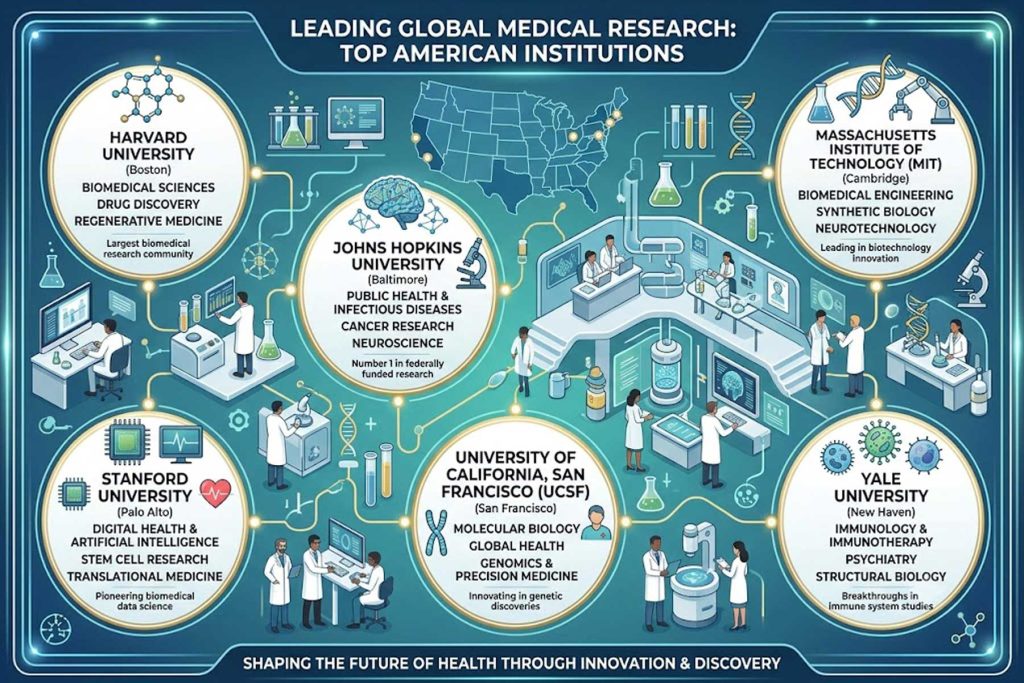
Modern medical research rarely stops at a hospital campus or national border. A clinical trial conducted in Boston can influence treatment protocols thousands of miles away, while research partnerships in Africa, Asia, Latin America, and Europe can generate evidence that changes how diseases are prevented, diagnosed, and treated. American medical institutions occupy a particularly important position in this international research system because of their combination of academic medicine, laboratory science, clinical trial infrastructure, research funding, and partnerships with institutions abroad.
The scale of the American research system helps explain that influence. The National Institutes of Health, the largest public funder of biomedical research in the world, invests nearly $48 billion in medical research and distributes most of its funding through competitive grants to researchers at universities, medical schools, and other institutions. NIH reported that nearly 82 percent of its funding supports extramural research, reaching more than 2,500 institutions across the United States.
The institutions leading global research do not all follow the same model. Some combine enormous clinical research enterprises with laboratory science. Others have built dedicated global health institutes with projects spanning dozens of countries. The 10 institutions below stand out for the scale of their research operations, international partnerships, clinical study infrastructure, or sustained involvement in major global health challenges.
How the Institutions Were Compared
The comparison considers several factors rather than a single funding figure. Research scale, clinical trial activity, international research partnerships, geographic reach, global health infrastructure, interdisciplinary capacity, and evidence of sustained research activity were considered when developing the list.
NIH funding provides useful context, but it does not provide a complete measure of global research influence. NIH explicitly warns that institutional funding totals can vary depending on how awards are grouped across schools, departments, and principal investigators.
Top 10 American Medical Institutions Leading Global Research
1 Johns Hopkins Medicine
Johns Hopkins Medicine combines one of the country’s most substantial academic medical research enterprises with a long history of basic, clinical, and translational science. The Department of Medicine alone reported more than 400 grants totaling over $150 million in a recent year and consistently ranks among leading departments in NIH funding.
Its research structure extends across laboratory science, clinical trials, disease prevention, diagnostics, and treatment. Johns Hopkins describes clinical research as an important component of improving care for communities in the United States and around the world.
The institution’s international influence also extends through public health, infectious disease research, epidemiology, health systems research, and training. That combination gives Johns Hopkins an unusually broad connection between scientific research and global health practice.
2 Mass General Brigham
Mass General Brigham represents a major hospital based research enterprise built around Massachusetts General Hospital, Brigham and Women’s Hospital, and other academic and specialty institutions.
The system reports an annual research budget exceeding $2.7 billion and more than 3,700 ongoing clinical trials. Researchers work across major therapeutic and technology disciplines, creating a research environment that connects laboratory science with patient care.
Its international work includes partnerships with governments, research centers, hospitals, industry organizations, and communities around the world. Mass General Brigham states that its international activities include research, teaching, innovation, and collaboration aimed at strengthening health systems and clinical capabilities.
The scale of its clinical research operation is particularly important. Large numbers of active trials create opportunities to test new approaches across different diseases and patient populations while connecting academic research with real world medical care.
3 Harvard Medical School
Harvard Medical School operates within one of the largest academic medical research ecosystems in the United States. Its research community includes approximately 12,000 faculty members and 1,600 medical and graduate students across its Boston campus and 15 affiliated hospitals.
That network gives Harvard an unusually broad research base. Basic scientists, clinicians, epidemiologists, public health researchers, and specialists work across institutions connected to the medical school.
Harvard’s global reach is also supported by the Harvard Global Health Institute and the Harvard T.H. Chan School of Public Health. The Global Health Institute facilitates interdisciplinary research and partnerships with organizations and communities around the world, while Harvard public health researchers work across numerous countries on subjects ranging from infectious disease to nutrition and health equity.
This combination of medical research, public health, and international collaboration makes Harvard a major contributor to global health research.
4 University of California, San Francisco
UC San Francisco has developed an international research footprint that is particularly strong in infectious diseases, cancer, malaria, tuberculosis, HIV, emergency medicine, tobacco research, and other major health areas.
UCSF reports that more than 600 investigators from across its schools conduct projects in more than 190 countries. Its Institute for Global Health Sciences coordinates much of this international activity and works with partners to address disease burdens affecting vulnerable populations.
The institution also maintains registered global program offices in countries including Kenya, Mozambique, Namibia, Tanzania, and Uganda. These offices provide operational infrastructure for research projects and help researchers manage regulatory, financial, staffing, and partnership requirements in different national settings.
That operational presence is significant because global research requires more than scientific expertise. Successful international studies often depend on long term relationships, local research capacity, regulatory knowledge, and reliable project infrastructure.
5 Stanford Medicine
Stanford Medicine combines high intensity biomedical research with a dedicated global health research infrastructure. The Stanford Center for Innovation in Global Health reports more than 400 active global health projects reaching more than 40 countries. It also reports 294 faculty and postdoctoral affiliates involved in global health research, education, and impact.
Stanford’s research portfolio spans medicine, engineering, data science, public health, environmental health, and other disciplines. Its global health seed grant program supports scientific and clinical research, implementation science, health care innovation, and research partnerships with international collaborators.
The seed grant program has awarded 161 grants since 2012, with reported follow on funding of $12.5 million between 2016 and 2024. Stanford also reports that 37 percent of the grants generated a new technology, innovation, or patent.
The model demonstrates how relatively targeted research funding can help turn early stage ideas into larger international research projects.
6 University of Washington
The University of Washington has one of the most geographically extensive global health research networks among American academic medical institutions.
UW’s Department of Global Health currently reports approximately 230 projects involving 127 countries, with more than 300 faculty connected to its global health activity. Its research spans infectious diseases, maternal and child health, health systems, implementation science, environmental health, health technologies, epidemiology, and other fields.
The geographic breadth is particularly notable. Research activity extends across low and middle income countries as well as other international settings, often through long term partnerships.
UW also reports more than 175 active global agreements across more than 45 countries involving international universities, government agencies, and nonprofit organizations.
This partnership infrastructure helps connect research with local institutions rather than treating international research as a series of isolated projects.
7 Duke University
Duke University has built a major global health research enterprise through the Duke Global Health Institute. Established in 2006, the institute was created to bring together research, education, policy, and international partnerships across the university.
Duke reports 204 research projects supported by external grants during the 2024 to 2025 period, with total annual funding exceeding $45.5 million. Its faculty, staff, and students were engaged in projects and partnerships across 49 countries.
The institute focuses on research addressing health equity, vulnerable populations, disease prevention, health systems, and evidence based interventions. Its model combines scientific investigation with international partnerships and implementation.
That structure gives Duke a distinctive position between academic research and practical global health programs. Research findings can be developed alongside policy and implementation work, allowing evidence to be tested in different health systems and communities.
8 Mayo Clinic
Mayo Clinic’s global research influence is closely connected to its integrated model of clinical practice, research, and education. The institution reports approximately 12,000 studies underway at any given time across its research enterprise.
Its clinical research operation is especially significant. Mayo reports that physicians and scientists conduct thousands of clinical trials each year, with studies addressing serious and complex medical conditions.
International collaboration is another important component. Mayo states that its Care Network connects independent health care providers with Mayo’s clinical, educational, research, and operational knowledge. Network relationships extend across multiple countries and allow medical institutions abroad to collaborate with Mayo specialists.
Mayo also reports more than 4,700 physicians and scientists and international patients arriving from more than 130 countries each year. While patient reach is not itself a measure of research influence, the international flow of patients and specialists creates additional opportunities for knowledge exchange and collaboration.
9 Cleveland Clinic
Cleveland Clinic has developed a large research enterprise covering basic, translational, computational, clinical, and implementation science.
Its research infrastructure includes specialized laboratories, clinical research programs, biorepositories, and research centers focused on areas such as cardiovascular genomics and precision medicine. Cleveland Clinic reports more than 3,200 active research projects and approximately $479 million in total research funding.
Its international research footprint is also distinctive because research activities connect with Cleveland Clinic’s broader global health system. The institution states that research extends across locations in Northeast Ohio, Florida, London, Las Vegas, Toronto, and Abu Dhabi.
A major recent initiative is the Global Center for Pathogen & Human Health Research, created to study pandemic threats and develop diagnostics, vaccines, treatments, and related technologies. Cleveland Clinic describes the center as a $500 million initiative involving the institution and the state of Ohio.
The center illustrates how medical research institutions are increasingly building infrastructure around threats that cross national borders.
10 University of Pennsylvania
The University of Pennsylvania combines a large research university with an academic medical system and dedicated global health programs. Penn reported a $1.33 billion university research budget for 2026, more than 6,000 research faculty, and 209 research centers and institutes across the university.
At the Perelman School of Medicine, the Center for Global Health supports international research, education, partnerships, and training. Penn’s global health network includes scholars and research affiliates working across international settings.
Penn has also expanded its global cancer research efforts. The Penn Center for Global Oncology was established to address the growing worldwide cancer burden through research, education, capacity strengthening, and international partnerships.
The combination of biomedical research, global health programs, and specialized initiatives gives Penn a broad platform for international medical research.
American Medical Research at a Glance
| Rank | Medical institution | Major research strength | Documented global reach |
| 1 | Johns Hopkins Medicine | Biomedical and clinical research | International medical and public health research |
| 2 | Mass General Brigham | Clinical trials and biomedical research | Global clinical and research partnerships |
| 3 | Harvard Medical School | Basic, clinical, and public health research | Research and partnerships across many countries |
| 4 | UCSF | Infectious disease and global health | More than 190 countries |
| 5 | Stanford Medicine | Interdisciplinary global health research | 400 plus projects in more than 40 countries |
| 6 | University of Washington | Global health and implementation science | 127 countries |
| 7 | Duke University | Global health research and implementation | 49 countries |
| 8 | Mayo Clinic | Clinical research and translational medicine | International research and clinical network |
| 9 | Cleveland Clinic | Translational and clinical research | Research across multiple international locations |
| 10 | University of Pennsylvania | Biomedical and global health research | International research and partnerships |
Why Global Medical Research Requires More Than Funding
Financial resources are important, but research conducted across borders depends on a much larger infrastructure. International studies can involve different regulatory systems, languages, health care structures, disease patterns, laboratory capabilities, and research priorities.
Long term institutional partnerships can reduce those barriers. Local researchers bring knowledge of communities, health systems, disease patterns, cultural practices, and national regulations. American institutions can contribute specialized laboratory capabilities, clinical trial expertise, research funding, data systems, and training.
The University of Washington’s international agreements, UCSF’s country offices, and Duke’s network of research partnerships illustrate different approaches to building this infrastructure.
The Research Areas Shaping Global Health
Several research areas connect many of these institutions. Infectious diseases remain a major focus, particularly tuberculosis, HIV, malaria, emerging pathogens, and antimicrobial resistance. Cancer, cardiovascular disease, neurological disorders, maternal health, environmental health, and health system performance are also major research priorities.
Pandemic preparedness has added another dimension. Cleveland Clinic’s pathogen research center is one example of institutions building dedicated infrastructure around emerging infectious threats. Stanford’s global health programs also incorporate planetary health, climate related risks, and vulnerable populations into their research portfolio.
Artificial intelligence and computational medicine are creating another area of international collaboration. Large medical institutions increasingly have access to extensive clinical datasets, specialized computing infrastructure, and multidisciplinary research teams. The resulting work can influence diagnostics, drug development, medical imaging, disease prediction, and clinical decision support.
What Makes These Institutions Globally Significant
Global research influence cannot be reduced to a single statistic. A large research budget can support thousands of studies, but geographic reach, partnership quality, scientific specialization, clinical trial capacity, and the ability to translate findings into health practice also matter.
The institutions in this list demonstrate several distinct models. Johns Hopkins and Harvard combine broad academic medical research with global health expertise. UCSF and the University of Washington have particularly extensive international project networks. Stanford uses interdisciplinary research and seed funding to build global projects. Duke has integrated research with international implementation and partnerships. Mayo Clinic and Cleveland Clinic connect large clinical enterprises with international collaboration, while Penn combines a major research university with specialized global health initiatives.
That variety matters because global health problems rarely fit neatly within one scientific discipline. A disease outbreak may require epidemiology, laboratory science, clinical medicine, data analysis, public policy, logistics, and community engagement at the same time.
The Future of American Medical Research Abroad
The next phase of global medical research is likely to depend increasingly on collaboration rather than institutional isolation. Large academic medical centers possess sophisticated research infrastructure, but international partners provide essential knowledge about local disease patterns, health systems, patient populations, and implementation conditions.
Data intensive medicine is likely to strengthen this relationship. International research networks can generate larger and more diverse datasets, while modern computational tools can help researchers analyze information across institutions and populations. At the same time, equitable partnerships will remain important because research quality depends on meaningful participation from the communities and institutions where studies take place.
The leading American medical institutions are therefore not defined only by the number of laboratories, grants, or clinical trials they operate. Their broader significance comes from the ability to connect scientific expertise with clinical evidence, international partnerships, local research capacity, and practical health needs. As diseases, environmental risks, and health systems become increasingly interconnected, institutions capable of sustaining those connections will remain central to medical research with worldwide implications.
FAQ
Which American medical institutions conduct the most global research?
Major American institutions involved in global medical research include Johns Hopkins Medicine, Mass General Brigham, Harvard Medical School, UCSF, Stanford Medicine, the University of Washington, Duke University, Mayo Clinic, Cleveland Clinic, and the University of Pennsylvania. Their research portfolios differ substantially in scientific focus and geographic reach.
Why is Johns Hopkins important to medical research?
Johns Hopkins has extensive basic, clinical, and translational research programs. Its Department of Medicine alone reports hundreds of grants and more than $150 million in funding in a recent year.
Which U.S. medical institution has research projects in the most countries?
The University of Washington’s Department of Global Health currently reports projects and faculty activity across 127 countries. UCSF also has an extensive international footprint, with more than 600 investigators conducting projects in more than 190 countries.
How much does Mass General Brigham spend on research?
Mass General Brigham reports an annual research budget exceeding $2.7 billion. The system also reports more than 3,700 ongoing clinical trials across its research enterprise.
Does Harvard conduct medical research outside the United States?
Yes. Harvard’s global health programs support research and partnerships involving organizations and communities around the world. Harvard public health researchers work across numerous countries on infectious diseases, nutrition, health equity, and other global health issues.
What type of global research does UCSF conduct?
UCSF has international research activity involving HIV/AIDS, malaria, tuberculosis, tobacco use, emergency medicine, cancer, and other health areas. Its Institute for Global Health Sciences coordinates research and partnerships across numerous countries.
How many countries does Stanford global health research reach?
Stanford’s Center for Innovation in Global Health reports more than 400 active global health projects reaching more than 40 countries. The center supports interdisciplinary research, international partnerships, training, and global health education.
What makes global medical research different from U.S. research?
Global research must account for differences in health systems, disease patterns, regulations, languages, infrastructure, and population characteristics. Strong international research programs therefore depend on local partnerships and long term collaboration in addition to scientific resources.
Which American medical institutions conduct major clinical trials?
Many leading academic medical institutions conduct large clinical research programs. Mass General Brigham reports more than 3,700 ongoing clinical trials, while Mayo Clinic states that its physicians and scientists conduct thousands of clinical trials each year.
Why do American medical institutions collaborate with international researchers?
International partnerships allow researchers to study diseases across different populations and health systems while building local research capacity. They can also provide access to specialized expertise, diverse patient populations, clinical settings, and locally relevant health data.