For decades, Silicon Valley represented the clearest image of American technology. San Francisco, Palo Alto, and nearby communities became synonymous with venture capital, software companies, startups, and ambitious founders. That picture still reflects a substantial part of the American technology economy, but it no longer tells the whole story. Technology is spreading across a much broader collection of American cities, each developing a distinctive combination of talent, capital, universities, infrastructure, corporations, and specialized industries.
The shift is especially visible in artificial intelligence. According to CBRE’s 2026 Scoring Tech Talent report, the U.S. and Canadian technology workforce with AI skills grew 45 percent during the previous year, reaching 751,000 workers by June 2026. Thirty seven percent of AI related jobs in the United States are concentrated in the San Francisco Bay Area, New York City, Seattle, and Washington, D.C. The concentration demonstrates that technology remains highly clustered, but it also shows that several major urban centers are now competing for the same strategic resource: specialized technology talent.
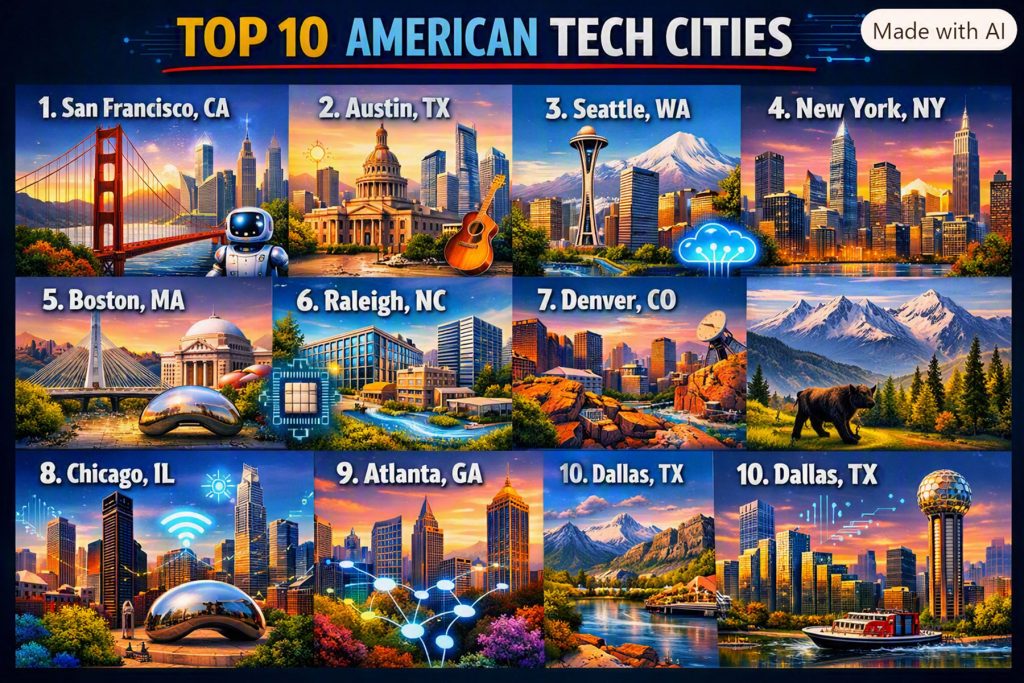
The change is not limited to AI. Cities such as Austin, Boston, Dallas, Atlanta, Chicago, Los Angeles, Miami, Pittsburgh, and Denver have developed strong technology ecosystems around software, semiconductors, cybersecurity, biotechnology, aerospace, financial technology, robotics, cloud infrastructure, and advanced manufacturing. The result is a more geographically diverse American technology economy. Silicon Valley remains exceptionally powerful, but the country’s technology map is becoming larger, more specialized, and increasingly interconnected.
Why American Cities Are Becoming Technology Hubs
Technology hubs rarely emerge because of a single company. The strongest ecosystems develop when several advantages reinforce one another.
A city with a major research university can produce graduates and scientific discoveries. Those graduates attract technology companies. Successful companies generate experienced employees who later launch startups. Venture capital follows promising founders and markets. Large employers create specialized suppliers and professional services. Eventually, the ecosystem becomes self reinforcing.
This pattern explains why established technology centers remain difficult to replicate. A startup founder is not simply choosing office space. The decision can involve access to engineers, investors, customers, research institutions, corporate partners, airports, housing, and a community of people familiar with building technology companies.
The economics are also changing. Remote and hybrid work have made geographic boundaries less restrictive for some technology workers, while high costs in traditional hubs have encouraged companies and employees to consider alternative markets. At the same time, companies still value physical clustering when specialized talent, investment, research, and collaboration are important.
CBRE’s 2026 research found that the six leading North American technology talent markets remained the San Francisco Bay Area, Seattle, Toronto, New York Metro, Austin, and Washington, D.C. Boston climbed to seventh, while Dallas Fort Worth entered the top ten.
The important development is not that one city is replacing another. It is that more cities now have enough ingredients to compete.
San Francisco Remains America’s AI Capital
San Francisco and the wider Bay Area continue to occupy an exceptional position in American technology.
Carta reported that Bay Area startups raised $39.92 billion in 2025, representing 41.3 percent of total U.S. startup funding tracked by its platform. The region raised more than the next seven largest U.S. startup ecosystems combined.
The concentration becomes even more striking when artificial intelligence is considered.
CBRE reported that the San Francisco Bay Area had 98,699 AI related workers as of June 2026, the largest AI talent cluster in North America. The region also had the highest technology talent index score among the markets measured.
AI is reinforcing San Francisco’s advantage
The Bay Area’s current strength comes from the combination of venture capital, experienced founders, major AI laboratories, universities, technology companies, and a deep pool of engineers.
AI has also reversed some of the concerns that San Francisco’s technology economy would permanently weaken after the pandemic. CBRE reported that AI companies had leased approximately 21 million square feet of office space in San Francisco and Silicon Valley since 2019.
That activity indicates that companies building advanced AI systems continue to value physical proximity to specialized workers.
San Francisco’s challenge is cost. CBRE’s 2026 data placed the average technology worker salary in the Bay Area at approximately $195,000 annually, the highest among the markets studied. High wages and expensive real estate can make the region difficult for smaller companies, but they also reflect the economic value attached to its unusually concentrated talent base.
New York Is Becoming a Technology Powerhouse
New York’s technology economy has a different foundation from Silicon Valley.
The city has enormous financial, media, advertising, retail, healthcare, fashion, publishing, and professional services industries. Those sectors create a large customer base for technology companies and provide opportunities for startups that need access to major enterprises.
New York has also become one of the country’s largest technology talent markets. CBRE reported that New York Metro surpassed the San Francisco Bay Area in total technology talent workforce, with 394,300 technology workers compared with 375,730 in the Bay Area.
The city’s AI workforce is growing as well. New York Metro had 67,949 AI related workers as of June 2026, second only to the San Francisco Bay Area. It also added more than 20,000 AI specialists during the preceding year.
Finance and AI are converging
One of New York’s major advantages is the overlap between technology and financial services.
Banks, investment firms, insurance companies, payment companies, and financial technology startups generate demand for machine learning, cybersecurity, data analytics, automation, and risk systems.
This gives New York a particularly strong position in applied AI. Instead of relying entirely on consumer technology startups, the city can support companies selling sophisticated technology to large financial and corporate institutions.
The result is a technology ecosystem with a distinctly commercial character.
Seattle Continues to Benefit From Big Technology
Seattle has long been one of America’s strongest technology centers because of major companies, engineering talent, research institutions, and a mature software ecosystem.
CBRE ranked Seattle second in its 2026 technology talent index, behind only the San Francisco Bay Area. The city also had 41,591 AI related workers in June 2026.
Seattle’s technology strength is closely connected to cloud computing, enterprise software, artificial intelligence, e commerce, gaming, and aerospace.
The city also benefits from the presence of large technology employers that have spent decades building sophisticated engineering organizations. That creates a pool of workers with experience in distributed computing, cloud infrastructure, machine learning, cybersecurity, and large scale software systems.
Seattle’s AI concentration is particularly strong
CBRE found that AI specialists represented about 20 percent of technology talent in Seattle. The technology industry employed 58 percent of the city’s AI specialty workforce, the highest share among the markets highlighted in its analysis.
This concentration makes Seattle particularly attractive for companies building infrastructure and enterprise technology.
The city’s proximity to major cloud and software ecosystems also creates a natural environment for startups working on AI infrastructure, developer tools, cybersecurity, and enterprise applications.
Austin Has Become a Major Technology Destination
Austin has evolved from a regional technology center into one of America’s most recognizable startup and technology markets.
CBRE ranked Austin fifth among North American technology talent markets in 2026, behind San Francisco, Seattle, Toronto, and New York.
The city’s appeal comes from several factors: a large university, a growing technology workforce, semiconductor activity, established technology employers, venture capital, and a reputation for entrepreneurship.
Semiconductors strengthen Austin’s position
Austin’s technology economy is not dependent entirely on software.
The broader Texas technology ecosystem includes semiconductor manufacturing, chip design, electronics, energy technology, aerospace, defense, and advanced manufacturing. That gives Austin a valuable connection between digital technology and physical production.
This distinction matters as the United States invests more heavily in domestic semiconductor capacity.
Artificial intelligence has also increased the strategic importance of chip development. AI systems require increasingly sophisticated processors, creating opportunities for cities with engineering talent and semiconductor expertise.
Austin therefore benefits from being positioned at the intersection of software, hardware, manufacturing, and entrepreneurship.
Boston Is Emerging as a Strong AI and Biotechnology Center
Boston has one of the deepest research ecosystems in the United States.
Its universities, hospitals, laboratories, biotechnology companies, and technology firms create an environment particularly well suited to businesses operating at the intersection of computing and science.
CBRE moved Boston up two positions to seventh in its 2026 technology talent ranking. The city had 27,494 AI related workers as of June 2026, and AI specialists represented approximately 17 percent of its technology talent workforce.
AI and life sciences reinforce each other
Boston’s major advantage is the combination of artificial intelligence and biotechnology.
AI can assist researchers with biological data, drug research, medical imaging, laboratory automation, and scientific modeling. Boston’s existing life sciences infrastructure provides potential customers, collaborators, researchers, and investors for companies building those technologies.
The city’s research universities also create a steady flow of specialized talent.
This combination makes Boston different from Silicon Valley. The technology economy is less centered on consumer internet products and more connected to science, healthcare, biotechnology, robotics, and advanced research.
Washington, D.C. Is Becoming a Technology Center Through Government and Cybersecurity
Washington, D.C. has historically been associated with government rather than technology startups, but that distinction is becoming increasingly outdated.
The region has a major concentration of cybersecurity companies, government contractors, defense technology companies, data analytics firms, and organizations working on artificial intelligence.
CBRE ranked Washington, D.C. sixth among technology talent markets in 2026. It also reported 33,515 AI related workers in the region.
National security is creating technology demand
The federal government is one of the world’s largest technology customers.
Cybersecurity, artificial intelligence, satellite systems, defense software, cloud infrastructure, communications, and data analytics are all strategically important to government agencies.
That creates a market for startups capable of meeting demanding security and procurement requirements.
Washington’s technology ecosystem therefore has an unusual advantage. Its proximity to federal institutions provides access to customers and policy discussions that are less central to other American technology hubs.
The city’s influence is likely to increase as artificial intelligence becomes more important to national security and public administration.
Dallas Fort Worth Is Building a Broad Technology Economy
Dallas Fort Worth has become one of the country’s most important technology growth markets.
CBRE placed Dallas Fort Worth eighth in its 2026 technology talent ranking and reported 29,840 AI related workers in the region.
The region benefits from a large population, a substantial corporate economy, transportation infrastructure, telecommunications, financial services, defense activity, and a growing technology workforce.
Technology and business services are converging
Dallas Fort Worth is particularly well positioned for enterprise technology.
The region contains large companies across financial services, telecommunications, logistics, healthcare, retail, energy, and professional services. Those industries create demand for cloud systems, cybersecurity, analytics, automation, artificial intelligence, and enterprise software.
The region also has an important physical advantage for data infrastructure.
As AI drives demand for data centers, cities and regions with available land, electricity, fiber connectivity, and favorable business conditions can become increasingly important technology infrastructure centers.
That gives Dallas Fort Worth a role that extends beyond software startups.
Los Angeles Is Combining Technology With Entertainment and Aerospace
Los Angeles has a technology identity that is often overshadowed by Silicon Valley, despite having an unusually diverse innovation economy.
The region combines entertainment, media, aerospace, defense, gaming, advertising, consumer products, biotechnology, and software.
CBRE reported 28,600 AI related workers in the Los Angeles and Orange County market in June 2026.
Generative AI creates new opportunities
Los Angeles has a natural advantage in technologies affecting visual media.
Generative AI is changing image creation, video production, animation, advertising, gaming, and digital entertainment. The city already has a large concentration of companies and professionals working in those fields.
Aerospace provides another major technology cluster.
Space companies, satellite systems, advanced materials, autonomous systems, and defense technology all require sophisticated engineering capabilities.
The combination gives Los Angeles a technology profile that is unusually broad.
Atlanta Is Strengthening Its Position as a Technology Hub
Atlanta is increasingly important in cybersecurity, fintech, logistics, healthcare technology, and enterprise software.
The city also benefits from a large university system, a substantial corporate presence, and one of the country’s most important transportation networks.
CBRE identified Atlanta as one of the markets with particularly rapid growth in AI talent. AI specialty employment increased by at least 45 percent in Atlanta, Philadelphia, Dallas Fort Worth, Washington, D.C., and Chicago over the period measured in its 2026 analysis.
Fintech gives Atlanta a distinct advantage
Atlanta has developed an important payments and financial technology ecosystem.
Payment processing companies and financial technology startups create demand for cybersecurity, data science, software engineering, fraud detection, cloud computing, and AI.
The city’s technology growth therefore reflects a broader trend in which established industries become anchors for startup ecosystems.
Atlanta also illustrates why the next generation of American technology hubs does not have to resemble Silicon Valley. A city can develop technology leadership by applying software to industries in which it already has economic strength.
Chicago Is Building a Technology Ecosystem Around Industry
Chicago’s technology economy benefits from its enormous industrial, financial, transportation, healthcare, and logistics base.
That combination gives the city a strong foundation for applied technology.
Artificial intelligence can improve supply chain management, financial analysis, manufacturing, healthcare operations, transportation, and industrial processes. Chicago’s existing economic infrastructure provides a large potential customer base for companies developing those systems.
CBRE reported that Chicago was among the U.S. markets where AI specialty talent grew by 45 percent or more in its 2026 analysis.
The Midwest is gaining strategic importance
Chicago’s growth also reflects a broader geographic shift.
Technology companies do not always need to locate next to venture capital firms if they can access strong universities, corporate customers, engineering talent, transportation infrastructure, and comparatively manageable operating costs.
That gives large Midwestern cities an opportunity to build technology ecosystems around manufacturing, logistics, healthcare, finance, and industrial automation.
Pittsburgh Is Becoming Known for Robotics
Pittsburgh has developed a distinctive technology identity around robotics and artificial intelligence.
The city benefits from Carnegie Mellon University, one of the world’s leading institutions for robotics and computer science.
That academic foundation has helped attract startups and research programs working on autonomous systems, robotics, artificial intelligence, and advanced manufacturing.
CBRE reported that Pittsburgh climbed three positions to No. 28 in its 2026 technology talent rankings, one of the largest improvements among the markets studied.
Pittsburgh demonstrates an important principle of technology cluster development: a city does not need the largest number of technology workers to become influential. A specialized concentration in a strategically important field can create a strong identity and attract companies seeking precisely that expertise.
Denver Is Expanding Beyond Traditional Technology
Denver and the broader Colorado technology ecosystem have developed significant strengths in software, cybersecurity, aerospace, energy technology, telecommunications, and outdoor technology.
The region also benefits from universities, an educated workforce, and proximity to major federal and aerospace institutions.
CBRE’s AI talent analysis found that Denver had one of the highest shares of AI specialty workers employed in the technology industry, at 36 percent.
The city’s technology economy is therefore increasingly connected to industries that require specialized engineering and scientific capabilities.
The New American Technology Map
The rise of multiple technology hubs does not mean that American technology is becoming evenly distributed.
The opposite is true in some respects. Highly specialized talent remains concentrated in particular cities.
| City or region | Major technology strengths | 2026 AI related workforce | Key advantage |
| San Francisco Bay Area | AI, software, venture capital | 98,699 | Capital and frontier AI talent |
| New York Metro | Fintech, AI, enterprise technology | 67,949 | Corporate customers and talent |
| Seattle | Cloud, AI, software, gaming | 41,591 | Engineering and large technology companies |
| Washington, D.C. | Cybersecurity, defense, AI | 33,515 | Government and national security |
| Dallas Fort Worth | Enterprise technology, data centers, fintech | 29,840 | Scale and corporate economy |
| Los Angeles | Media technology, aerospace, AI | 28,600 | Entertainment and aerospace |
| Boston | AI, biotechnology, research | 27,494 | Universities and life sciences |
| Chicago | Fintech, logistics, industrial technology | 21,207 | Large diversified economy |
| Atlanta | Fintech, cybersecurity, logistics | 19,576 | Payments and transportation |
| Austin | Software, semiconductors, startups | Not separately listed in source table | Entrepreneurship and hardware |
AI workforce figures are CBRE estimates for June 2026 and should not be interpreted as total technology employment. Austin’s separate AI employment figure was not included in the cited CBRE table.
The table shows that technology leadership is increasingly distributed among cities with different economic foundations.
San Francisco dominates frontier AI and venture capital. New York combines technology with finance and enterprise services. Seattle remains powerful in cloud computing and software. Boston connects AI with biotechnology. Washington connects technology with government and national security. Austin combines software with semiconductors. Pittsburgh emphasizes robotics.
That specialization could become one of the defining characteristics of America’s next technology era.
Venture Capital Still Shapes the Geography of Innovation
Capital remains one of the strongest forces determining where startups grow.
Carta’s 2025 data showed that the San Francisco Bay Area accounted for 41.3 percent of U.S. startup funding on its platform. New York, Los Angeles, Boston, Austin, and Seattle followed as major startup ecosystems.
AI has amplified that concentration.
CBRE reported that AI companies accounted for $225 billion, or 55 percent, of venture capital funding across the United States, Canada, and Europe in 2025. In the first quarter of 2026, AI accounted for $218 billion, or 83 percent, of total venture capital funding in those markets.
That concentration creates both opportunity and risk.
Cities with strong AI ecosystems can attract more investors, founders, researchers, and companies. Cities without those networks may struggle to compete for frontier AI startups even if they offer lower operating costs.
The result is likely to be a technology economy with a small number of dominant hubs and a larger group of specialized regional centers.
Data Centers Are Creating New Technology Regions
Technology hubs are increasingly defined by infrastructure as well as talent.
The expansion of artificial intelligence has created enormous demand for data centers. Axios reported in August 2026 that the United States had roughly 4,000 data centers, including approximately 580 hyperscale facilities. Large facilities now represent multibillion dollar construction projects and can require substantial electricity capacity.
This development is creating technology investment in places that may not have traditionally been considered startup hubs.
A city or region does not need thousands of software engineers to benefit economically from data center expansion. Construction companies, electrical contractors, utilities, fiber providers, engineering firms, real estate developers, and equipment suppliers can all participate in the growth.
At the same time, data centers create difficult local questions about electricity, water, land use, taxes, and infrastructure.
The technology geography of the United States is therefore becoming partly a geography of computing infrastructure.
What Makes a City the Next Technology Hub?
The most promising technology centers tend to share several characteristics.
First is talent. Universities and existing technology companies create pools of engineers, scientists, designers, researchers, and managers.
Second is capital. Startups require funding at different stages, from early angel investment through venture capital and later growth financing.
Third is customers. A city with major financial, healthcare, manufacturing, defense, retail, or logistics companies can provide startups with valuable early markets.
Fourth is specialization. Cities become more competitive when they develop expertise in areas such as robotics, fintech, biotechnology, aerospace, cybersecurity, or semiconductors.
Fifth is infrastructure. Reliable electricity, high speed connectivity, transportation, housing, laboratories, offices, and data centers increasingly influence technology investment.
Finally, there is culture. Entrepreneurs tend to cluster where other entrepreneurs, investors, engineers, and experienced technology executives already live.
These factors reinforce one another. A city that excels in only one category may struggle to become a major technology hub. A city that performs well across several can develop momentum that becomes difficult for competitors to replicate.
The Future of America’s Technology Cities
The geography of American technology is entering a more competitive phase. Silicon Valley remains the country’s most concentrated center of venture capital and frontier AI, but New York now has the largest technology talent workforce by headcount, Seattle remains a dominant engineering market, Austin has become a major technology and semiconductor center, Boston is strengthening its AI and biotechnology position, and Washington, D.C. is benefiting from growing demand for cybersecurity, defense technology, and government AI.
The next generation of technology hubs will probably not be defined by a single industry. Instead, cities will gain influence by combining specialized expertise with capital, research, infrastructure, and large customer markets. That creates opportunities for places far beyond the traditional technology corridor.
The deeper change is geographic diversification. American technology is becoming less dependent on one metropolitan region and more dependent on a network of specialized cities. San Francisco may remain the center of frontier AI, but New York can lead in financial technology, Boston in computational life sciences, Pittsburgh in robotics, Seattle in cloud technology, Austin in semiconductors, and Washington in national security technology. As artificial intelligence, advanced computing, robotics, and digital infrastructure continue expanding, the most successful American cities may be those that develop a clear technical identity while connecting it to the industries already rooted in their local economies. The technology map of the United States is not moving away from established hubs. It is becoming considerably larger.
Frequently Asked Questions
Which American cities are becoming major technology hubs?
San Francisco, New York, Seattle, Austin, Boston, Washington, D.C., Dallas Fort Worth, Los Angeles, Atlanta, and Chicago are among the most important technology markets. Pittsburgh and Denver are also gaining influence through specialized technology sectors.
Is San Francisco still the biggest technology hub in America?
San Francisco and the wider Bay Area remain the strongest U.S. market for startup funding and frontier AI. Carta reported that Bay Area startups raised 41.3 percent of U.S. startup funding tracked by its platform in 2025.
Which U.S. city has the most AI talent?
The San Francisco Bay Area had the largest AI related workforce in CBRE’s June 2026 analysis, with 98,699 AI related workers. New York Metro ranked second with 67,949.
Why is Austin becoming a technology hub?
Austin benefits from technology companies, universities, venture capital, semiconductor activity, engineering talent, and a strong entrepreneurial culture. Its position within the broader Texas technology and manufacturing ecosystem also gives it connections to hardware and advanced industry.
Is New York becoming more important than Silicon Valley for technology?
New York has surpassed the San Francisco Bay Area in total technology talent workforce by headcount, according to CBRE’s 2026 research. However, San Francisco remains substantially stronger in startup fundraising and frontier AI investment.
Why is Boston important for technology?
Boston combines major universities, biotechnology, healthcare, research institutions, and a growing AI workforce. This makes the city particularly strong in technologies that connect artificial intelligence with scientific research and life sciences.
Which American cities are strong in robotics?
Pittsburgh is particularly notable because of Carnegie Mellon University’s robotics and computer science expertise. Other major technology centers, including Boston, Seattle, Austin, and the Bay Area, also have significant robotics activity.
Are technology companies leaving Silicon Valley?
Some companies and workers have relocated or expanded elsewhere, but the Bay Area remains extremely influential. AI investment and specialized talent have actually reinforced its position in several areas, including frontier AI and venture capital.
Why are data centers affecting American technology hubs?
AI data centers require enormous investments in computing equipment, electricity, networking, construction, and cooling. Regions with suitable power, land, connectivity, and infrastructure can therefore attract technology investment even without having a traditional startup ecosystem.
What will determine which American cities become future technology hubs?
Talent, universities, venture capital, corporate customers, infrastructure, energy availability, housing, specialized industries, and technology entrepreneurship will all matter. Cities that can combine several of these advantages are more likely to develop durable technology ecosystems.