Technology careers once centered primarily on software development and traditional information technology. That definition has changed dramatically. Artificial intelligence, cybersecurity, data science, cloud infrastructure, robotics, semiconductor engineering, and advanced computing now influence nearly every major sector of the American economy. Banks need security specialists and data scientists. Manufacturers need robotics engineers. Hospitals increasingly depend on sophisticated information systems. Retailers rely on cloud platforms, analytics, automation, and digital commerce.
The employment outlook reflects this transformation. The U.S. Bureau of Labor Statistics projects that employment in computer and mathematical occupations will grow 10.1 percent between 2024 and 2034, more than three times the projected 3.1 percent growth for the overall economy. The agency specifically connects that growth to continued development of artificial intelligence, increasing volumes of data, and the integration of technology into business operations.
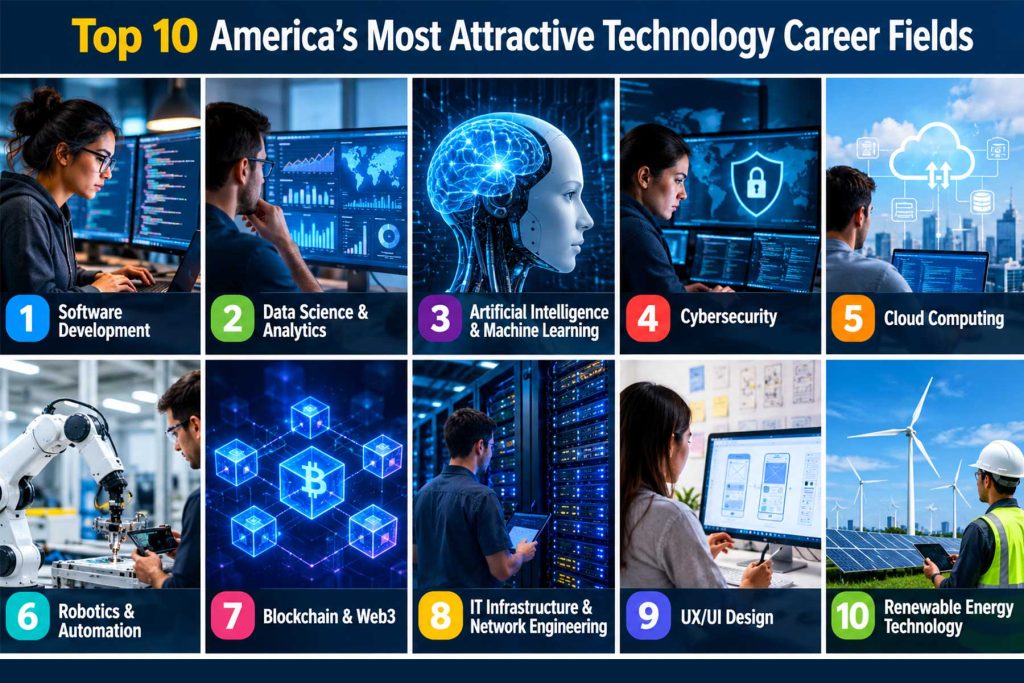
The most attractive technology career fields are therefore not necessarily the ones with the most attention on social media. A strong technology career combines several factors: employment growth, compensation, long term relevance, transferable skills, demand across industries, and opportunities to work on increasingly important technical problems. By those measures, several fields stand out in the American labor market.
Artificial Intelligence Is Reshaping Technology Careers
Artificial intelligence has become one of the strongest forces influencing technology employment in the United States.
The field extends far beyond the job title of artificial intelligence engineer. Companies need machine learning engineers, research scientists, AI infrastructure specialists, model evaluation professionals, data scientists, software developers, AI product managers, and professionals who can integrate AI systems into existing business processes.
The expanding use of AI is also creating demand outside traditional technology companies. Financial institutions, manufacturers, retailers, healthcare organizations, logistics companies, media businesses, and government agencies all have reasons to invest in systems capable of analyzing information and automating complex tasks.
AI research offers a highly specialized path
Computer and information research scientists occupy one of the more specialized positions within the technology sector. Their work involves developing new computing methods, algorithms, and technologies rather than simply implementing existing software.
The BLS projects employment for computer and information research scientists to grow 20 percent from 2024 to 2034, significantly faster than the average for all occupations. The occupation had a 2024 median annual wage of $140,910.
The field generally demands substantial technical preparation, particularly for advanced research positions. Mathematics, computer science, statistics, and specialized research experience can be important foundations.
For people interested in the scientific side of artificial intelligence, this is one of America’s most technically demanding technology career fields.
Software Development Remains a Core Technology Career
Artificial intelligence has not eliminated the importance of software developers. In many respects, AI has increased the amount of software being built.
AI systems require applications, interfaces, databases, security controls, infrastructure, testing systems, and integration layers. Businesses also continue to digitize processes that have little direct connection to AI.
The BLS projects software developers, quality assurance analysts, and testers as a group to grow 10 percent from 2025 to 2035, with approximately 106,100 openings expected each year on average. The agency specifically cites continued software development for AI, Internet of Things systems, robotics, and other automation applications as a source of demand.
Software careers are becoming broader
Modern software development is no longer limited to writing application code.
Developers increasingly work with cloud services, application programming interfaces, data pipelines, machine learning systems, cybersecurity controls, automated testing, and distributed systems.
Artificial intelligence tools are also changing the development process. Developers can use these systems to generate routine code, explain unfamiliar code, create tests, and assist with debugging.
That does not make engineering knowledge irrelevant. It makes software architecture, system design, security, testing, and technical judgment more important.
A strong software professional increasingly needs to understand what the system should accomplish, not simply how to type the code.
Data Science Is One of America’s Fastest Growing Technology Fields
American businesses generate enormous amounts of information, but raw data has limited value without effective analysis.
Data scientists turn large and complex datasets into useful insights. Their work can involve statistical analysis, machine learning, experimentation, forecasting, data visualization, and predictive modeling.
The BLS projects data scientist employment to grow 33.5 percent between 2024 and 2034, adding approximately 82,500 jobs. The 2024 median annual wage was $112,590.
That combination of growth and compensation makes data science one of the most attractive technology career fields in the United States.
Data science is becoming more closely connected to business
The strongest data professionals often understand both technical methods and the business problem being analyzed.
A retailer may need demand forecasting. A bank may need fraud detection. A manufacturer may need predictive maintenance. A healthcare organization may need operational analysis.
In each case, statistical knowledge matters, but so does understanding the context in which the model will be used.
The BLS identifies mathematics, computers and information technology, and writing and reading among the top skills associated with data scientist employment.
That combination illustrates an important feature of modern technology careers. Technical expertise alone is not always enough. Communication and analytical reasoning can determine whether technical work produces useful business results.
Cybersecurity Has Become a Strategic Career Field
Every new digital system creates another potential security responsibility.
Companies now manage cloud applications, remote access systems, connected devices, artificial intelligence tools, digital payment systems, customer databases, and increasingly complex technology networks. Protecting those systems requires specialized expertise.
The BLS projects information security analyst employment to grow 29 percent from 2024 to 2034, with approximately 16,000 openings per year on average. The occupation had a 2024 median annual wage of $124,910.
Cybersecurity is attractive partly because demand does not depend on one particular technology trend.
Businesses need security regardless of whether a particular software platform becomes popular or fades away.
Artificial intelligence is increasing the security challenge
AI creates additional cybersecurity requirements.
Organizations must protect AI systems, training data, application programming interfaces, confidential information, and automated workflows. They also need to consider attacks that use AI to generate more convincing phishing messages or automate malicious activity.
That makes cybersecurity increasingly connected to artificial intelligence, cloud computing, identity management, and data governance.
Professionals who understand several of these areas can potentially build highly transferable expertise.
Cloud Computing Continues to Support the Digital Economy
Cloud computing has become foundational to modern business technology.
Companies use cloud platforms for storage, databases, application hosting, analytics, software development, artificial intelligence, disaster recovery, and communications.
The field includes cloud engineers, cloud architects, platform engineers, site reliability engineers, cloud security specialists, and infrastructure professionals.
Cloud expertise is particularly valuable because almost every major technology trend depends on computing infrastructure.
Artificial intelligence needs computing resources. Data science needs scalable storage and processing. Software companies need deployment infrastructure. Cybersecurity teams need monitoring and identity systems.
Cloud and AI are becoming tightly connected
The rise of artificial intelligence has increased demand for specialized computing resources.
Large AI models require substantial processing power, storage, networking, and data infrastructure. Businesses therefore need professionals who understand how to build reliable systems capable of supporting these workloads.
This has expanded the importance of infrastructure engineering.
The work may be less visible than consumer software development, but it supports many of the services businesses and consumers use every day.
Robotics Is Creating Technology Careers Beyond the Screen
Robotics brings software engineering into the physical world.
Modern robots can operate in warehouses, factories, laboratories, hospitals, agricultural environments, and other specialized settings. Their capabilities increasingly depend on computer vision, artificial intelligence, sensors, control systems, embedded computing, and sophisticated software.
This creates opportunities for robotics engineers, automation engineers, controls specialists, computer vision engineers, embedded systems developers, and related technical professionals.
Manufacturing is becoming more automated
American manufacturers face pressure to improve productivity, maintain quality, and respond to changing demand.
Robotics can help automate repetitive processes while enabling workers to focus on tasks requiring judgment, maintenance, supervision, and specialized knowledge.
AI is making robots more adaptable as well.
Traditional industrial robots often performed tightly defined sequences. Newer systems can incorporate vision and machine learning to handle more variable environments.
That convergence makes robotics particularly attractive for professionals interested in both hardware and software.
Semiconductor Engineering Is Becoming Strategically Important
Artificial intelligence has increased the strategic importance of semiconductor technology.
Advanced chips power data centers, smartphones, vehicles, industrial systems, communication equipment, and AI applications. As the United States invests in domestic semiconductor capacity, opportunities are expanding across chip design, manufacturing, packaging, testing, equipment engineering, and materials science.
This career field differs from software because it sits at the intersection of electrical engineering, materials science, physics, manufacturing, and computer architecture.
The chip industry supports several specialized careers
Semiconductor companies require engineers who can design processors, improve manufacturing processes, develop fabrication equipment, test chips, manage thermal performance, and solve reliability problems.
The expansion of AI computing makes these capabilities increasingly important.
For technology professionals interested in hardware, semiconductor engineering provides an alternative to software and data careers while remaining closely connected to the growth of artificial intelligence and advanced computing.
Computer Systems Analysis Bridges Technology and Business
Not every attractive technology career requires building software or algorithms.
Computer systems analysts study an organization’s existing technology systems and identify ways to improve efficiency.
The occupation can be especially valuable to businesses undergoing digital transformation because someone needs to connect business requirements with technical implementation.
The BLS projects employment for computer systems analysts to grow 9 percent from 2024 to 2034, with approximately 34,200 openings each year on average.
Business knowledge becomes a competitive advantage
Systems analysts need to understand how technology affects actual business processes.
A technically impressive system can still fail if it does not solve the organization’s operational problem.
Professionals who can communicate with executives, employees, developers, security teams, and vendors occupy an important position between business strategy and technical execution.
That makes systems analysis particularly suitable for people who enjoy technology but prefer solving organizational problems over writing software all day.
Technology Management Offers a High Compensation Path
As technology becomes central to business strategy, companies need managers who can coordinate technical teams, budgets, infrastructure, cybersecurity, software development, and digital transformation.
Computer and information systems managers represent one of the more financially attractive technology related occupations.
The BLS reported a 2024 median annual wage of $171,200 and projects employment growth of 15.2 percent from 2024 to 2034.
Leadership skills become increasingly important
Technical management is not simply advanced programming.
Managers must allocate resources, prioritize projects, evaluate risks, communicate with executives, hire talent, and determine which technology investments support business goals.
Strong technical managers often combine technology knowledge with communication, financial reasoning, project management, and leadership skills.
For experienced technology professionals, management can provide a path toward greater organizational responsibility without abandoning technical expertise completely.
Advanced Analytics Is Expanding the Role of Mathematics
Technology careers increasingly reward strong mathematical and analytical abilities.
Operations research analysts use mathematical methods to help organizations make better decisions involving logistics, pricing, scheduling, supply chains, and resource allocation.
The BLS projects operations research analyst employment to grow 21.5 percent from 2024 to 2034. Their 2024 median annual wage was $91,290.
Actuarial work is another quantitative technology adjacent field. Actuaries use mathematics, statistics, and financial theory to analyze risk. The BLS projects 21.8 percent employment growth for actuaries between 2024 and 2034, with a 2024 median annual wage of $125,770.
These careers demonstrate that technology employment is not limited to traditional computing.
People with strong quantitative abilities can build careers where mathematics, software, statistics, and business decision making overlap.
User Experience Technology Keeps the Human Element Central
Technology succeeds only when people can use it effectively.
User experience professionals work on how users interact with websites, applications, software platforms, devices, and digital services.
Their responsibilities can include interface design, usability research, information architecture, accessibility, user testing, and interaction design.
The growth of AI creates new user experience challenges.
People need understandable ways to interact with AI systems, review generated results, correct errors, and understand when an automated system is making a recommendation rather than a guaranteed decision.
This means human centered design remains important even as software becomes more automated.
Technology Career Fields With Strong Growth and Pay
| Career field | Projected employment growth | 2024 median annual wage | Typical education |
| Data science | 33.5 percent | $112,590 | Bachelor’s degree |
| Cybersecurity analysis | 28.5 percent | $124,910 | Bachelor’s degree |
| Computer and information research science | 19.7 percent | $140,910 | Bachelor’s degree or advanced study depending on role |
| Software development | 15.8 percent | $133,080 | Bachelor’s degree |
| Computer and information systems management | 15.2 percent | $171,200 | Bachelor’s degree |
| Computer systems analysis | 9 percent | $105,850 | Bachelor’s degree |
| Operations research | 21.5 percent | $91,290 | Bachelor’s degree |
| Actuarial science | 21.8 percent | $125,770 | Bachelor’s degree plus professional examinations |
Figures are based primarily on BLS 2024 to 2034 employment projections. Median wage figures refer to 2024 and can vary by occupation, location, industry, experience, and employer.
The comparison shows why there is no single definition of an attractive technology career.
Data science has exceptionally strong projected growth. Cybersecurity combines high demand with strong compensation. Software development offers a large employment base and substantial annual openings. Technology management has especially high median pay but generally requires professional experience before reaching managerial responsibility.
The Skills That Matter Across Technology Careers
Technology changes quickly, but several underlying skills remain valuable.
Analytical thinking
Professionals must be able to break complicated problems into smaller components and determine which information matters.
Technical literacy
Even managers and business professionals increasingly benefit from understanding software, data, AI, cybersecurity, and cloud concepts.
Adaptability
The BLS identifies adaptability among the leading skills associated with several fast growing technology related occupations.
Technology professionals rarely work with exactly the same tools throughout an entire career. The ability to learn new systems can therefore be more durable than mastery of a single platform.
Communication
Technical work frequently fails when specialists cannot explain their reasoning to nontechnical colleagues.
Writing, presenting, documentation, and collaboration remain important even in highly technical roles.
Business judgment
Technology exists within an economic environment.
Professionals who understand customer needs, operational constraints, budgets, risk, and return on investment can often make more effective decisions than those who focus exclusively on technical performance.
Degrees Are Valuable, But They Are Not the Whole Career Strategy
Many technology occupations still list a bachelor’s degree as the typical entry level education.
BLS data show that software developers, data scientists, information security analysts, computer systems analysts, and several other technology occupations generally require a bachelor’s degree for entry.
However, education is only one part of employability.
Technology employers also evaluate practical skills, project experience, technical portfolios, internships, certifications where relevant, communication ability, and familiarity with current tools.
The appropriate preparation depends heavily on the field.
A research scientist may need advanced mathematics and graduate level research experience. A software developer may benefit from substantial project work. A cybersecurity professional may build expertise through a combination of formal education and practical security experience.
There is no universal route into technology.
Location Still Matters for Technology Careers
Technology work has become more geographically flexible, but location remains relevant.
Major American technology centers such as the San Francisco Bay Area, New York, Seattle, Boston, Austin, Washington, D.C., Dallas, and Los Angeles contain large concentrations of technology companies and specialized workers.
Those ecosystems provide access to employers, professional networks, universities, venture capital, conferences, and specialized industries.
At the same time, remote and distributed work have created opportunities outside traditional technology centers.
A professional does not necessarily need to live in Silicon Valley to build a technology career. Employers increasingly recruit talent across regions, particularly for software, cybersecurity, data, and cloud roles.
This has broadened the potential geography of American technology employment.
Technology Careers Are Becoming More Interdisciplinary
The strongest career opportunities increasingly sit at the intersection of several fields.
AI and cybersecurity overlap when companies need to protect machine learning systems.
AI and healthcare overlap when researchers use computational methods to analyze biological information.
Robotics and manufacturing overlap through intelligent automation.
Cloud computing and cybersecurity overlap through infrastructure protection.
Data science and finance overlap through risk analysis and fraud detection.
Semiconductors and AI overlap because advanced computing depends on specialized processors.
This creates an important career advantage for professionals who can work across disciplines.
A person who understands both cybersecurity and AI may have a different value proposition from someone who knows only one. A professional combining software development and cloud infrastructure can support a wider range of projects.
The technology labor market increasingly rewards these intersections.
How Artificial Intelligence Is Changing Technology Careers
AI is creating a complicated employment picture.
Some technology tasks are becoming easier to automate, particularly repetitive coding, documentation, classification, and routine analysis. At the same time, businesses are creating demand for people who can design, supervise, integrate, secure, and evaluate AI systems.
The BLS expects AI adoption to support strong employment growth in several computer and mathematical occupations. Data scientists, information security analysts, computer and information research scientists, and software professionals all benefit from technology investment even as the tasks inside those jobs change.
This suggests that the safest long term career strategy is not simply learning one AI tool.
It is developing skills that remain valuable when tools change.
Problem solving, system design, statistical reasoning, security awareness, communication, and domain expertise are examples.
Technology professionals who can use AI effectively while understanding its limitations may be particularly valuable.
Choosing Among America’s Most Attractive Technology Career Fields
The best career choice depends on the individual’s strengths rather than a single ranking.
Someone who enjoys mathematics and experimentation may prefer data science or machine learning research.
Someone interested in defense and risk may gravitate toward cybersecurity.
Someone who enjoys building applications may prefer software development.
Someone interested in physical systems may find robotics or semiconductor engineering more appealing.
A person who prefers business strategy may eventually move toward technology management or systems analysis.
The most attractive technology career field is therefore personal as well as economic.
Employment projections can identify promising markets, but they cannot determine whether a particular career will be satisfying or suitable for an individual.
The Future of Technology Careers in America
America’s technology labor market is moving toward greater specialization while becoming more interdisciplinary at the same time. Artificial intelligence is increasing demand for data scientists, research scientists, software developers, infrastructure specialists, and cybersecurity professionals. Robotics is connecting software with physical production. Semiconductor investment is strengthening demand for hardware expertise. Cloud computing continues to provide the infrastructure behind digital services. Technology management and systems analysis are becoming more important as companies integrate these capabilities into core operations.
The most attractive technology careers will increasingly belong to professionals who can combine technical depth with adaptability and business understanding. The BLS projections provide a useful signal: data science, cybersecurity, research science, software development, systems management, operations research, and actuarial work all show stronger projected growth than the overall American labor market. But career durability will depend on more than today’s job titles. Tools will change, programming methods will evolve, and AI capabilities will expand. The enduring advantage will belong to people who can understand complex systems, solve meaningful problems, communicate clearly, and keep learning as technology changes. That is the characteristic most likely to separate a temporary technology trend from a lasting American career opportunity.
Frequently Asked Questions
What are America’s most attractive technology career fields?
Artificial intelligence, data science, cybersecurity, software development, cloud computing, robotics, semiconductor engineering, and technology management are among the strongest fields. Their appeal comes from a combination of projected demand, compensation, industry breadth, and technological importance.
Which technology career has the fastest projected growth?
Data scientists are among the fastest growing technology occupations tracked by the BLS, with projected employment growth of 33.5 percent from 2024 to 2034. Information security analysts are projected to grow 28.5 percent during the same period.
Is software development still a good career in the age of AI?
Software development remains a major technology career because AI itself requires software, infrastructure, testing, security, and integration. The BLS projects 15.8 percent growth for software developers from 2024 to 2034.
Are cybersecurity careers in high demand in the United States?
Yes. The BLS projects information security analyst employment to grow 29 percent between 2024 and 2034 and estimates approximately 16,000 annual openings on average.
What technology careers pay the most?
Technology management, research science, software development, cybersecurity, and certain specialized quantitative careers can offer high compensation. The BLS reported a 2024 median annual wage of $171,200 for computer and information systems managers and $140,910 for computer and information research scientists.
Is data science a good technology career for the future?
Data science has one of the strongest projected growth rates among technology occupations. The BLS expects employment to increase 33.5 percent from 2024 to 2034 as businesses require more data driven analysis and decision making.
What skills are most valuable in technology careers?
Analytical thinking, computer and information technology skills, mathematics, adaptability, writing, reading, communication, and problem solving are valuable across many technology occupations. The exact combination depends on the chosen specialization.
Can someone build a technology career without becoming a programmer?
Yes. Cybersecurity, data analysis, systems analysis, technology management, user experience, cloud operations, technical project management, and several other careers do not center entirely on programming. Many technology roles combine technical knowledge with business, analytical, or communication skills.
Which technology careers are likely to remain important as AI improves?
Cybersecurity, AI research, data science, systems architecture, infrastructure, software engineering, robotics, and technology governance are likely to remain important because AI systems themselves require development, deployment, security, infrastructure, evaluation, and oversight.
What is the best way to choose a technology career?
A practical choice should consider personal strengths, preferred type of work, education requirements, projected employment growth, compensation, industry demand, and opportunities for continued learning. A career with strong market demand is most useful when its daily work also matches the individual’s abilities and interests.