
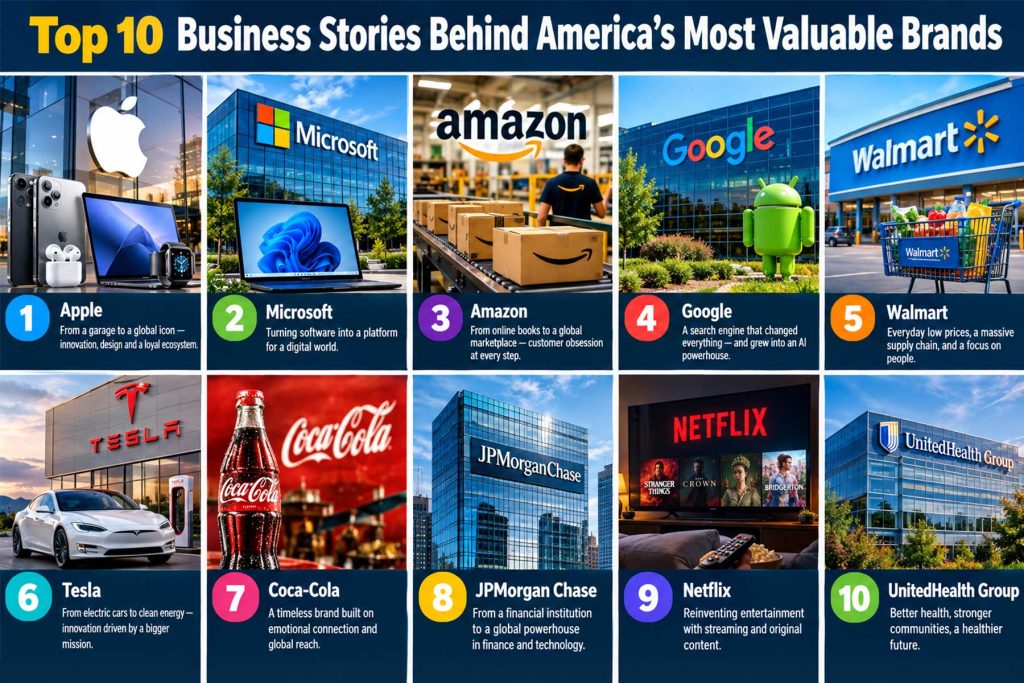
America’s most valuable brands did not become business icons simply because they sold popular products. Behind the logos are decades of product decisions, technology investments, acquisitions, distribution strategies, customer relationships, marketing choices, and responses to changing consumer behavior. Some began as small technology ventures, while others grew from physical retail, telecommunications, advertising, or specialized industrial markets.
The scale of that business success is visible in current brand valuation data. Brand Finance’s 2026 US 500 report places the combined value of America’s top 500 brands at $6.44 trillion, an increase of 10 percent from the previous year. Apple leads the US ranking at about $607.6 billion, followed by Microsoft at about $565.2 billion and Google at about $433.1 billion.
The individual stories behind these brands are particularly useful because they reveal different paths to enormous business value. Apple built an ecosystem around hardware, software and services. Amazon expanded from online books into a broad commerce and cloud platform. NVIDIA moved from graphics processors into a central position in artificial intelligence infrastructure. Walmart combined physical scale with increasingly sophisticated digital commerce.
For this ranking, the ten brands follow the top ten positions in Brand Finance’s 2026 US 500 data: Apple, Microsoft, Google, Amazon, NVIDIA, Walmart, Facebook, Instagram, Home Depot and Verizon. Brand Finance uses a royalty relief approach for its brand valuation, while organizations such as Kantar and Interbrand use different methodologies and can therefore produce different rankings and values.
Top 10 Business Stories Behind America’s Most Valuable Brands
Apple: Turning Product Design Into an Ecosystem
Apple’s business story began in 1976, but its modern commercial identity was shaped through repeated transformations. The company moved from the Apple II and Macintosh into portable music, smartphones, tablets, wearable devices and digital services.
The major business breakthrough came from understanding that individual products could reinforce one another. The iPhone became much more than a smartphone when it connected with iOS, the App Store, iCloud, Apple Pay, Apple Music and other services.
Apple itself describes its current ecosystem as spanning iPhone, iPad, Mac, Apple Watch, AirPods, Vision Pro and multiple software platforms and services. In fiscal 2025, Apple reported annual revenue of $416 billion and said its installed base of active devices reached an all time high.
Services have become an increasingly important part of that story. Apple reported that its services business reached a record level in 2025, while the App Store averaged more than 850 million weekly users globally. Apple also reported that Apple Pay generated more than $100 billion in incremental merchant sales globally during 2025.
The deeper business lesson is ecosystem economics. A customer buying one Apple product can become connected to several additional products and services. That relationship can increase retention, recurring revenue and the perceived usefulness of the entire product family.
Apple’s story also shows how a company can repeatedly redefine itself without abandoning a recognizable brand identity. In 2026, Apple marked 50 years since its founding and highlighted the progression from Apple II and Macintosh to iPhone, Apple Watch, Vision Pro and its expanding services portfolio.
Microsoft: From Software Licensing to Cloud and AI
Microsoft represents one of the clearest examples of business reinvention in American technology.
The company initially built enormous scale through personal computer software. Windows and Office became deeply embedded in business and consumer computing. That installed base provided Microsoft with a powerful foundation, but the company later had to adapt as computing moved toward cloud services.
Azure became central to that transformation. Microsoft’s current business reaches across cloud infrastructure, enterprise software, productivity applications, gaming, cybersecurity and artificial intelligence.
Microsoft reported in its 2025 annual report that it operated more than 400 data centers across 70 regions and added more than two gigawatts of new capacity during the year. The company described its cloud and AI infrastructure as a major part of its strategy.
That shift changed the economics of the business. Instead of relying primarily on traditional software sales and licensing, Microsoft increasingly built recurring relationships with organizations through cloud subscriptions and enterprise services.
Its business story is therefore not simply about creating Windows or Office. It is about recognizing that the location of computing was changing and repositioning the company around that change.
Microsoft’s current position also illustrates how an established technology brand can use an existing enterprise customer base to enter new technological categories. Cloud computing, cybersecurity, collaboration software and artificial intelligence can all be connected to existing corporate relationships.
Google: Turning Search Into a Global Business Platform
Google began with a powerful idea: organize information on the internet more effectively.
Search created an enormous audience, but the more important business story was what happened after that audience existed. Google developed advertising products that connected businesses with people searching for information, products and services.
That created a business model with exceptional scale. Search became the center of a wider ecosystem involving YouTube, Android, Maps, Gmail, Chrome, Google Cloud and artificial intelligence.
The brand has also evolved beyond its original search identity. Interbrand valued Google at $317.1 billion in its 2025 Best Global Brands ranking, placing it fourth globally behind Apple, Microsoft and Amazon.
Brand Finance placed Google third among US brands in 2026, with a brand value of about $433.1 billion.
The business lesson is particularly significant. Google did not simply monetize a search engine. It built a network of products around a central information platform.
The company is now adapting that platform for the artificial intelligence era. Search, cloud computing, advertising and AI are increasingly interconnected, creating new opportunities while also forcing Google to reconsider how people find and consume information.
Amazon: From Online Bookstore to Business Infrastructure
Amazon’s early story is one of the most recognizable examples of strategic expansion in American business.
The company began as an online bookstore, using the internet to offer consumers a selection that physical bookstores could not easily match. That initial business created the foundation for a much larger ambition.
Amazon expanded into general merchandise, third party marketplace services, Prime membership, digital entertainment, logistics, advertising and cloud computing.
AWS became particularly important because it transformed Amazon from an online retailer into a major technology infrastructure company. Businesses could use Amazon’s computing infrastructure rather than building all of their own systems.
Kantar’s 2025 BrandZ ranking valued Amazon at $866.1 billion, a 50 percent increase from the previous year. Kantar attributed the brand’s strength partly to its positioning around convenience and affordability.
Brand Finance’s 2026 global data placed Amazon fourth worldwide with a brand value of about $369.9 billion, while Brand Finance’s US ranking placed Amazon fourth among American brands.
Amazon’s most important business story is diversification around customer frequency. A person can interact with Amazon through shopping, Prime Video, music, cloud services, advertising or third party marketplaces.
That creates multiple revenue streams around a familiar consumer and business relationship.
NVIDIA: The Graphics Company That Became an AI Infrastructure Powerhouse
NVIDIA’s story demonstrates how a specialized technology company can become strategically important when an emerging technology changes the value of its core products.
NVIDIA was founded around graphics processing technology. GPUs were initially strongly associated with computer graphics and gaming, but their parallel computing capabilities eventually made them highly useful for demanding computational workloads.
The rise of artificial intelligence dramatically increased the importance of accelerated computing.
Brand Finance reported that NVIDIA’s brand value increased by about 110 percent in 2026 to $184.3 billion, placing it fifth among the world’s most valuable brands. The company’s rise was linked to its central position in AI infrastructure.
NVIDIA’s story is not simply about selling chips. Its broader advantage has included a software ecosystem and development tools that make its hardware useful to researchers, developers and organizations building AI systems.
That combination of hardware and software can create stronger business relationships than a commodity hardware model.
NVIDIA illustrates an important principle in technology markets: a company can become dramatically more valuable when an existing capability becomes essential to a new computing paradigm.
Its rise also demonstrates why brand value can increase rapidly when technological relevance and business demand reinforce one another.
Walmart: Making Scale a Competitive Advantage
Walmart’s story began with a straightforward retail proposition: offer customers broad selection and low prices while operating at enormous scale.
Founded in Arkansas, Walmart expanded through large stores, efficient distribution and a focus on price. Over time, its physical footprint became one of its most significant strategic assets.
Today, Walmart operates thousands of stores across the United States and internationally. Its US network includes more than 5,200 retail units, according to company figures updated in 2026.
The next stage of the business story has involved connecting that physical network with digital commerce.
Walmart reported that US ecommerce sales increased 27 percent in the fourth quarter of fiscal 2026. The company also reported strong growth in advertising, with Walmart Connect sales excluding VIZIO increasing 41 percent during the quarter.
That means the modern Walmart business is no longer simply about stores.
Stores can function as shopping destinations, fulfillment locations and parts of the company’s digital delivery system. The company has also expanded into advertising and marketplace services.
The strategic lesson is the ability to turn physical scale into digital capability. Instead of treating stores and ecommerce as separate businesses, Walmart increasingly connects them.
Facebook: Building a Global Social Platform From a College Startup
Facebook’s business story began in 2004 as a social networking service created around college communities.
Its early growth came from network effects. A social platform becomes more useful when more people join because users can find more friends, communities and conversations.
That dynamic helped Facebook expand beyond universities and eventually into a global social media platform.
The company later acquired other major platforms and expanded its advertising infrastructure. Facebook became a major channel for businesses trying to reach consumers based on interests, behavior and demographics.
Brand Finance valued Facebook at approximately $107.1 billion in its 2026 US ranking.
The business story also reflects a major change in digital advertising. Traditional advertising depended heavily on broad audiences, while social platforms could provide businesses with increasingly targeted ways to reach users.
Facebook’s evolution shows the economic value of network effects. A technology platform with a huge active audience can create a powerful commercial ecosystem around advertising, creators, communities and business pages.
The challenge for such a platform is maintaining relevance as user behavior changes. The rise of short form video, creator platforms and new social products has made continual adaptation important.
Instagram: Turning Visual Communication Into a Global Business
Instagram began in 2010 as a photo sharing application and quickly developed a distinctive visual identity.
Its early appeal came from simplicity. Users could capture photographs, apply creative effects and share them with followers. The product was relatively focused compared with the increasingly complex social networks of the period.
Facebook acquired Instagram in 2012. The acquisition allowed Instagram to retain much of its identity while gaining access to a much larger technological and commercial infrastructure.
Instagram later expanded from photographs into video, creators, commerce, advertising and short form content.
Brand Finance placed Instagram among the ten most valuable US brands in 2026, with a reported brand value of about $80.8 billion.
Its story shows why acquisitions can create enormous value when a parent company allows a strong consumer product to develop while providing resources for infrastructure and monetization.
Instagram also demonstrates the growing relationship between culture and commerce. Creators can build audiences, businesses can market products, and consumers can move from content discovery toward purchasing without leaving the platform ecosystem.
Home Depot: Making Expertise Part of the Retail Product
Home Depot built its business around a retail problem that went beyond product availability.
Its founders, Bernie Marcus and Arthur Blank, envisioned large warehouse style stores where customers could find a broad assortment of home improvement products at competitive prices.
The first Home Depot stores opened in Atlanta in 1979. The company says those stores were approximately 60,000 square feet and carried about 25,000 products, giving them a dramatically different scale from traditional hardware stores of the time.
But merchandise was only part of the strategy.
Home Depot invested heavily in knowledgeable store associates who could help customers understand how to complete projects. That approach helped make expertise part of the customer experience.
The company now operates more than 2,300 stores across the United States, Canada and Mexico and offers more than one million products through its ecommerce business.
Another important part of the business is the professional customer. Contractors and other professional users can generate frequent, substantial purchases, giving the company an important customer segment beyond occasional DIY shoppers.
The business story therefore combines physical scale, product breadth, service and professional relationships.
It is an example of how a retailer can differentiate itself by selling knowledge and solutions alongside products.
Verizon: Building Brand Value Through Network Scale
Verizon’s story is different from the technology and retail companies dominating much of the list.
Verizon was created in 2000 through the merger of Bell Atlantic and GTE, a transaction that combined regional telecommunications capabilities with a broader national footprint. Verizon’s own historical records describe the merger as one of the largest in US business history at the time.
The company then built its identity around communications infrastructure.
Wireless services became a central part of the business, followed by investments in broadband, fiber and newer mobile technologies. Verizon identifies milestones including fiber based home service, 4G LTE and 5G as important stages in its development.
The company’s brand value reflects something that is often less visible than a consumer product: infrastructure.
A telecommunications network becomes valuable because people depend on it every day. Consumers, businesses and public organizations all require reliable connectivity, creating recurring relationships and significant infrastructure advantages.
Verizon’s story demonstrates how a company can build a major brand around reliability, coverage and technological investment rather than a single consumer product.
What These Business Stories Have in Common
The ten stories are very different, but several patterns appear repeatedly.
Innovation Was Usually Cumulative
Apple, Microsoft, Amazon, Google and NVIDIA did not create their current businesses from a single product launch.
Each company built upon previous capabilities. Apple connected devices to software and services. Microsoft moved from software toward cloud computing and AI. Amazon expanded from books into commerce and cloud infrastructure. Google extended search into a broad technology ecosystem. NVIDIA expanded the relevance of GPUs through accelerated computing.
This suggests that innovation is often less about one dramatic invention and more about repeatedly extending a company’s strongest capabilities.
Scale Created New Business Opportunities
Scale appears in nearly every story.
Walmart used physical scale to improve retail economics. Amazon used digital scale to build commerce and cloud businesses. Google used audience scale to create an advertising platform. Facebook and Instagram used network scale to attract users, advertisers and creators.
Large customer networks can create advantages that are difficult for smaller competitors to reproduce.
Brand Value Often Followed Business Relevance
Brand value is not the same as revenue, market capitalization or customer satisfaction. It is a separate concept measured using specific methodologies.
Kantar, Brand Finance and Interbrand can produce substantially different valuations because they measure brand value differently. Interbrand’s 2025 ranking, for example, valued Apple at $470.9 billion, Microsoft at $388.5 billion, Amazon at $319.9 billion and Google at $317.1 billion.
That difference is important.
The strongest business lesson is not that one valuation is universally correct. It is that these methodologies consistently identify the enormous economic importance of recognizable brands.
Customer Relationships Became More Valuable Over Time
Several companies moved beyond one time transactions.
Apple developed services around its installed devices. Amazon created Prime and multiple recurring relationships. Microsoft built subscription and cloud relationships with organizations. Walmart expanded membership, ecommerce and advertising. Visa created a payment network connecting consumers, merchants and financial institutions.
The more frequently customers interact with a business, the more opportunities exist to provide additional products and services.
Data Table: America’s Most Valuable Brands and Their Business Stories
| Brand | 2026 US Brand Value | Core Business Story | Major Strategic Strength |
| Apple | $607.6 billion | Product ecosystem | Hardware, software and services |
| Microsoft | $565.2 billion | Software to cloud | Enterprise relationships and AI |
| $433.1 billion | Search to platform | Advertising, data and digital services | |
| Amazon | $369.9 billion | Books to global platform | Commerce, cloud and Prime |
| NVIDIA | $184.3 billion | Graphics to AI infrastructure | Accelerated computing |
| Walmart | $141.0 billion | Discount retail to omnichannel commerce | Scale and distribution |
| $107.1 billion | Social network to advertising platform | Network effects | |
| $80.8 billion | Photo sharing to creator platform | Visual engagement and commerce | |
| Home Depot | $73.4 billion | Hardware store to home improvement ecosystem | Product breadth and expertise |
| Verizon | $73.0 billion | Telecom merger to national network | Connectivity and infrastructure |
Brand values shown are based on Brand Finance US 500 2026 data. Values are rounded from reported figures. Brand Finance uses a royalty relief methodology, so figures should not be directly compared with valuations from Kantar or Interbrand.
Why These Stories Matter to American Business
The stories behind America’s most valuable brands reveal that brand building is closely connected to business design.
A recognizable name can attract attention, but attention alone does not create lasting economic value. The brands that remain powerful tend to connect reputation with something customers repeatedly value.
For Apple, that value comes from an integrated technology ecosystem. For Walmart, it comes from price, convenience and scale. For Amazon, it comes from selection and convenience supported by enormous infrastructure. For Microsoft, it comes from software and services deeply embedded in organizational operations.
NVIDIA demonstrates another route. A brand can become strategically important when its technology becomes essential to a rapidly growing industry.
Home Depot illustrates the importance of service and expertise. Verizon demonstrates the value of infrastructure. Facebook and Instagram show how networks and user generated content can support enormous advertising businesses.
Together, these examples show that there is no single formula for building an American business brand.
The Next Chapter for America’s Most Valuable Brands
The competitive environment is changing quickly.
Artificial intelligence is affecting technology companies, retailers, advertising platforms, telecommunications networks and virtually every major business sector. Brand Finance reported that the world’s 500 most valuable brands increased their combined value by 11 percent in 2026, with AI related companies contributing strongly to the change.
At the same time, established companies are using AI to strengthen existing businesses rather than simply creating new AI products.
Walmart, for example, is investing in AI powered retail solutions while connecting physical stores, ecommerce, membership and advertising. Microsoft is expanding AI infrastructure through Azure. Apple is integrating intelligent capabilities into its devices and services. NVIDIA is supplying infrastructure for the wider AI economy.
That makes the next phase of brand competition particularly interesting. The companies with the strongest brand recognition may not necessarily be those that invent every new technology. They may be the companies that integrate new technology into products and services customers already understand and trust.
Final Takeaway
The business stories behind America’s most valuable brands are stories of adaptation as much as invention. Apple evolved from personal computers into an ecosystem. Microsoft transformed software expertise into cloud and AI infrastructure. Amazon expanded from books into commerce and computing. NVIDIA turned graphics technology into a foundation for modern AI. Walmart converted physical scale into an increasingly digital retail system.
Facebook and Instagram demonstrate the economic power of social networks, while Home Depot shows how service and expertise can strengthen a retail model. Verizon demonstrates how infrastructure, mergers and continued network investment can create a durable communications brand.
The common thread is not a single marketing technique. It is the ability to build something valuable, protect a distinctive position, adapt to major changes and create additional business opportunities around an established customer relationship.
Frequently Asked Questions
What is the most valuable American brand in 2026?
According to Brand Finance’s 2026 US 500 ranking, Apple is the most valuable US brand, with a reported brand value of approximately $607.6 billion. Microsoft ranks second at approximately $565.2 billion.
How is brand value different from company value?
Brand value measures the estimated economic contribution of a brand, while company value can refer to measures such as market capitalization or enterprise value. Different organizations use different methodologies to calculate brand value.
Why is Apple such a valuable brand?
Apple has built a large ecosystem connecting devices, software and services. Its strong customer loyalty, product integration and expanding services business have helped strengthen its overall commercial position.
How did Amazon become more than an online retailer?
Amazon expanded from books into general merchandise, third party marketplaces, Prime, advertising, entertainment and cloud computing. AWS in particular transformed Amazon into a major technology infrastructure provider.
Why has NVIDIA become so valuable?
NVIDIA’s graphics processing technology became increasingly important for accelerated computing and artificial intelligence. Brand Finance reported a 110 percent increase in NVIDIA’s brand value in 2026, reaching $184.3 billion.
What made Walmart’s business model successful?
Walmart built its business around scale, broad distribution and competitive pricing. It is now combining that physical network with ecommerce, delivery, membership, marketplace services and advertising.
How did Facebook create such a valuable business?
Facebook benefited from network effects as its user base expanded. The company then developed advertising capabilities that allowed businesses to reach large audiences using the platform’s data and targeting infrastructure.
Why is Instagram considered such a valuable brand?
Instagram developed a large visual communication and creator ecosystem after beginning as a simple photo sharing service. Its integration with advertising, creators, video and commerce helped turn the platform into a major digital business.
How did Home Depot differentiate itself from traditional hardware stores?
Home Depot combined large stores and broad product selection with trained employees who could help customers complete projects. The company continues to serve both DIY customers and professional contractors.
What can businesses learn from America’s most valuable brands?
The major lesson is that lasting brand value usually develops alongside a strong business model. Innovation, customer trust, scale, distribution, technology and the ability to adapt can reinforce one another over many years.

