A growing number of American businesses are no longer asking whether new technology should be adopted. The more difficult question is where it should be integrated first. Artificial intelligence is writing software, analyzing documents, assisting customer service teams, and processing business information. Robots are moving into warehouses and factories. Cybersecurity systems are using machine learning to identify threats. Cloud platforms are becoming increasingly intelligent, while data centers are turning into major infrastructure projects that affect electricity markets and local economies.
The scale of this shift is reflected in Stanford University’s 2026 AI Index. The report found that 88 percent of surveyed organizations had adopted artificial intelligence in at least one business function during 2025, while generative AI was being used in at least one function by 70 percent of organizations. Yet AI agents remained at an early stage, with deployment still in the single digits across nearly all business functions. The distinction matters because American companies are moving from experimenting with AI tools toward reconsidering how work itself is organized.
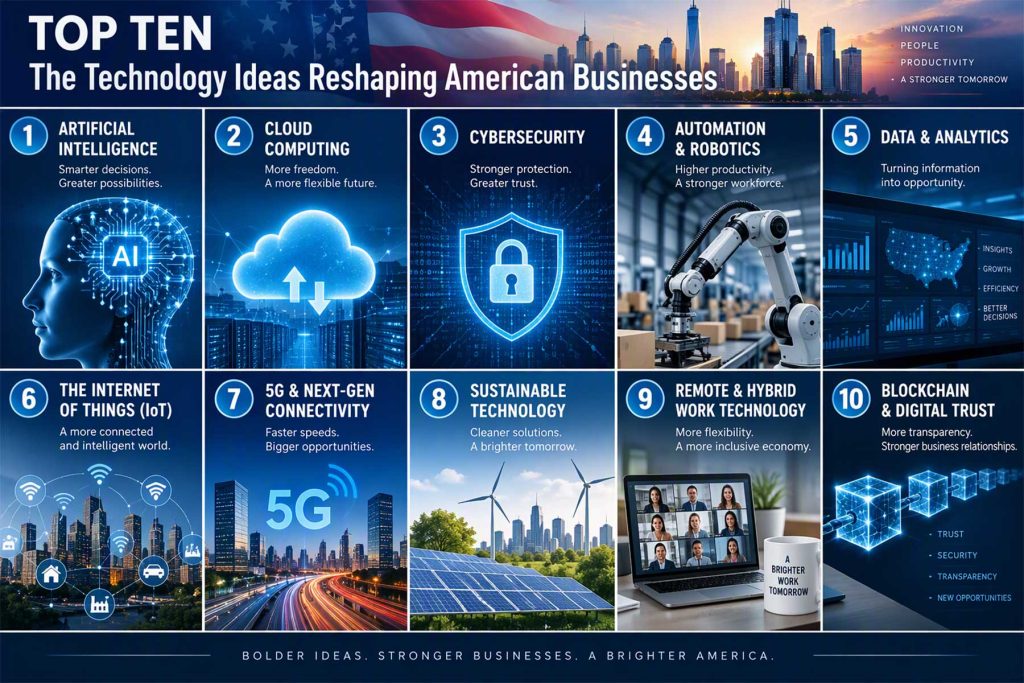
Technology is also becoming less isolated from the physical economy. Advanced computing requires chips, data centers, electricity, networking, and cooling. Robotics connects software with warehouses, factories, laboratories, and transportation systems. Cybersecurity must protect increasingly autonomous digital systems. The most important technology ideas reshaping American businesses therefore involve a connected set of capabilities rather than one revolutionary product. Companies that understand those connections may be better positioned to improve productivity while managing the costs and risks that accompany rapid technological change.
AI Is Becoming Part of Everyday Business Operations
Artificial intelligence has moved from an experimental technology to a practical business capability.
For years, companies accumulated digital tools that helped employees perform individual tasks. Modern AI changes the equation because software can increasingly interpret information, generate content, write code, summarize documents, analyze data, and interact with other systems.
Stanford’s 2026 AI Index found that organizational AI adoption reached 88 percent, although the depth of adoption varies substantially between companies. Generative AI has spread particularly quickly, reaching 53 percent population adoption globally within three years, a faster pace than the personal computer or the internet achieved over comparable periods.
Generative AI is moving beyond content creation
Early business adoption focused heavily on writing, summarization, brainstorming, presentations, and other knowledge tasks.
The next stage is more operational.
AI can assist with software development, customer support, research, document processing, sales analysis, internal search, marketing operations, and financial workflows. The value comes not merely from generating text but from reducing the time required to move information through an organization.
That changes the economics of productivity.
An employee who previously spent hours locating information across multiple systems may be able to retrieve and synthesize it through an AI interface. A developer can use AI to inspect a large codebase. A sales team can analyze customer conversations at scale.
The technology does not eliminate the need for judgment. Instead, it changes where human attention is spent.
AI Agents Could Redesign Business Processes
The next major shift is from AI that answers questions to AI that performs sequences of tasks.
AI agents are designed to interact with software, retrieve information, make decisions within defined boundaries, and complete work with varying degrees of human oversight.
Deloitte’s August 2026 research found that 74 percent of surveyed leaders expect nearly half of their business processes to be redesigned or rebuilt around AI agents within four years. At the same time, only 5 percent of organizations said their processes were highly prepared for AI agents, while just 15 percent had scaled orchestrated, cross functional multi agent systems.
That gap is important.
Businesses may have access to capable AI systems without having the internal processes needed to use them effectively.
Workflow redesign matters more than adding another tool
Consider a procurement department.
A conventional AI assistant might summarize supplier documents. An agentic system could potentially gather quotations, compare terms, check internal requirements, prepare a recommendation, and route the result for approval.
The second approach does not simply improve one task. It changes the structure of the workflow.
That is why agentic AI could have a larger effect on businesses than standalone chatbots. It challenges organizations to reconsider who performs each step, which approvals remain human, what information systems need to communicate, and how performance should be measured.
Deloitte reported that nearly two thirds of executives surveyed were reevaluating business models because agentic AI requires changes to processes and workflows in addition to technical deployment.
The businesses that benefit most may therefore be those willing to redesign processes rather than simply add AI to existing ones.
AI Powered Robotics Is Bringing Software Into the Physical Workplace
For much of the digital era, software transformed activities performed on screens. Robotics extends that transformation into physical environments.
AI enabled robots can increasingly interpret visual information, adapt to changing conditions, and perform tasks that previously required more rigid programming.
Deloitte identified AI enabled robotics as one of the major technology forces shaping organizations over the next 18 to 24 months. Its 2026 technology research describes a shift from narrowly programmed machines toward systems capable of observing, deciding, acting, learning, and adapting in more dynamic environments.
Warehouses are an early testing ground
Warehousing is particularly suitable for automation because many tasks involve predictable physical movements.
Robotic systems can move inventory, sort packages, assist with picking, inspect products, and transport materials through facilities.
The technology is becoming more capable as computer vision and AI improve.
The business case is also broader than reducing labor requirements. Automation can increase operating hours, improve consistency, reduce exposure to hazardous tasks, and help companies manage fluctuations in demand.
Manufacturing could see a deeper transformation
Factories are another major area of opportunity.
AI can help robots recognize objects, identify defects, predict maintenance needs, and adjust operations based on changing conditions.
This creates a convergence between industrial automation and software intelligence.
American manufacturers have additional incentives to invest in automation because domestic production is increasingly connected to supply chain resilience and national economic strategy.
The result could be a manufacturing environment in which human workers supervise, configure, maintain, and collaborate with increasingly capable machines.
Cybersecurity Is Becoming an AI Era Business Priority
The growth of AI creates a difficult contradiction for American companies.
The same technology that can strengthen cybersecurity can also create new security risks.
AI can help security teams analyze large quantities of alerts, identify unusual behavior, automate parts of incident response, and prioritize threats. At the same time, malicious actors can use AI to improve social engineering, automate reconnaissance, generate convincing content, and scale attacks.
Stanford’s 2026 AI Index documented 362 AI related incidents in 2025, up from 233 in 2024.
That increase reinforces a basic business reality: AI adoption and cybersecurity cannot be treated as separate projects.
Identity becomes more important when software can act
A conventional employee using a business application operates within a relatively familiar permission structure.
An AI agent can potentially access several applications and take actions across them.
That raises difficult questions.
Which systems should an agent access? What information should it be allowed to retrieve? Which actions require approval? How should its activity be logged? What happens when its decision is incorrect?
These questions make identity management, access controls, monitoring, authentication, and governance increasingly important.
Deloitte’s 2026 technology research identifies cybersecurity in the AI age as one of five interconnected forces reshaping enterprise technology.
For American businesses, cybersecurity is becoming less about protecting a fixed digital perimeter and more about controlling interactions among people, software, AI systems, data, and connected devices.
Cloud Computing Is Becoming More Intelligent
Cloud computing transformed business technology by allowing companies to access computing, storage, software, and infrastructure without maintaining all of it internally.
AI is now changing what businesses expect from the cloud.
Modern cloud platforms increasingly incorporate machine learning, AI development tools, data analytics, automated infrastructure management, and specialized computing resources.
The result is a shift from cloud infrastructure as a utility toward cloud infrastructure as an intelligent operating environment.
AI workloads are changing infrastructure economics
AI models require significantly different computing resources from conventional enterprise applications.
Businesses running advanced models may need access to GPUs or specialized AI accelerators, high speed networking, large scale storage, and sophisticated data pipelines.
Stanford’s 2026 AI Index reported that major cloud providers accelerated capital spending, with Google reporting more than $150 billion in annual capital expenditure during 2025.
That investment demonstrates how strongly AI demand is influencing the broader technology infrastructure market.
For businesses, the consequence is straightforward. Technology strategy increasingly depends on understanding computing economics rather than treating infrastructure as an invisible service.
Data Is Becoming a Strategic Business Asset
American companies have accumulated enormous amounts of data through transactions, customer interactions, sensors, websites, software applications, supply chains, and connected devices.
The challenge has increasingly shifted from collecting data to making it useful.
AI makes large data repositories more valuable because models can identify patterns, summarize documents, classify information, generate forecasts, and retrieve relevant material using natural language.
Enterprise search is changing
Employees traditionally search company information through folders, databases, intranets, and separate software platforms.
AI powered enterprise search can potentially combine information across those systems and provide a contextual answer.
That has implications for productivity.
A new employee can potentially obtain information without learning every internal system. An experienced worker can spend less time locating documentation. Executives can retrieve information from large collections of reports and records more quickly.
But data quality becomes critical.
AI systems cannot reliably compensate for outdated, contradictory, incomplete, or poorly structured information. Businesses therefore have a stronger incentive to maintain accurate data systems.
AI adoption is consequently increasing the strategic value of data governance.
Small Language Models Are Creating New Enterprise Options
Not every business problem requires the largest available AI model.
A smaller model can be cheaper to operate, easier to customize, faster to deploy, and more suitable for certain narrowly defined tasks.
This creates an opportunity for businesses to use different models for different workloads.
A company might use a large model for complex reasoning while using a smaller model for classification, document routing, customer support, or internal automation.
The economic benefit comes from matching computing power to the task.
Deloitte’s 2026 technology research emphasizes the importance of AI infrastructure and the changing economics of inference as organizations move from experimentation toward larger scale deployment.
That suggests enterprise AI architecture will increasingly resemble a portfolio rather than a single model.
Edge Computing Is Moving Intelligence Closer to the Customer
Cloud computing centralized large quantities of processing.
Edge computing moves some processing closer to where data is generated.
This can matter for businesses operating factories, retail stores, vehicles, hospitals, warehouses, telecommunications networks, or other environments where latency and connectivity are important.
AI increases the appeal of edge computing because many applications need rapid responses.
A manufacturing system monitoring equipment may need to identify an anomaly immediately. A vehicle may need to process sensor information without waiting for a remote server. A retail system may need to interpret local activity in real time.
Deloitte identifies edge AI as one of the technology signals worth tracking as organizations adapt to growing AI workloads.
The likely business model is not a complete replacement for cloud computing. Instead, cloud and edge systems will increasingly work together.
AI Is Changing Software Development
Software development is one of the business functions where AI’s impact is particularly visible.
AI coding systems can generate functions, explain unfamiliar code, write tests, identify errors, suggest improvements, and assist with documentation.
Stanford’s 2026 AI Index reported that performance on SWE bench Verified rose from approximately 60 percent to nearly 100 percent within one year, illustrating the rapid improvement of AI systems on software engineering tasks.
The role of developers is changing
AI does not eliminate the need for software engineers simply because it can generate code.
Someone still needs to define requirements, assess architecture, review generated code, test systems, identify security problems, and understand how changes affect the larger application.
The difference is that developers can increasingly delegate portions of implementation.
This can change team structures.
Smaller teams may be able to build more sophisticated software. Larger teams may spend less time on repetitive implementation and more time on architecture, product decisions, reliability, and security.
The long term effect will depend heavily on how businesses reorganize development processes around these capabilities.
Intelligent Customer Service Is Becoming Standard
Customer service is another area where AI can affect both cost and customer experience.
Modern systems can summarize customer histories, classify requests, generate responses, retrieve policies, and assist human representatives.
The most advanced implementations can combine several of these capabilities.
The key advantage is context.
A customer service employee often has to search several systems before understanding a problem. An AI system can potentially assemble relevant information into a single interface.
That can reduce repetitive work while allowing human representatives to concentrate on unusual or sensitive cases.
However, automated customer service can create frustration when customers cannot reach a human or when systems misunderstand unusual requests.
The best business applications are therefore likely to combine automation with effective human escalation rather than assuming every interaction should be automated.
Predictive Analytics Is Becoming More Accessible
Businesses have used predictive analytics for years, but AI is making advanced analysis accessible to a wider range of organizations.
Companies can use historical data to identify demand patterns, estimate inventory needs, detect unusual transactions, forecast maintenance requirements, or analyze customer behavior.
The technology becomes particularly valuable when integrated into operational systems.
A forecast sitting in a report has limited value if nobody acts on it.
A predictive system connected directly to inventory management, scheduling, procurement, or maintenance can influence decisions in real time.
That is another reason integration matters.
The future of business analytics is increasingly about connecting predictions to actions.
Digital Twins Are Connecting Data With Physical Operations
Digital twins are virtual representations of physical assets, facilities, processes, or systems.
Manufacturers can use them to simulate production environments. Building operators can model energy consumption. Logistics companies can simulate routes and warehouse operations. Engineers can test changes before modifying physical equipment.
AI can make digital twins more useful by analyzing large quantities of sensor information and identifying patterns that would otherwise be difficult to detect.
This creates a bridge between data analytics and physical operations.
The concept is particularly important for industries where physical changes are expensive.
A factory cannot easily experiment with every possible production configuration. A digital model can allow teams to test scenarios before making changes in the real environment.
Smart Manufacturing Is Becoming More Data Driven
American manufacturing is increasingly combining sensors, automation, robotics, AI, cloud computing, and advanced analytics.
The traditional factory relied heavily on fixed automation.
The newer model emphasizes flexible systems that can respond to changing conditions.
A production line can potentially monitor equipment health, detect quality problems, adjust processes, and provide workers with contextual information.
This is sometimes described as the industrial internet or Industry 4.0, but the underlying idea is straightforward: physical production is becoming increasingly connected to software intelligence.
The trend matters for the United States because manufacturing competitiveness depends not only on labor costs but also on productivity, supply chain reliability, product quality, and the ability to adapt quickly.
Technology Is Reshaping Business Infrastructure
The technology transformation is now visible in the physical infrastructure supporting American companies.
Data centers are a major example.
Axios reported in August 2026 that the United States had roughly 4,000 data centers, including around 580 hyperscale facilities. A large facility can require billions of dollars in investment and substantial electricity capacity.
This creates an unusual relationship between software companies and physical infrastructure.
An AI application may appear to be purely digital to its users, but the service depends on processors, buildings, electricity, cooling systems, fiber networks, and physical security.
The growing infrastructure requirements are also creating local economic and political debates.
Communities are increasingly evaluating whether data centers justify their electricity use, water consumption, construction demands, tax incentives, and employment benefits.
For businesses, this means infrastructure availability may increasingly influence where technology operations can be expanded.
Sustainable Computing Is Becoming a Business Concern
Energy efficiency was already important to technology companies, but AI has increased the urgency.
Stanford reported that U.S. AI data center power capacity reached 29.6 gigawatts and that AI’s environmental footprint is increasing across electricity, water, and emissions.
That has consequences for business strategy.
Companies operating large AI systems need to consider computing efficiency, model selection, data center location, energy contracts, cooling technologies, and hardware utilization.
A more capable model is not automatically the most economically attractive model if it costs substantially more to operate.
This creates an incentive for efficiency improvements across the technology stack.
Businesses may increasingly evaluate AI systems using several measures at once: accuracy, speed, security, reliability, energy use, and total operating cost.
Open Source Technology Is Expanding Business Choice
Open source AI and software are creating alternatives to proprietary technology.
Stanford’s 2026 AI Index reported that open source AI development continued to scale, with 5.6 million projects on GitHub and model uploads to Hugging Face tripling since 2023.
For businesses, open source systems can provide greater control over customization and deployment.
They can also introduce additional responsibilities.
Companies using open models may need stronger internal expertise, security review, model evaluation, infrastructure, and governance.
The strategic choice is therefore not simply open versus proprietary.
Businesses need to consider the full cost of ownership and the importance of control, customization, performance, security, and vendor dependence.
Technology Ideas Reshaping American Businesses
| Technology idea | Business impact | Most affected functions | Current maturity |
| Generative AI | High | Content, software, research, support | High |
| AI agents | Potentially very high | Operations, service, administration | Early |
| AI robotics | High | Manufacturing, logistics, warehouses | Growing |
| Cybersecurity AI | Very high | Security, IT, risk | High |
| Cloud AI infrastructure | Very high | IT, analytics, software | High |
| Enterprise data platforms | High | Analytics, operations, management | High |
| Edge AI | Moderate to high | Manufacturing, retail, transportation | Growing |
| AI assisted software development | Very high | Engineering, product development | High |
| Predictive analytics | High | Supply chain, finance, sales | High |
| Digital twins | Moderate to high | Manufacturing, engineering | Growing |
| Open source AI | High | Development, research, enterprise AI | Growing |
| Sustainable computing | Increasing | Infrastructure, finance, operations | Growing |
The table highlights an important distinction. Some technologies are already producing measurable business value, while others are still developing. AI assisted software development and generative AI are relatively mature compared with autonomous agents or advanced digital twins.
Businesses that distinguish between proven capabilities and speculative opportunities can make more disciplined technology decisions.
The Human Role Is Changing, Not Disappearing
Technology adoption inevitably raises concerns about employment.
Stanford’s 2026 AI Index found that AI’s labor effects are appearing unevenly, with some of the strongest effects concentrated in hiring pipelines and younger workers in occupations exposed to AI. Employment among software developers aged 22 to 25 had fallen nearly 20 percent from 2024, according to the report.
At the same time, large scale job losses have not appeared uniformly across the broader labor market.
This suggests that the more immediate change may involve task composition.
A worker may spend less time preparing a report and more time reviewing it. A developer may write less routine code and spend more time defining system architecture. A customer service representative may handle fewer straightforward requests and more complicated cases.
That makes workforce adaptation important.
Businesses need employees who can work effectively with automated systems while retaining the judgment required to evaluate their output.
The most valuable workers may increasingly combine technical literacy with deep knowledge of a specific business domain.
Responsible Technology Is Becoming Part of Corporate Strategy
Technology adoption creates new governance responsibilities.
Stanford reported that AI specific governance roles grew 17 percent in 2025, while the share of businesses reporting no responsible AI policies fell from 24 percent to 11 percent. The largest obstacles remained knowledge gaps, budget limitations, and regulatory uncertainty.
This indicates that responsible technology is becoming more institutionalized.
Businesses increasingly need policies covering data use, AI procurement, model evaluation, employee access, security, privacy, intellectual property, and accountability.
Governance is especially important when AI systems become capable of taking actions rather than simply producing information.
A company can tolerate a low stakes drafting error more easily than an automated system that sends an incorrect customer communication, changes a financial record, or exposes confidential information.
The more autonomous technology becomes, the more important clear boundaries become.
What American Businesses Should Watch Next
The most significant technology ideas are converging.
AI agents need secure cloud infrastructure.
Cloud infrastructure needs efficient computing and reliable electricity.
AI robotics needs advanced chips, sensors, software, and connectivity.
Cybersecurity needs to protect increasingly autonomous systems.
Enterprise AI needs clean data.
Digital twins need sensors and analytics.
Software developers need tools that integrate AI directly into their workflows.
This convergence means technology strategy can no longer be managed entirely through isolated departments.
A business may purchase an AI application through one team, but the consequences can extend into cybersecurity, legal, human resources, infrastructure, finance, and operations.
The organizations that manage those connections effectively are likely to gain more value from technology than organizations that simply accumulate tools.
The Future of American Business Technology
The most important technology ideas reshaping American businesses are not defined by novelty alone. Their significance comes from their ability to change how organizations perform work, allocate resources, serve customers, manage risk, and build products. Generative AI is already widespread, while agentic systems are beginning to challenge traditional workflows. Robotics is bringing intelligence into physical operations. Cloud infrastructure is adapting to AI workloads. Cybersecurity is being redesigned around increasingly autonomous systems. Data is becoming more valuable when it can be interpreted and acted upon quickly.
The next phase will be less about adding technology for its own sake and more about redesigning organizations around what the technology makes possible. A company that simply adds an AI assistant to an inefficient process may see limited improvement. A company that redesigns the process, connects the necessary data, establishes appropriate controls, and gives employees the right tools can achieve a much larger change. That distinction may determine which American businesses turn today’s rapid technology development into durable productivity, stronger customer relationships, and long term competitive advantage.
Frequently Asked Questions
What technology is having the biggest impact on American businesses?
Artificial intelligence is currently having one of the broadest effects because it can be applied across software development, customer service, research, marketing, operations, analytics, and administration. Stanford reported that 88 percent of surveyed organizations had adopted AI in at least one business function during 2025.
How are AI agents different from generative AI?
Generative AI primarily produces content or answers based on instructions. AI agents are designed to perform sequences of actions, interact with software, retrieve information, and complete tasks with varying levels of autonomy.
Will AI agents replace business software?
AI agents could change how employees interact with business software, but replacement is not inevitable. Many organizations are likely to use agents as an intelligent layer connecting existing applications rather than eliminating those applications entirely.
Why are American businesses investing in robotics?
Robotics can automate repetitive physical tasks, improve consistency, increase operating capacity, and help companies address productivity and workforce challenges. AI is also making robots more adaptable in environments that were previously difficult to automate.
How is AI changing cybersecurity?
AI can help security teams detect unusual activity, prioritize threats, analyze large quantities of security information, and automate portions of response. It can also help attackers scale sophisticated social engineering and other malicious activities, making security controls increasingly important.
Why is data quality important for business AI?
AI systems depend heavily on the information used to train, retrieve, or evaluate their outputs. Poorly maintained business data can produce unreliable results, making data governance and information quality important parts of successful AI adoption.
Are small AI models useful for businesses?
Yes. Smaller models can be attractive for tasks that do not require the capabilities of the largest systems because they can reduce computing costs and latency. Businesses may increasingly use different models for different workloads.
How will AI affect American workers?
AI is likely to change the tasks workers perform rather than affect every occupation in the same way. Some routine activities may become automated, while employees may spend more time on judgment, supervision, customer relationships, problem solving, and higher value work.
Why are data centers important to American businesses?
Data centers provide the computing infrastructure behind cloud services and AI applications. Their rapid expansion is also increasing demand for electricity, networking, construction, cooling, and physical infrastructure across the United States.
What should businesses consider before adopting new technology?
Businesses should evaluate the problem being solved, expected return, data requirements, cybersecurity implications, integration costs, workforce effects, governance requirements, and long term operating expenses. Technology adoption is more likely to create durable value when it improves a measurable business process rather than simply adding another software tool.