Leadership development has become a significant part of the American college experience, extending well beyond traditional student government positions or club officer roles. At leading universities, students can encounter structured programs built around coaching, reflection, teamwork, public service, communication, ethical decision making, and practical experience. These programs treat leadership as a skill set that can be developed through repeated practice rather than simply a title awarded through an election or appointment.
The strongest leadership development programs also connect classroom learning with situations that require judgment and collaboration. Students may work with community organizations, participate in intensive workshops, complete leadership coursework, receive individual coaching, or take responsibility for complex student organizations. That combination gives leadership education a practical dimension that conventional classroom instruction cannot always provide.
American universities differ considerably in how leadership education is organized. Some institutions operate dedicated leadership centers, while others integrate leadership development into business schools, public policy programs, student affairs divisions, civic engagement initiatives, and undergraduate curricula. The following 10 universities stand out for the breadth, structure, or experiential character of their documented leadership opportunities.
How the Leadership Programs Were Compared
The list considers several characteristics rather than relying on a single national ranking. Program breadth, experiential learning, coaching or mentoring, formal curriculum, opportunities for reflection, accessibility to students, and integration with the wider university were considered when ordering the institutions.
The ranking is an editorial comparison of documented program characteristics, not an official university ranking. Program availability, eligibility, application requirements, and schedules can change between academic years.
Top 10 Leadership Development Programs in the USA
1 University of Pennsylvania
The University of Pennsylvania has one of the broadest documented leadership ecosystems among American universities. Through Wharton’s McNulty Leadership Program, undergraduate students have access to co curricular experiences designed around leadership development, communication, reflection, and practical application.
Wharton reports more than 30 leadership programs and seven fellowships across its wider leadership portfolio. Undergraduate opportunities include Leadership Ventures, Leadership Compass, Wharton Leadership Academy, Leadership Journey coursework, fellowships, speakers, and experiential programs.
The Leadership Ventures are particularly distinctive because they place students in situations requiring teamwork, decision making, adaptability, and reflection. Intensives can last one or two days, while expeditions can extend from several days into international experiential settings.
Penn also offers the Student Fellowship in Leadership Development through the Graduate School of Education. The program uses a cohort model and focuses on value based leadership development, giving students an opportunity to examine leadership from an interdisciplinary perspective.
2 University of Michigan
The University of Michigan has developed a substantial infrastructure around student leadership through M LEAD and the Sanger Leadership Center. Its programs combine formal leadership education with coaching, peer learning, reflection, and practical experience.
The Ross Leaders Academy is a year long program for selected students across campus. Participants receive individual and group coaching while working with leadership research developed by Michigan faculty. The program is connected to the Michigan Model of Leadership, an evidence based framework used to organize leadership competencies.
Michigan also offers LeaderShape, an intensive leadership experience centered on values, personal reflection, relationships, adaptability, facilitation, resilience, and responsible citizenship.
Another distinctive feature is the university’s Leadership Certificate. The certificate brings together coursework, co curricular experiences, and engagement through service, employment, or student organizations. This structure gives students a way to document leadership development across multiple parts of university life.
3 Duke University
Duke University takes a particularly experiential approach to leadership education. The Hart Leadership Program challenges undergraduates to examine leadership through academic study, experiential learning, community based research, and co curricular activities.
The Laidlaw Scholars Research and Leadership Program adds a substantial research component. Duke describes it as a 24 month leadership development sequence for eligible first and second year undergraduates, with an emphasis on developing ethical leaders across different sectors.
Duke also operates True North Leadership, a three year program designed to provide students with progressive leadership development through the university experience. Student Affairs additionally provides programs such as Next Level Leadership and the Penny Pilgram George Women’s Leadership Initiative.
This variety means leadership development is not confined to a single academic department. Students can encounter leadership education through public life, student organizations, research, community involvement, and longer term developmental programs.
4 Harvard University
Harvard provides leadership education through several schools and centers, with particularly strong opportunities connected to public leadership and executive education.
At Harvard Kennedy School, the Center for Public Leadership runs Leadership Intensives for students from Harvard graduate schools. These experiences use peer cohorts, workshops, reflection, and experiential methods to develop skills associated with principled public leadership.
Harvard also offers the Art and Practice of Leadership Development through executive education. The program addresses leadership development through intensive residential instruction and includes adaptive leadership content.
The university’s strength lies partly in the range of contexts in which leadership is taught. Students and professionals can encounter leadership through public policy, management, civic responsibility, organizational decision making, and interdisciplinary study.
5 Georgetown University
Georgetown University places leadership development closely alongside civic engagement and community involvement. Its Georgetown Opportunities for Leadership Development program provides a structured curriculum involving leadership theory, workshops, retreats, seminars, and practical opportunities.
The program begins with opportunities for newer students and continues through different stages of the undergraduate experience. That progression is significant because leadership education is treated as a developmental process rather than a single workshop.
Georgetown’s location in Washington, DC also creates a distinctive environment for students interested in public service, government, nonprofit organizations, advocacy, international affairs, and community leadership. The university’s broader emphasis on civic participation adds another practical dimension to leadership education.
6 University of Virginia
The University of Virginia offers several leadership development pathways through Student Affairs and Student Engagement. The Blueprint Leadership Program gives first year, second year, and transfer students an opportunity to build foundational leadership skills.
UVA also operates L2K for students holding organizational leadership roles with broad university responsibilities. The program combines workshops, peer learning, advising, mentoring, and preparation for student self governance.
Lead to Serve provides another structured option for first and second year undergraduates. The five week program uses the Citizen Leader Framework and focuses on ethical, service oriented leadership.
The range of programs is notable because students can enter leadership education at different stages. Programs also connect leadership development with student governance, community responsibility, service, and organizational management.
7 University of California, Berkeley
UC Berkeley provides leadership education through Student Leadership and Engagement, including the Berkeley Student Leadership Academy. The academy uses workshops, customized experiences, mentorship, networking, and reflection to develop undergraduate leadership competencies.
Participants completing the program must attend at least seven workshops during an academic year and complete reflection requirements before receiving the leadership certificate.
Workshop subjects include feedback, difficult conversations, group dynamics, event planning, time management, online presence, and public or community service. The range reflects an important characteristic of practical leadership education: effective leadership requires interpersonal and organizational skills in addition to strategic thinking.
Berkeley also maintains a Leadership Hub that connects students with pathways involving professional development, student organizations, conferences, training, mentorship, and campus engagement.
8 Northwestern University
Northwestern University approaches leadership development through its Leadership Development and Community Engagement division. The university offers campus programs that combine leadership education with community engagement and peer learning.
Programs include Difference Dialogues and Peer Inclusion Educators. Peer Inclusion Educators, for example, develop facilitation skills while leading workshops for other students.
The Northwestern model is especially relevant for students who view leadership as a process of communication, inclusion, facilitation, and community participation. Rather than limiting leadership to formal authority, its programs provide opportunities to practice influence and collaboration among peers.
The connection between leadership education and community engagement also gives students opportunities to apply interpersonal skills outside traditional classroom settings.
9 University of Chicago
The University of Chicago organizes student leadership development through LEADS, or Leadership Education and Development Series. The program serves as a central structure for leadership development programs, student organization training, and advising.
The university’s leadership development model emphasizes self awareness and individual development alongside interpersonal skills, resilience, adaptability, humility, and innovation.
That framework is useful for students who want leadership education grounded in reflection as well as action. Leadership training through LEADS can connect personal development with the practical responsibilities involved in running student organizations.
The emphasis on self awareness is particularly important because leadership effectiveness often depends on how individuals communicate, respond to feedback, handle uncertainty, and work with people who have different perspectives.
10 Massachusetts Institute of Technology
MIT takes a deliberate approach to leadership education through Student Organizations, Leadership, and Engagement. The institution states that leadership can be learned and provides students with intentional opportunities to develop leadership philosophy and skills.
MIT’s leadership programs use theories, models, and approaches that address personal responsibility, relationships, communities, context, and ethical decision making. Students can develop skills connected with collaboration, social responsibility, and meaningful community participation.
The MIT model is especially relevant in an environment where technical expertise and innovation are central to student life. Leadership education adds interpersonal, organizational, and ethical dimensions to those technical capabilities.
Leadership Programs at a Glance
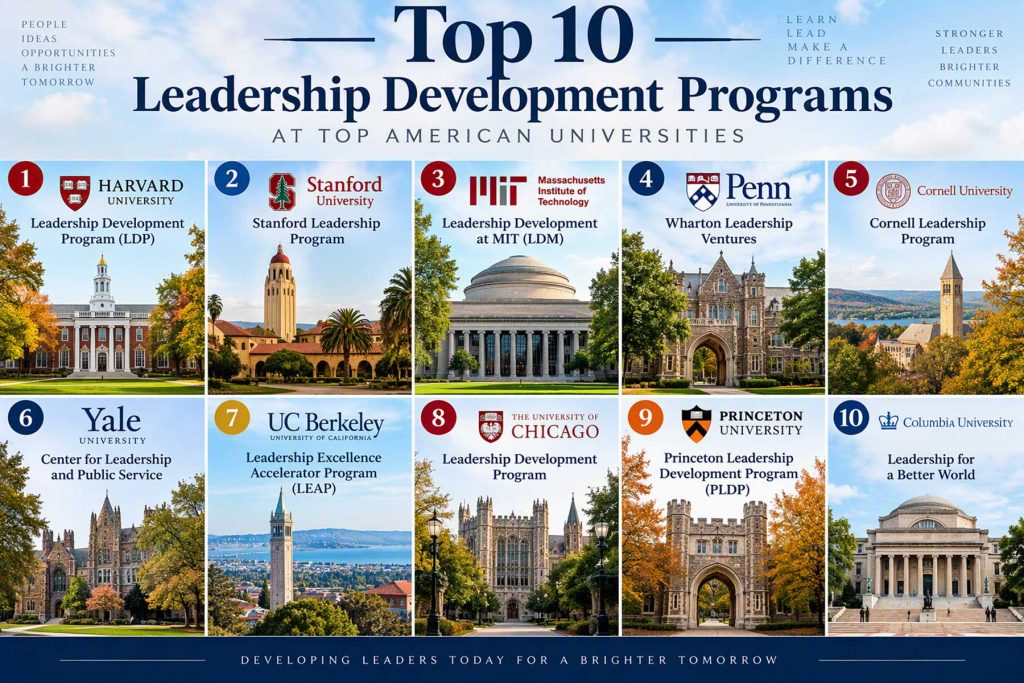
| Rank | University | Notable leadership pathway | Distinctive emphasis |
| 1 | University of Pennsylvania | McNulty Leadership Program | Experiential leadership and coaching |
| 2 | University of Michigan | Ross Leaders Academy | Coaching and leadership research |
| 3 | Duke University | Hart Leadership Program | Public leadership and experience |
| 4 | Harvard University | Center for Public Leadership | Principled public leadership |
| 5 | Georgetown University | Georgetown Opportunities for Leadership Development | Civic and practical leadership |
| 6 | University of Virginia | Blueprint and L2K | Student governance and service |
| 7 | UC Berkeley | Berkeley Student Leadership Academy | Workshops and mentorship |
| 8 | Northwestern University | Leadership Development and Community Engagement | Facilitation and community |
| 9 | University of Chicago | LEADS | Self awareness and adaptability |
| 10 | MIT | Student Leadership Programs | Responsible and collaborative leadership |
What Makes a University Leadership Program Valuable
Program design matters more than the presence of a leadership course on a university website. Stronger programs tend to give students repeated opportunities to practice skills, receive feedback, reflect on outcomes, and apply lessons in new situations.
Experiential learning is particularly important. Leadership is difficult to develop through lectures alone because many leadership challenges involve uncertainty, competing priorities, interpersonal tension, and incomplete information. Simulations, community projects, student organizations, research projects, and team based activities create settings where those issues become tangible.
Coaching and reflection add another layer. A student may recognize a communication problem only after receiving structured feedback from a coach, mentor, faculty member, or peer. Programs that combine experience with reflection can therefore create a more deliberate developmental process.
Access also matters. Some programs are highly selective, while others provide open enrollment workshops or opportunities for students at different stages. A university with several entry points can give students more chances to build leadership skills over time.
Why Leadership Education Is Becoming More Experiential
University leadership education increasingly connects personal development with real responsibilities. Students may manage organizations, coordinate events, conduct community research, facilitate discussions, work with peers, or participate in public service.
That shift reflects the practical nature of leadership itself. Employers, graduate programs, nonprofit organizations, and public institutions often value communication, teamwork, adaptability, judgment, and responsibility alongside technical knowledge.
The programs listed above demonstrate several different models. Penn emphasizes a large portfolio of experiential opportunities. Michigan combines research with coaching. Duke connects leadership with public purpose and research. Georgetown links leadership with civic engagement. Berkeley emphasizes workshops and mentorship, while MIT places greater emphasis on responsible leadership within communities.
Choosing Among Leadership Development Programs
Students comparing universities should look beyond the name of a leadership center. Program eligibility, duration, selection requirements, academic credit, mentoring access, experiential components, and expected time commitment can differ substantially.
A student interested in public service may value programs centered on civic leadership and public policy. Another student may benefit more from coaching, team development, entrepreneurship, research, or organizational leadership. The most useful comparison therefore depends on the student’s academic direction and the type of leadership experience sought.
Program continuity is another consideration. A single weekend workshop can provide useful exposure, but a year long or multi year program creates more opportunities for practice, feedback, and relationship building.
Conclusion
Leadership development programs at American universities now take many forms, from intensive retreats and coaching cohorts to academic courses, community projects, student organization training, research programs, and multi year fellowships. The strongest documented examples do not treat leadership as a personality trait reserved for a small group of naturally confident students. Instead, they create structured opportunities for students to practice communication, judgment, collaboration, reflection, responsibility, and ethical decision making. For students comparing American universities, the most meaningful distinction may therefore be the quality and depth of the developmental experience rather than the existence of a leadership program alone. A university that provides repeated opportunities to lead, receive feedback, reflect, and apply new skills can make leadership education a substantive part of the college experience.
FAQ
Which American universities have strong leadership development programs?
Several American universities operate substantial leadership development programs, including the University of Pennsylvania, University of Michigan, Duke University, Harvard University, Georgetown University, and University of Virginia. Their programs differ in focus, eligibility, structure, and experiential components.
What do university leadership development programs teach?
Programs commonly address communication, teamwork, self awareness, decision making, conflict management, ethical leadership, adaptability, reflection, and organizational skills. Some also emphasize public service, community engagement, research, or entrepreneurship.
Are leadership programs available to undergraduate students?
Yes. Many universities offer dedicated undergraduate programs, workshops, fellowships, certificates, or student organization training. Eligibility varies considerably by institution and program.
Does Penn have leadership development programs?
Yes. Penn offers extensive leadership programming through the McNulty Leadership Program and related Wharton initiatives. Opportunities include experiential Leadership Ventures, fellowships, coursework, workshops, and community based experiences.
Does the University of Michigan offer a leadership certificate?
Yes. Michigan offers a Leadership Certificate that brings together coursework, co curricular experiences, and engagement through service, employment, or student organizations. The certificate is designed to formalize undergraduate leadership development.
Which universities use coaching in leadership education?
The University of Michigan’s Ross Leaders Academy includes individual and group coaching. Coaching also appears in various leadership programs across American universities, although the format and availability differ.
Are university leadership programs useful for international students?
Many can be relevant to international students, particularly programs that emphasize communication, teamwork, intercultural experiences, and community engagement. Eligibility should be checked for each individual program because some opportunities are restricted to specific student populations.
How long do leadership development programs usually last?
Duration varies from individual workshops and short retreats to full academic year, multi year, or intensive summer programs. Duke’s Laidlaw Scholars Research and Leadership Program, for example, is structured as a 24 month sequence.
What should students look for in a leadership program?
Students can compare coaching, mentoring, experiential learning, reflection, academic credit, program duration, eligibility, selectivity, and opportunities to apply leadership skills. The best fit depends on the student’s goals and the type of leadership experience desired.
Can leadership development be studied alongside a regular degree?
Yes. Many university leadership programs are co curricular, meaning students can participate while completing a separate academic major or degree. Others are embedded within courses, fellowships, certificates, or professional programs.